

Snedden Chair Dobbyn gives lecture on power of local journalism, state of industry
Story and photo by Jonathan Wasilewski
Last week, veteran journalist and current Snedden Endowed Chair of Journalism Paula Dobbyn, who holds more than three decades of experience, lectured on the power of local journalism and the state of the industry today.
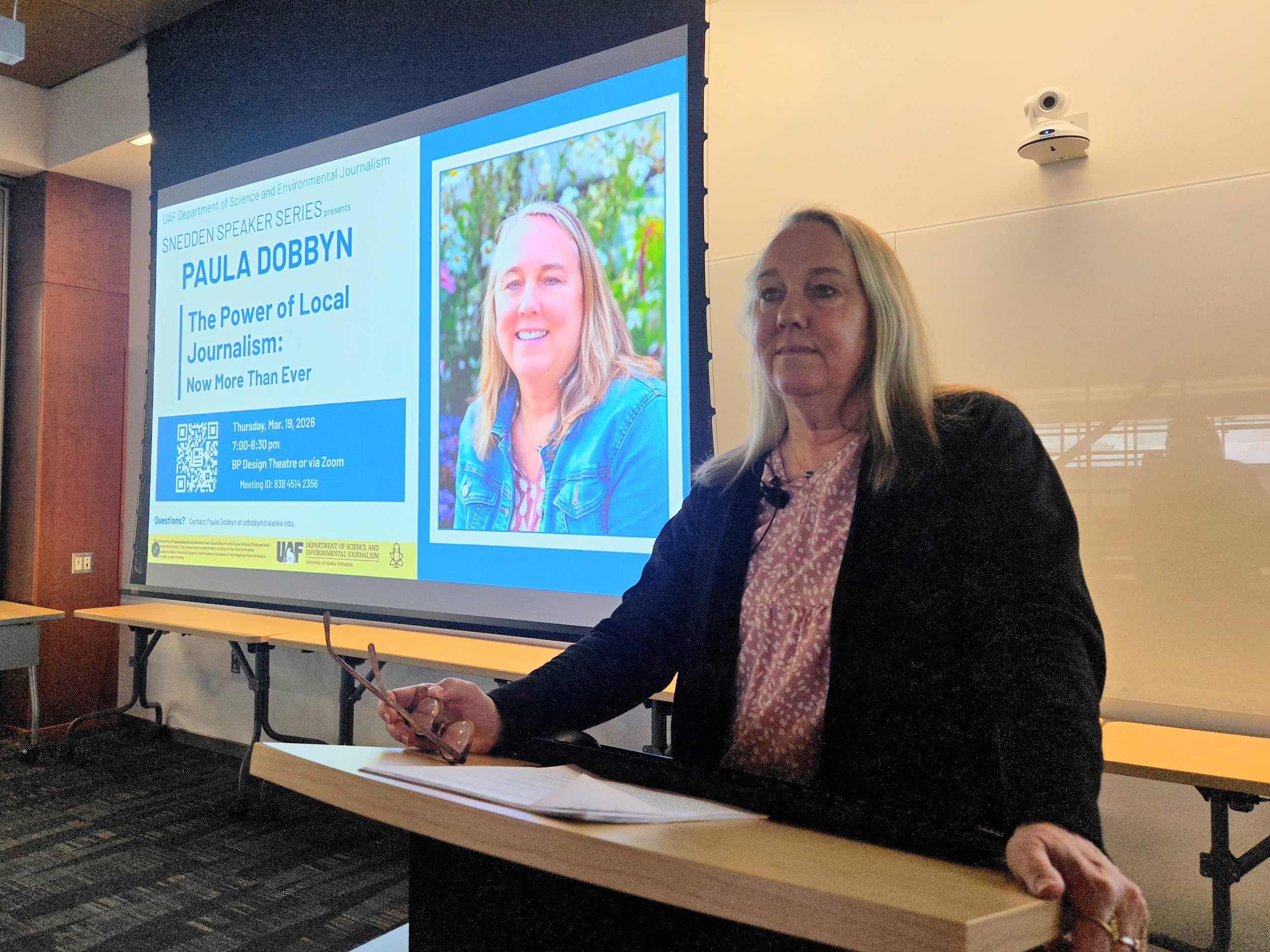
Long-term journalist and current Snedden Chair Paula Dobbyn stands before her talk in the BP Design Theater March 19, 2026.
The event, held as part of the Snedden Chair Lecture Series on UAF’s campus, brought the public to UAF’s BP Design Theater the evening of Thursday, March 19. Dobbyn’s talk focused on the importance of local journalism and a reporter’s essential role covering topics such as high school sports, homicides and obituaries.
“As a local news reporter,” she said, “there’s simply no shortage of things to cover.”
Dobbyn gave specific examples of how local journalism has led to change.
While working for Channel 2 in Anchorage, she described her work as “the crime all the time beat.”
In the journalism world, a beat is a specific genre that focuses on an issue, sector, organization or institution over time.
After explaining some disturbing cases she wrote about to the audience, Dobbyn mentioned that every homicide victim or homeless person who dies out in the streets deserves to have their story told.
“As a local news reporter, you get to do that,” she said.
While Dobbyn was covering homelessness for The Anchorage Daily News during the first year of the pandemic, the way outside deaths were categorized was changed.
Although the paper categorized if people were homeless when they died outside, the Anchorage authorities did not. After more reporting was done by the paper, authorities began to add if the deceased had a permanent address, leading to a change in data. It was then realized that Anchorage had an “enormous” problem with homelessness; the local paper helped.
In another example, ADN reporter Kyle Hopkins exposed the “gross inequities” for accessing justice, especially in rural Alaska and for Alaska Native people. He was the lead reporter on the series Lawless: Sexual Violence in Alaska, which won a Pulitzer Prize in 2020, revealing that one third of Alaska villages lack any form of local law enforcement.
After the reporting, the U.S. Department of Justice declared a federal emergency in Alaska, and over $60 million in federal and state funding for public safety was released.
A third example included research done by The Sun Star, UAF professor emeritus Brian O’Donoghue and his students in 2015, which led to the freedom of four Fairbanks men after they were wrongfully convicted of murder in 1997.
O’Donoghue sat near the front of the room during Dobbyn’s lecture.
“Local news reporting is a public service for our community,” Dobbyn said.
Another part of Dobbyn’s talk was about the state of the industry.
She said that 3,500 newspapers have closed in the U.S since 2005, and there are now more than 1,800 news deserts.
“News deserts are places that have no form of local news coverage,” Dobbyn explained.
The journalism industry has had to deal with many challenges from funding cuts. The Corporation for Public Broadcasting ceased receiving federal funding after President Trump signed an executive order last year. Ad revenue fell by 80% from 2000 to 2020, artificial intelligence is on the rise, and attacks on press freedom and the First Amendment have been carried out by the White House.
“Its chief occupant refers to journalists as enemies of the people, while the Justice Department regularly files lawsuits against news outlets that report stories that the president doesn't like,” Dobbyn said.
She also mentioned that foreign born reporters have been arrested by Immigration and Customs Enforcement, or ICE.
One example was Estefany Rodríguez in Nashville, a Colombian-born reporter with a work visa and a pending green card. She was covering immigration for four years before being arrested on March 4.
Even though it’s not glamorous and not always thrilling, Dobbyn said that the work of local journalists is important.
“Personally, I welcome all news, regardless of its political bent,” she said. “The key is using media literacy.”
Media literacy involves paying attention to misinformation and disinformation, using care in “your daily news diet,” and “getting out of our echo chamber.”
If people follow local news, Dobbyn said they are more likely to vote in local elections, feel attached to their local communities and vote across party lines.
According to a 2025 Gallup poll Dobbyn referenced, only 28% of Americans said they had confidence in the news media.
However, the same study found that 74% of Americans said they had a lot of trust or some trust in local news.
“I encourage you to contribute to local journalism,” Dobbyn said.