

Thinking Like a Pika
By Louis Seymour
A trio of ptarmigans appeared as we crested a broad summit. A fierce wind blew heavy snowflakes into our faces. Lowbush cranberries poked through the fine layer of snow beneath us. We stopped for a moment to collect ourselves on the ridge, eyeing the birds ahead of us.
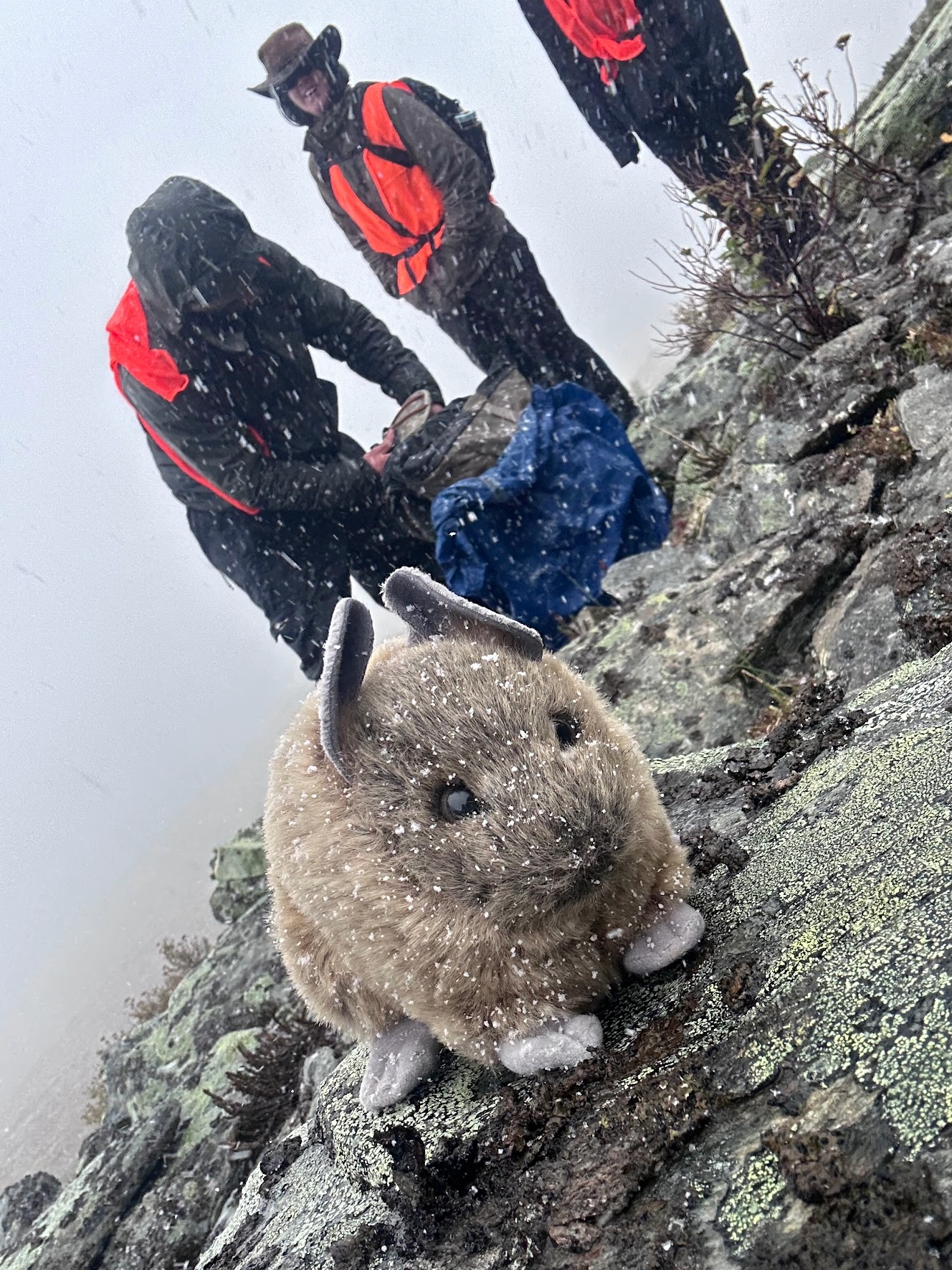
Students gather around a stuffed pika and a Bluetooth speaker in an attempt to lure a real pika from its den.
We stopped for a snack break, pulling food and water out from our backpacks. We had brought a stuffed animal and a Bluetooth speaker into the August snowstorm. For most, these items might not make sense on a packing list. For a class of mammalogy students, they were essential.
It wasn’t exactly what I had imagined when I signed up for mammalogy class. Mammalogy is the study of mammals, a group that includes much of Alaska’s most characteristic wildlife. For many college students, learning happens in the classroom. While taking such a class will inevitably result in hours of poring over bones, pelts and plaster casts of tracks, the real subjects of our studies remain outdoors. For UAF professor Chris Smith’s mammalogy class, that classroom happened to be situated on the tundra near Twelvemile Summit. Out on the tundra, learning about Alaska’s wildlife meant getting out of the classroom and occasionally trying to fool it.
Twelvemile Summit—around a two-hour drive north of Fairbanks—sits as a backdrop for caribou migration every fall. On a cold, wet Saturday in late August, I climbed out of a white van on the side of the Steese Highway with six other mammalogy students hoping to spot some caribou myself. Smith passed out blaze-orange vests to the group and led us over to the trailhead as snow began to fall.
Our field trip had been pitched to us by Smith in our first class of the semester. Given the cold and snowy forecast, it would be entirely optional. Still, a few of us raised our hands with interest. We weren’t going to turn down a chance for field experience. “That’s why I like being a biologist,” Smith said. “It’s probably why you guys are biologists.”
Around a half-mile along the trail, the last few spruce trees subsided, leaving only the open tundra. With wind howling at our backs and snow in our faces, it seemed impossible to picture any life being able to thrive in such an environment. Despite this, the alpine tundra hosts an array of fauna. One of the tundra’s year-round residents—and one we had hoped to spot—was the collared pika.
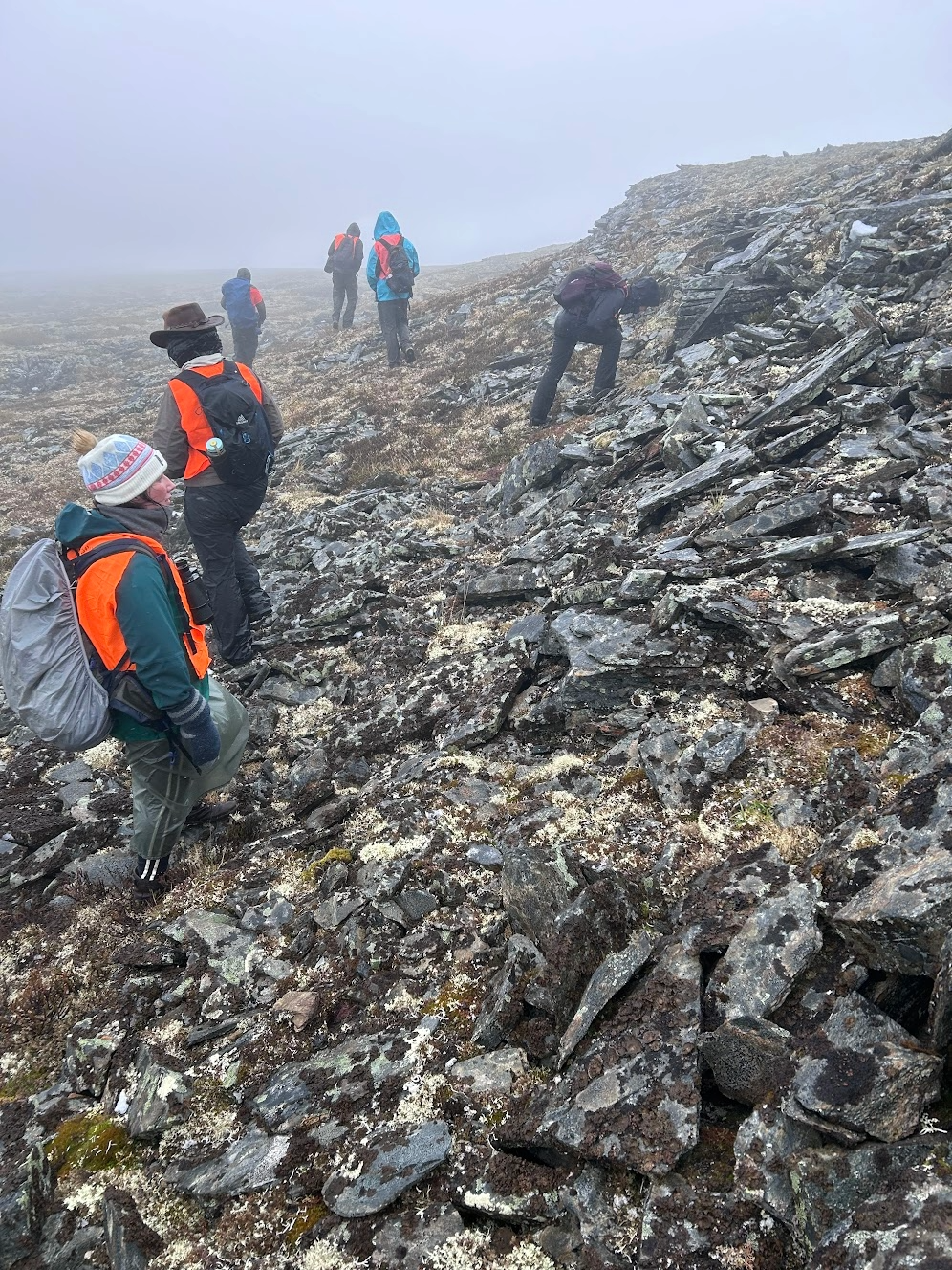
Students search a talus field near Twelvemile Summit for signs of collared pikas.
Unlike the caribou, that would be simply passing through, the pika of Twelvemile Summit had no intention of leaving. In fact, many pikas will rarely ever leave a single talus field. Smith later explained this behavior, saying “It’s like living next door to mom, basically. Just kind of sticking to the same talus fields.” Because of this, pikas have learned to fiercely guard their food, which they store in small dens between the rocks. The small mammals are highly territorial—a trait that we would need to exploit if we wanted to spot one.
We knew we wouldn’t just stumble on a pika by accident. “They’re like an animal that, if you’re not paying attention, you don’t see,” Smith explained, “but if you know what to look for, they’re everywhere.” After searching through a few fields of talus for pika dens, we found a fresh bundle of grasses and plants stuffed underneath the rocks. Deciding that a pika had likely been there recently, we gathered around the rocks. Smith pulled a stuffed animal and a Bluetooth speaker out of his bag. If we could trick a pika into thinking a neighbor had stopped by, it might emerge from its den. After all, if a pika’s den is taken over by a greedy neighbor, it won’t have food for the winter. After setting up our decoy and a speaker, we backed down the hill and waited quietly.
Pika calls played intermittently over the speaker. Five minutes passed, but there was no movement in the rocks uphill. Maybe the dens weren’t inhabited after all, or maybe we were the only animals crazy enough to go outside in an August snowstorm. Either way, we collected our belongings and began the hike back.
Though we had failed to spot any pika, our day on the tundra was far from over. The weather began to reluctantly clear, and it wasn’t long until we spotted a small group of caribou trotting up a neighboring ridge. We soon followed, searching for tracks. As the clouds continued to lift, the landscape around us emerged. The caribou we had spotted were remarkably close to the road. A caribou skull sat on a nearby rock, also within view of the road. Just a short walk off of the Steese Highway, we had been able to encounter some of Alaska’s most iconic wildlife. It certainly wasn’t the sort of experience easily found in a classroom.
The sun began to emerge as we loaded our bags into the van. Though we joked about the sunny weather that seemed to arrive only at our departure, nobody seemed disappointed. “It rained on us for five of the six hours,” Smith later admitted. “But it’s the one hour that you get to see the caribou that makes it worth it.”
We had also learned an important lesson that can seldom be taught indoors. Paying attention to even the smallest of things—like a bundle of grass under some rocks—can often yield more knowledge than any lecture will ever impart. Sometimes it’s not enough to read about a pika. You have to think like one, too.