

By Tane Timling
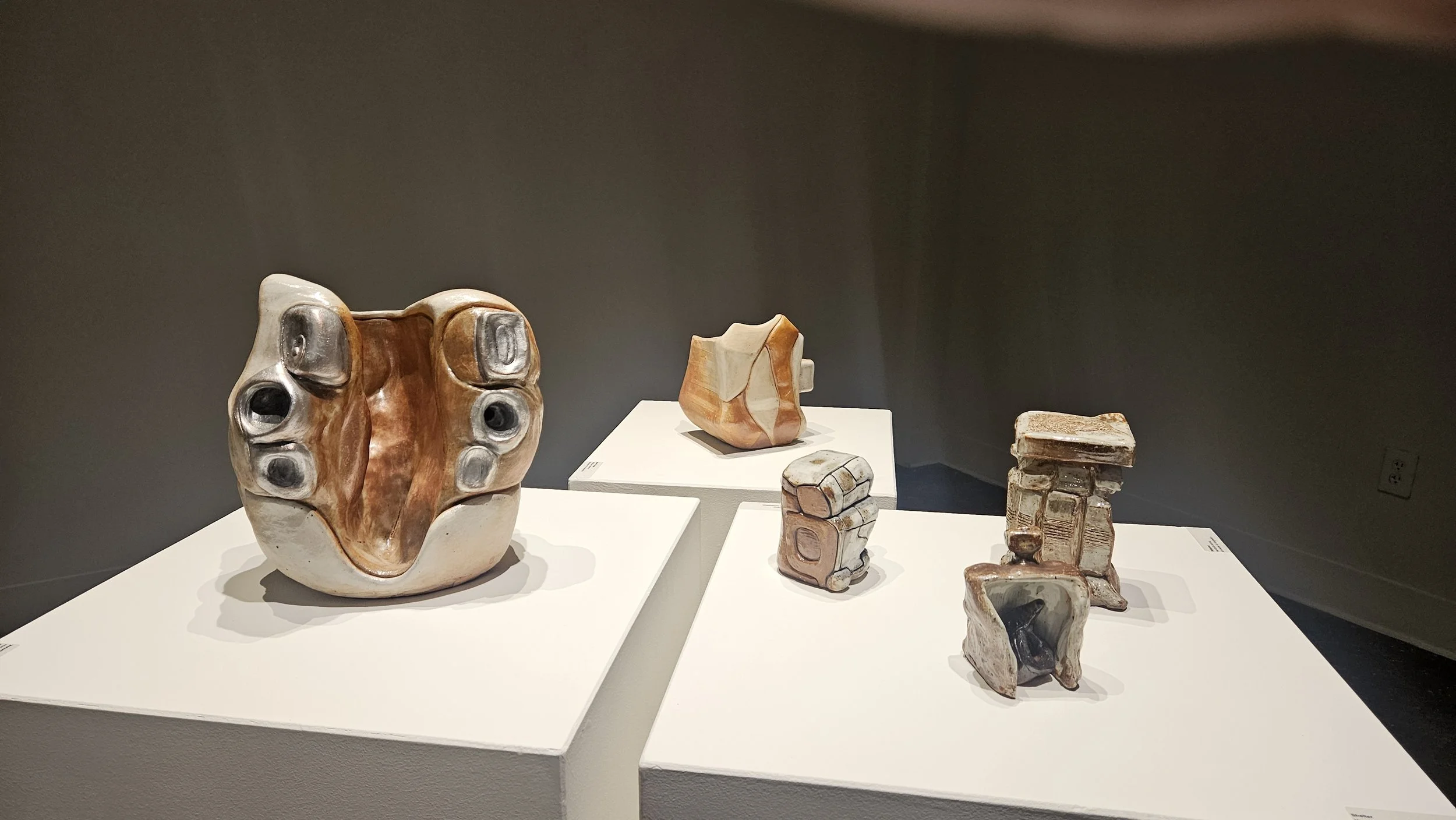
Photo by Tane Timling
Handmade ceramics at “Frontier Liminals” exhibit by Nick Dwyer.
AI in art is a controversial subject. Since generative AI came into the world, debate about the rights and authorship surrounding generative AI imagery immediately became a friction point for artists. Nick Dwyer explores this debate in his latest exhibition, “Frontier Liminals,” as part of his master’s thesis defense. The exhibition features ceramics Dwyer created, inspired by concepts based on generative AI images.
“My exhibition explores the relationship between humanity and AI, artificial intelligence, at a time when we're experiencing rapid technological change,” said Dwyer, introducing his thesis “Frontier Liminals: AI, Ceramics and Authorship.”
Dwyer is an MFA student at the University of Alaska Fairbanks majoring in Ceramics, as well as Computer Art. His show draws inspiration from ancient history, science fiction, consciousness and contemporary technology. Dwyer’s fascination with AI began with a face filter application called FaceApp, which let users change images of a person’s age or gender. “I used it quite a bit to explore my own identity,” he said.
Abstracted forms of fired clay mimicking ancient artifacts and surreal vessels fill the UAF art gallery on white plinths. Each piece is grouped in separate parts of the room like islands of . Dwyer’s latest exhibition explores separating the art from the artist by experimentally removing his hands from the concept phase. He does this by using a closed-loop generative AI software called Artbreeder. This software generates imagery based on a database of images uploaded by the user and a wider database submitted by other users with explicit permission for ArtBreeder to use. Because it is a closed loop, it can only draw from images selected as material for the AI to create new images from, rather than drawing on images from across the Internet. Dwyer used several images of his own ceramic artworks to be the baseline for the Frontier Liminals exhibit. This differs from open systems like ChatGPT or Claude, which artists have critiqued for using artwork without permission. Dwyer described the concepts for his ceramic sculptures as “AI compositions,” noting his ability to control image parameters within ArtBreeder. From the AI generated concepts, he then sculpts the ceramics. This brings in subtle imperfections and Dwyer’s interpretation as he takes the step from a two-dimensional image to a three-dimensional sculpture. “I like to think of these as artifacts in this AI pixel universe that I'm going and retrieving and bringing back into our reality,” Dwyer said. He noted that artists have been exploring the idea of authorship before.
Andy Warhol explored authorship through his famous pop-art silk-screen prints. Warhol said, “I want to be a machine.” He would design prints and then have other people execute the printing process. Dwyer presented another exploration of authorship by Harold Cohen, the creator of AARON, the earliest AI program for artmaking. Cohen was an accomplished painter who created an algorithmic program in the 1960s designed to create paintings. This was combined with a machine that accommodated pencils, paint and a canvas, which Cohen would dub AARON in the 1970s. His work would be shown in a retrospective exhibition at Whitney Museum of American Art in 2014, two years before Cohen passed away.
Dwyer started his artistic journey after he left the Air Force and went to college at the University of Oklahoma, teaching himself how to draw and finding freelance work as a concept artist. While also finding time to do contemporary and figurative sculpture, he found great enjoyment in ceramics. Part of his abstract ceramic work from his undergraduate days has become part of the image data used for Frontier Liminals. Dwyer’s abstract work draws on fascination with the uncanny. “I like to explore bending reality or even false narratives or fake history, fake artifacts and even creatures,” Dwyer said. He has a similar appreciation for the uncanny images generated with early AI models. After enrolling at UAF in 2023, he created one of his first AI sculptures dubbed “Echos of Creation,” which Dwyer said plays into the idea of “recursive imagery and ideas that go between people, we share ideas, AI also shares those ideas, like a warped mirror.”
Dwyer acknowledges the potential harm of generative AI, such as deepfakes and copyright infringement, but also wishes to make a genuine exploratory exhibit that tries to ask the question of how generative AI fits in fine art. Frontier Liminals will probably be the last of its concept from Dwyer, as he wants to move on to other projects. “We are at a turning point, a crossroads if you will, for our society and I'm not sure what's going to happen and I'm not fully formed in my opinions. I can change my mind and change my course whenever I see fit,” Dwyer