

UAF researchers travel 1,500-mile Arctic route to connect science with communities
By Amber McCain
Two University of Alaska Fairbanks researchers are crossing more than 1,500 miles of Alaska’s western and Arctic coast by snowmachine this spring, not just to study climate change, but to hear directly from the people living it.
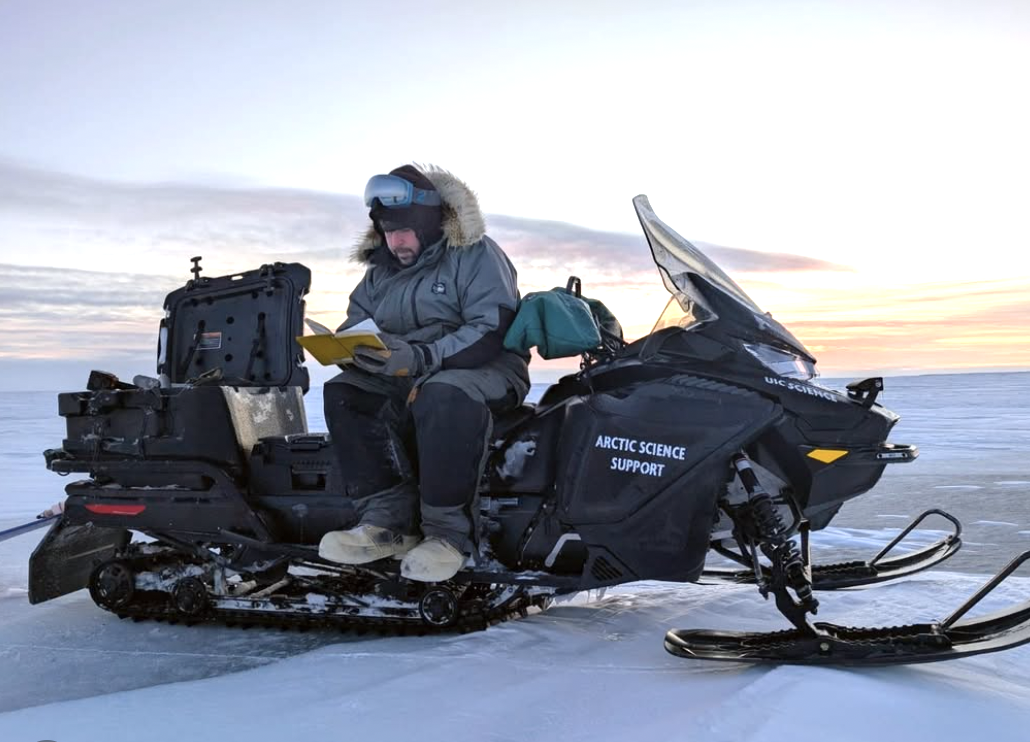
Photo courtesy of the COAST-X instagram page
Benjamin Jones pauses on the snowmachine, taking a moment to prepare as the COAST-X duo continues their 1,500 mile journey across Alaska’s western and Arctic coast.
“We’re not flying over communities and looking down,” Jones said. “We’re traveling the same way people do, in the same conditions, and really trying to connect and learn from them.”
The expedition, known as COAST-X, is led by UAF researchers Ben Jones and Philip Wilson, who departed from Fairbanks in late March and began their route in Bethel. From there, they will travel north along the coast to Utqiaġvik, stopping in more than a dozen communities along their route.
Unlike traditional research expeditions, COAST-X is designed as what Jones describes as “a moving caravan of conversations.”
Jones, a research associate professor at UAF’s Institute of Northern Engineering, said the idea for the expedition has been more than a decade in the making. While working on a project in western Alaska years ago, he recalled flying over the region, looking out the window and thinking about how incredible it would be to actually stop, talk to people, and understand what they’re seeing.
The project focuses on environmental changes affecting coastal Alaska, including permafrost thaw, erosion, flooding and changing travel conditions. But instead of relying only on instruments, the team is also gathering observations from residents who live there year-round.
“We’re interested in what people are noticing,” Jones said. “Is travel getting more dangerous? Are freeze-up times changing? What obstacles are they seeing?”
The expedition consists of just two people, Jones and Wilson, traveling by snowmachine with sleds carrying fuel, food and equipment.
Keeping the team small is intentional. Jones says two people can be more efficient and be “less overwhelming” when arriving in communities.
The journey is expected to take several weeks, with planned stops in communities including Hooper Bay, Kotlik, Unalakleet, Nome, Shishmaref, Kotzebue and others along the coast.
In many of these locations, the team has scheduled meetings with tribal councils, local organizations and schools. In Hooper Bay, for example, they plan to meet with community leaders, host a potluck and spend time in classrooms talking with students.
Jones said those interactions are just as important as the research itself.
Although community engagement is central to COAST-X, the team is also collecting scientific data throughout the trip.
One of their primary tools is a ground-penetrating radar system, which allows them to measure ice thickness on rivers and lakes continuously as they travel. This type of data is rarely collected over such long distances.
“We’ll have ice thickness measurements from the Yukon-Kuskokwim Delta all the way to Utqiaġvik,” Jones said. “That’s a huge stretch and a really unique dataset.”
They are also tracking travel speed and terrain conditions using GPS, helping researchers identify difficult or hazardous areas along the route. That information may later be compared with satellite data to better understand how Arctic landscapes are changing.
The duo has cameras mounted on their snowmachines documenting trail markers and conditions along historic winter routes, data that could help inform future transportation planning in rural Alaska.
Traveling thousands of miles across Arctic terrain comes with risks. Equipped with satellite communication devices, including Starlink systems and GPS trackers that automatically update their location every 10 minutes, Jones is confident they are well prepared. They also have backup power systems, emergency communication tools and multiple heat sources.
“Sometimes everything is just white, the sky, the ground, and you can’t tell if you’re going up or down,” Jones said. Because of those challenges, he said flexibility is important. The pair has no strict timeline. “If the weather’s bad, we stop.”
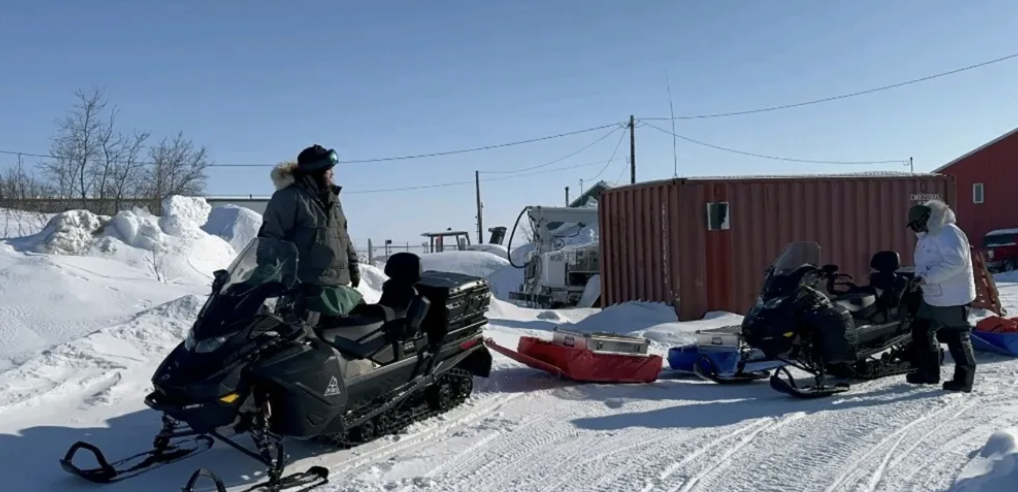
Photo courtesy of the COAST-X instagram page
Ben Jones and Phillip Wilson arrived in Bethel March 19 to kick off the Coast-X expedition. The pair took a few days to organize equipment, fueled up, and prepared for departure.
Part of a wider Arctic change initiative, COAST-X is funded through a combination of support from UAF’s Institute of Northern Engineering, the National Science Foundation and the U.S. Army Corps of Engineers’ Cold Regions Research and Engineering Laboratory.
The project centers on partnership between scientists and community members. Jones said success won’t just be measured by reaching the destination.
Just as important is talking with people, sharing knowledge, and having them share what they’re seeing.”
Jones hopes to see a long-term impact extending beyond this single expedition, like an annual traverse eventually traveling farther saying he’d “love to see the next generation get excited about science and research,” adding that if this inspires even a few students to get involved, “that’s a big win.”
As the pair continues north, the public can follow every mile of the journey through blog updates, instagram updates and live GPS tracking shared along the way.