

A Nanook among penguins – The Antarctic journey of UAF’s R/V Sikuliaq
By Gabriele Rigaudo
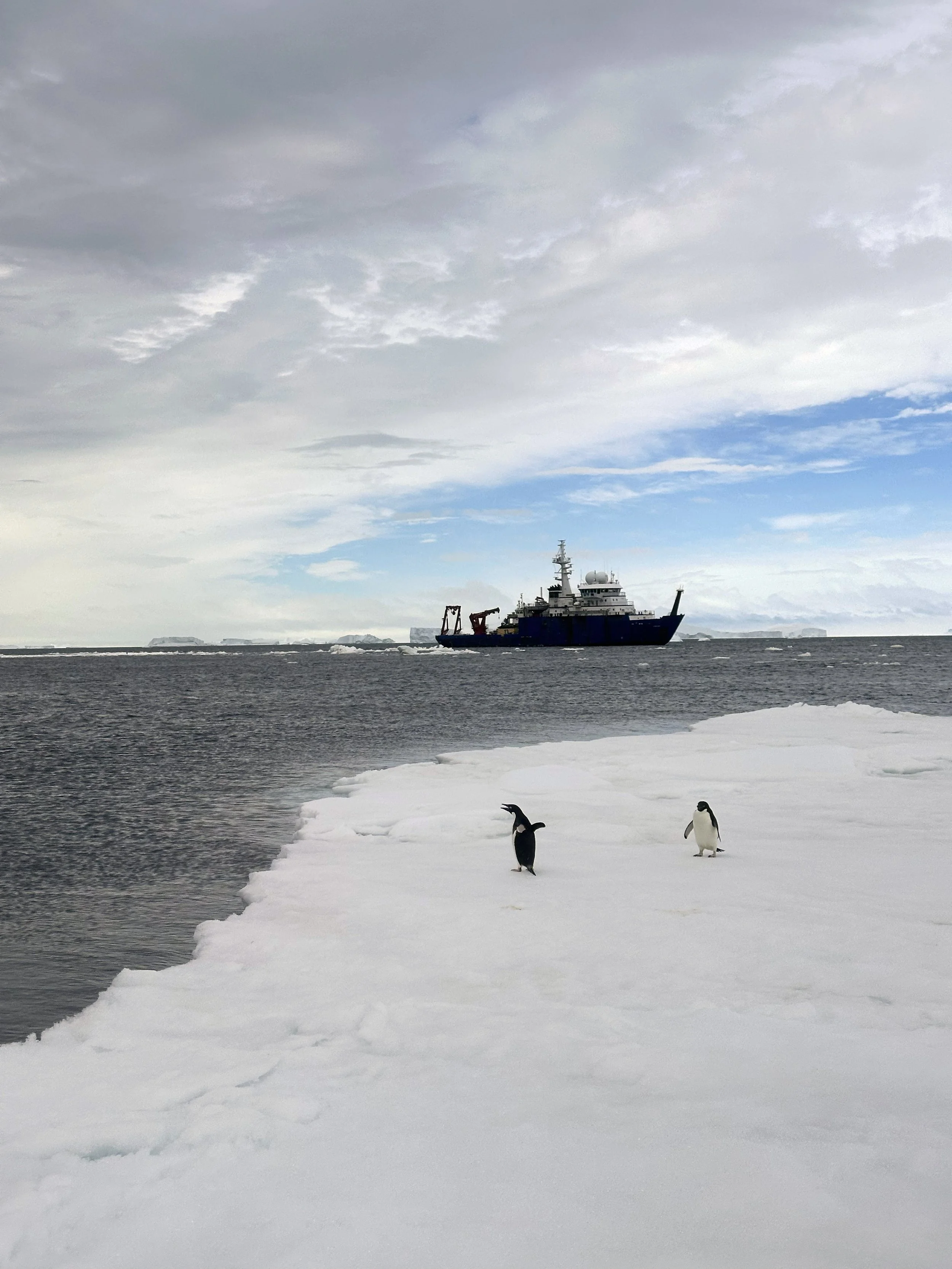
Photo courtesy of Ellen Buckley/University of Illinois
R/V Sikuliaq pauses in the Weddell Sea in January 2026 as a pair of penguins roam on shore.
In the freezing waters of Earth’s loneliest continent, secrets are being unveiled: from a marine invertebrate producing a compound effective in treating skin cancer, to the only animal surviving without the oxygen transporter molecule hemoglobin, all while more is discovered about one of Earth’s mass extinctions. In this breathtaking environment, the R/V Sikuliaq is serving as a floating home to researchers who aim to understand more of the Southern Ocean’s secrets.
Completed in 2014, Sikuliaq is a 261-foot ice-capable research vessel. Owned by the National Science Foundation and operated by our university’s College of Fisheries and Ocean Sciences since 2015, Sikuliaq calls Seward’s port home. It has contributed to countless operations in Arctic waters.
After federal budget cuts affected the National Science Foundation last year, the NSF board had to terminate the lease of the previous permanent Antarctic research vessel, the Nathaniel B. Palmer. Because of this, things started to feel shaky for research projects in the Southern Ocean. In this uncertain environment, the Sikuliaq stepped up to provide a temporary research platform for scientists and embarked on its longest journey ever – from one of Earth’s poles to the other.
One of only five global-class vessels in the U.S. Academic Research Fleet, the Sikuliaq stands out as the only ice-capable among them. Global-class vessels are able to stay out in the sea the longest and host the greatest number of scientists. In addition to that, Sikuliaq offers researchers the latest scientific gear.
Doug Baird is the Sikuliaq’s marine superintendent, managing the vessel’s crew, operations, safety, and logistics.
The decision to send the Sikuliaq down to Antarctica was a mix between necessity and coincidence, he explained. “The ship was already halfway there, because the project we were working on in November and December in Honolulu.” This allowed for a significant reduction in the costs of the expedition.
Necessitating 20 coast guard credentialed crew members and two marine techs, the vessel hosts up to 24 scientists.
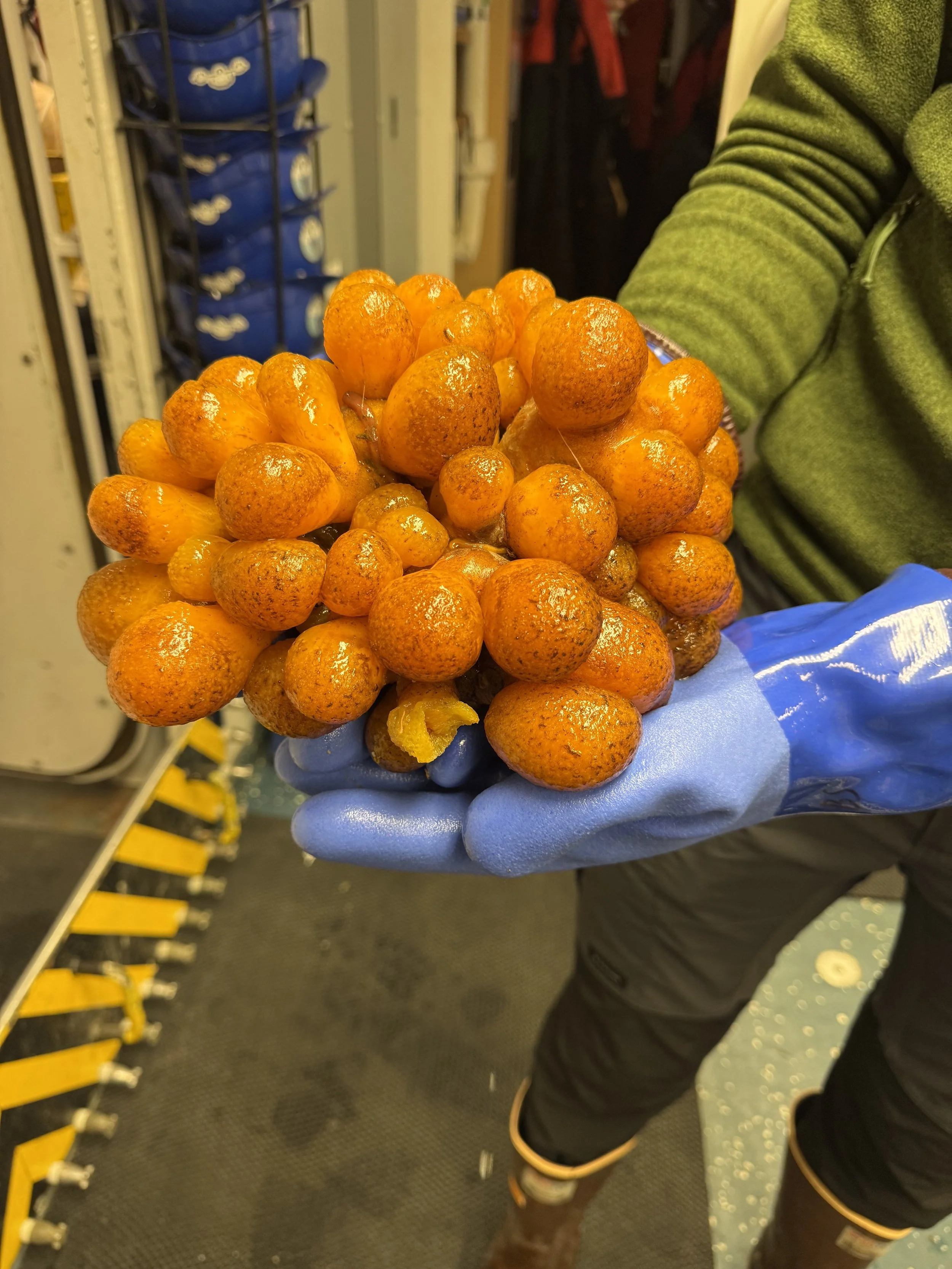
Photo courtesy of Katrin Iken
Colonial tunicate (Synoicum adareanum) collected and studied in one of R/V Sikuliaq’s labs.
The Sikuliaq has many specialized components: in addition to a large stern A-frame and oceanographic winches capable of lowering scientific gear into the ocean-- such as sensors, remotely operated vehicles, and seafloor corers–– the vessel is home to a main lab, an instrument lab, and a very large working deck. The disciplines studied in Sikuliaq are many. “We do a lot of physical oceanography, some chemical oceanography, marine geology, marine biology, and even some bathymetric mapping,” Baird said.
Part of Baird’s job is to manage Sikuliaq's project schedule. Baird also mentioned that federal agencies such as the NSF and NOAA are involved in the decision-making process, although their influence is based on grants awarded rather than direct scheduling.
As with every NSF-related lab at our university, and across the country, funding is given after a rigorous evaluation of a written proposal that considers both a project's intellectual merit and broader impacts.
Baird described how the Antarctic Ocean is an unusual location for the Sikuliaq: “She spends anywhere from two-thirds to three-quarters of her operational days in the Arctic. Anywhere from the Gulf of Alaska projects, through the Bering, Chukchi, and Beaufort Seas.”
Some of the challenges encountered in this last trip so far are related to the different geography of Antarctica when compared to the Arctic. “The ship was designed for working in the Arctic, and the Antarctic ice is a little bit different.”
Baird noted that Antarctic ice is land-based, unlike the sea ice found in the Arctic. Some of the problems the crew had to face involved more ice-– 7-to-8-foot thick —than anticipated in the Weddell Sea. In journeys like this one to Antarctica, efficiency is a must. The main operational focus of the vessel is to maximize the sample-collecting window.
Modern instrumentation on the Sikuliaq allows researchers to dive far— so far—back in time on our home planet. One of the questions that the Sikuliaq is currently helping answer is what exactly caused the Cretaceous-Paleogene (K-Pg) mass extinction, which occurred around 66 million years ago.
A mass extinction is an event in which at least three-quarters of all species on Earth become extinct. Over the last 540 million years, five of these events have been described by scientists. Researchers across the globe are studying these catastrophic events to identify the causes, in the hope that this might prevent further events from happening again.
Sikuliaq, with its oceanographic tools and labs, is helping researchers describe the K-Pg extinction patterns rigorously, with the goal of better understanding the nature of this event.
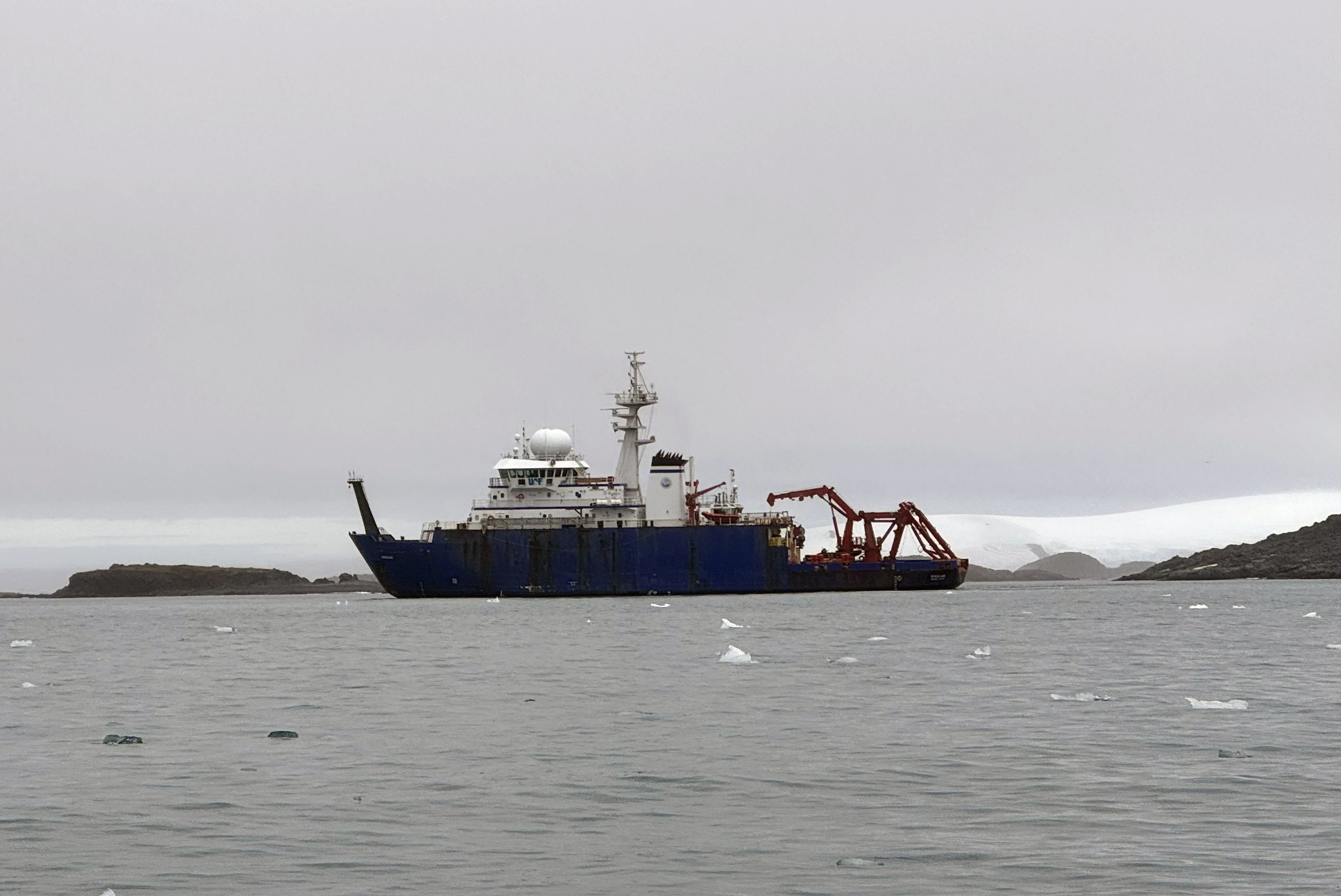
Photo courtesy of Katrin Iken
R/V Sikuliaq travels through icy waters west of the Antarctic Peninsula in February.
The project, taking place around Seymour Island, drills deep for samples. The island itself contains some of the best-preserved fossils from the period. Still, erosion and oxygen exposure severely damaged the quality of the sediments found on the surface. Because of this, using the Sikuliaq’s tools, researchers can drill deep into the ocean bed surrounding the island. This allows much more precise geological studies on the topic.
Still, the past is not the only thing scientists on the Sikuliaq are looking at. The second project taking place on the boat aims to discover something that might save countless lives in the future: helping find the cure for skin cancer.
Dr. Iken, interim director of the Institute of Marine Sciences at UAF, is currently taking part in the Antarctic expedition. She is in a supporting role for a team of researchers working on a colonial tunicate (an invertebrate found in the Southern Ocean). Dr. Iken is an experienced cold-water diver, and she is currently assisting the research team with sample collection. Aside from diving, Iken mentioned that scientists working on this project are using a remotely operated vehicle to gather samples. This allows them to collect from greater depths.
This tunicate, as mentioned by Dr. Iken herself, produces a compound (a biomolecule) that has been proven effective against human melanomas. According to the American Cancer Society, melanomas account for only 1% of all skin cancers diagnosed each year. Yet it is by far the deadliest type of skin cancer a person can get. This year alone, melanomas will account for 8,500 deaths in the U.S., according to the American Cancer Society.
As described by Iken, the research team working on this project is trying to understand how and which part of this creature produces such chemical. It is theorized that the compound is synthesized by the animal’s associated microbial community. The microbial community refers to all the small organisms coexisting with the tunicate.
“Within that week or so we have been collecting, the scientists have made some pretty spectacular discoveries already about where exactly in the tunicate the compound-producing microbes are located and about gene expression,” Iken said. “I am sure there are more exciting discoveries to come.”
Yet, the K-Pg mass extinction and the colonial tunicate projects are only the tip of the iceberg of research happening in Antarctica.
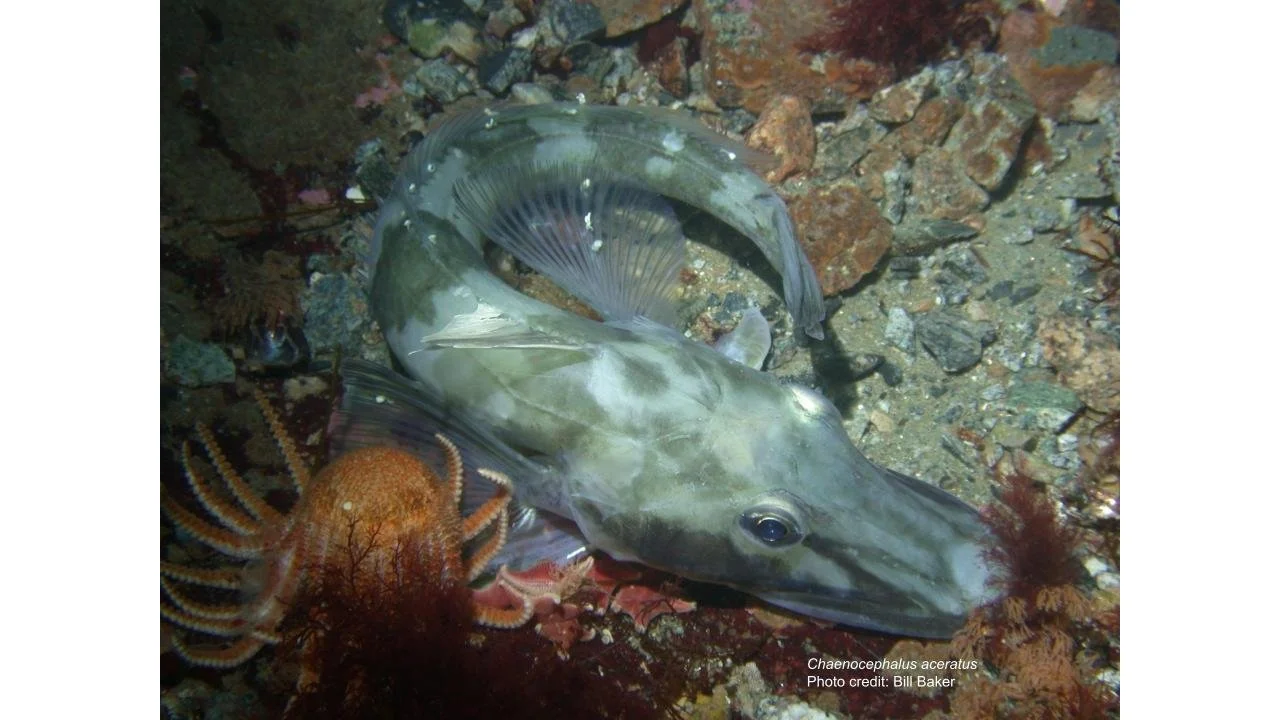
Photo courtesy of Bill Baker
C. Aceratus, the hemoglobin-free icefish center to many of O’Brien’s studies.
Dr. Kristin O’Brien, a professor of biology here at UAF, has dedicated most of her life to Antarctic research projects. Studying this massive, ownerless land hasn’t to do only with the past or future of our planet, but with the present itself. “The Antarctic icesheets on the continent hold the largest reserves of freshwater on earth. The melting of ice sheets in Antarctica will significantly impact global sea level rise and people worldwide.”
But the rising sea level is not the only concern. As stated by O’Brien, all ecosystems on Earth are interconnected. With the poles warming up at a faster rate than everywhere else in the globe, an unhealthy flora and fauna in Antarctica would cause damage we do not yet fully understand to the rest of the planet.
Why basic research matters, in O’Brien’s eyes, has also to do with chance: “As a colleague of mine once said, Alexander Fleming didn’t set out to discover the antibiotic penicillin. It was discovered serendipitously and has made a tremendous positive impact on human health.”
Who knows what secrets might be unveiled with basic research done in Antarctica, but if a colonial tunicate has the potential to help us cure melanomas, funding and trust in science seem to be the only limiting factors.
More information about the R/V Sikuliaq can be found on the College of Fisheries and Ocean Sciences website and on the R/V Sikuliaq Science Operations website.
View the board video of the R/V Sikuliaq with Josh Barna.
Additional information on the Colonial Tunicate project can be found on the Desert Research Institute “Journey to Antarctica” page.
Correction: This story has been changed reflect that the Sikuliaq is owned by the NSF and operated by CFOS.