

Alaska’s Congressional candidates talk energy, military and healthcare
By Tane Timling
Energy costs, infrastructure and Alaska’s reliance on fossil fuels took center stage during a congressional candidate forum hosted by the Greater Fairbanks Chamber of Commerce in Fairbanks on Oct. 20. Bill Hill, Dan Sullivan and Nick Begich participated in moderated discussions, with the proposed 807-mile liquid natural gas pipeline from Prudhoe Bay to Nikiski emerging as a main topic.
Hill and Begich, who are currently competing for Alaska’s seat in the House of Representatives, both agree that constructing the LNG pipeline to bring natural gas south from Prudhoe Bay is part of the path to reducing energy costs in Alaska. The pipeline would transport the natural gas to a liquefaction plant in Nikiski, where it would be condensed and exported to the world. Spur lines built adjacent to the LNG pipeline would bring natural gas to communities along the way, like Fairbanks.
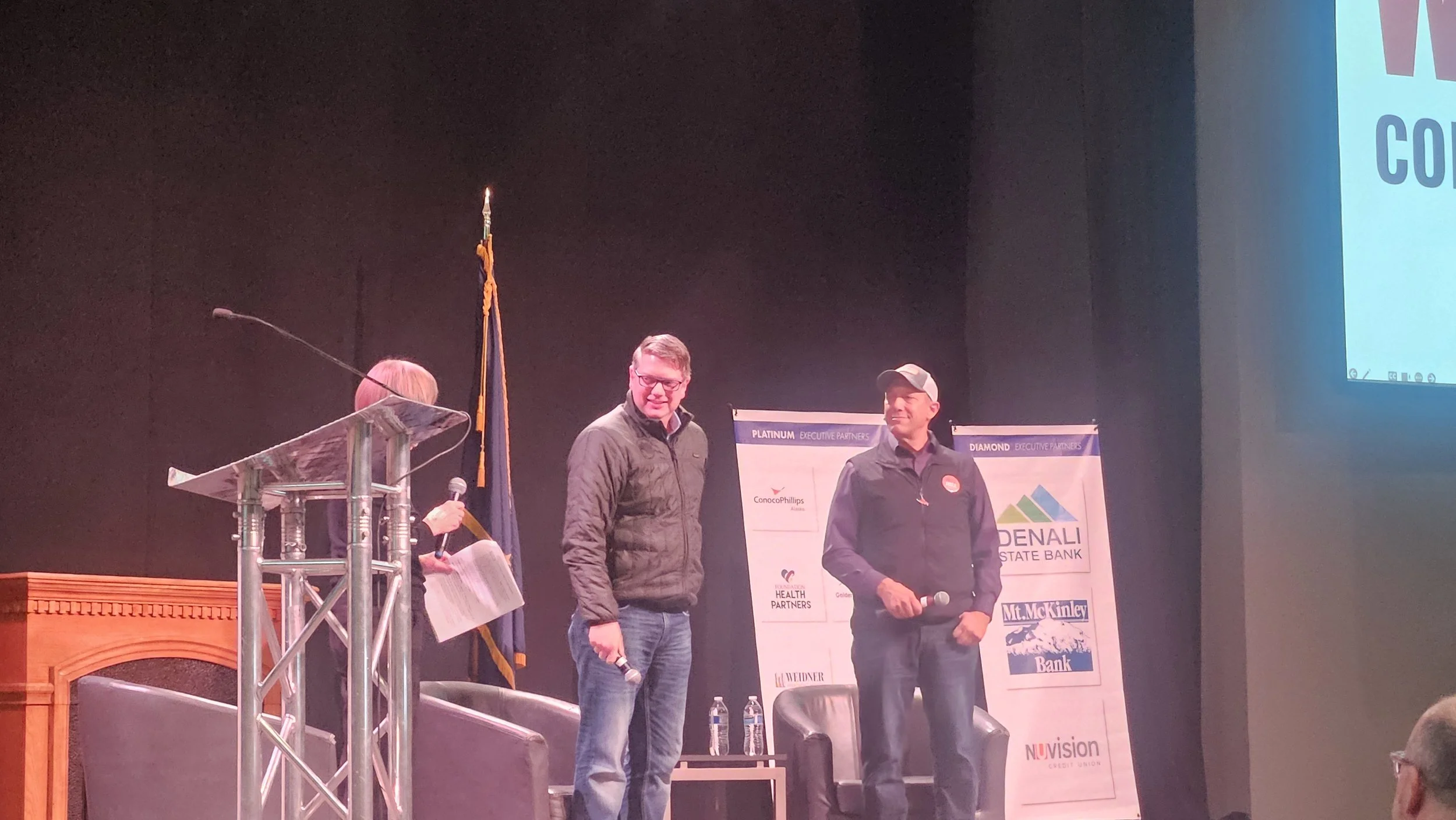
Photo by Tane Timling
House of Representatives candidates Nick Begich and Bill Hill take the stage.
Begich spoke to reforming the permitting process for power generator construction. He wants to speed up the process and reform it so it can’t be “weaponized from a legal perspective to prevent the country from moving forward,” said Begich. Hill agreed that permitting reform is important, but also focused on renewable energy development. “We need the LNG gas line built and supported in Congress,” Hill said. “At the end of the day, things like wind and battery projects that were slated for Fairbanks should be supported in Congress.”
During a rapid-response round of questions, a notable point of disagreement was Hill’s support for a tax credit for renewable energy development, while Begich opposed the tax credit.
Rising fuel costs are a major part of Alaskans’ energy cost issues. Begich claimed that decreased refining capacity from refinery closures in California and Ukraine's destruction of Russian refineries were behind increased fuel prices. Both candidates agreed that more oil refining capacity in Alaska would help, but Hill responded that the Iran War was driving up fuel prices. “What Alaskans are telling me is they're seeing a direct correlation with the start of the Iran War and the increase in the cost of their fuel,” Hill said. Hill expressed numerous times over the debate that the war in Iran should end.
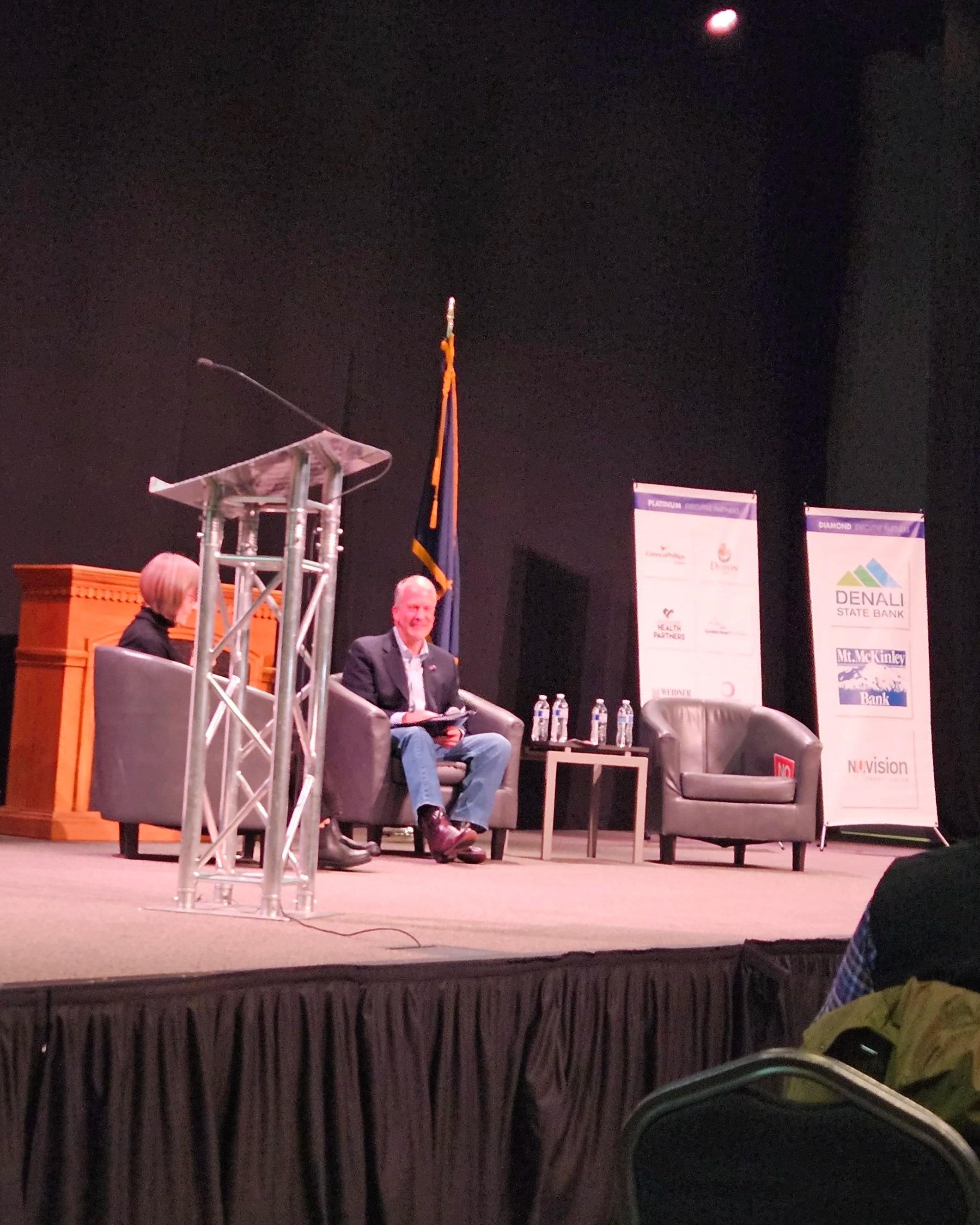
Photo by Tane Timling
Senate candidate Dan Sullivan making his opening statements.
When asked if Alaska could diversify its economy to become less reliant on fossil fuel extraction, Hill said, “Yeah, absolutely, but it requires us to decrease the cost of living,” citing the need to continue fossil fuel development while acknowledging the jobs potential of not only building up renewable energy but keeping those jobs for maintaining those sustainable power generators.
Sullivan took the debate stage, next to an empty seat. Mary Peltola declined the Greater Fairbanks Chamber of Commerce invitation. As part of his opening statement, Sullivan said, “This empty chair is very symbolic, particularly as it relates to Fairbanks and the interior. She does not have a record of showing up and getting the job done.” Sullivan spoke to his support for a military buildup in Alaska, noting $1.4 billion spent on F-35 deployments at Eielson Air Force Base in Fairbanks, a $7 billion recapitalization at Joint Base Elmendorf-Richardson in Anchorage and a $25 billion recapitalization for the U.S. Coast Guard. According to the U.S. Army Corps of Engineers, only $600 million was spent for F-35 deployment at Eielson Air Force Base.
He also discussed investments in Alaska’s healthcare system through the Rural Health Transformation Program, which allocated $1.6 billion over four years for Alaska. The Centers for Medicare and Medicaid Services administers this federal money. On infrastructure development, Sullivan hopes to use his position on the Environment and Public Works Committee to bring resources for highway maintenance, ports and broadband expansion for Alaska. Sullivan also announced that Secretary of Transportation Sean Duffy awarded $250 million for the Port Mackenzie rail extension. “Fairbanks and the Interior would have access to a port directly by rail,” Sullivan said. The 32-mile rail line extension is currently under construction in Susitna Valley and is intended to connect Port Mackenzie to the Alaska Railroad Corporation's existing rail network.
University of Alaska Fairbanks students in attendance shared their perspectives on the congressional candidate forum. Bambi Zhuang, who is pursuing an MBA at UAF, appreciated Sullivan's acknowledgment of Alaska’s mental health crisis, “I think that's a much bigger deal than any of the candidates really talked about.” Regarding how the candidates addressed the public, Zhuang said: “I think everyone could just be better listeners and actually answer and talk to the individual instead of keep talking about talking points.” Kaylee Fulmer, a justice major at UAF, shared her opinion on the candidates running for the House of Representatives. “Nick Begich has already perfected his way of obfuscating questions and skating around anything to avoid blame,” referencing Begich’s argument that recent national deficit increases were driven primarily by interest rate hikes, while Hill argued that tariffs and the war in Iran were behind the increasing national debt.
“He was ready to say that it's not exactly what it looks like, it's a mirage, it's the interest rates, it's something else you don't really understand,” Fulmer said. Lael Bartch, who is pursuing a bachelor’s in business administration, expresses an appreciation for the inclusion of Interior Alaska during the debates. She appreciates the “emphasis on UAF's importance as well as the Chamber of Commerce,” which Bartch believes is often overlooked. Bartch also liked the emphasis on the cost of living and supporting Alaskans. “As someone who was born and raised right here in Fairbanks, I feel like we see a lot of people leaving.”