

Cancer reports prompt questions about Gruening Building as UAF, state begin review
By Amber McCain
Additional reporting by Aaron Thomas
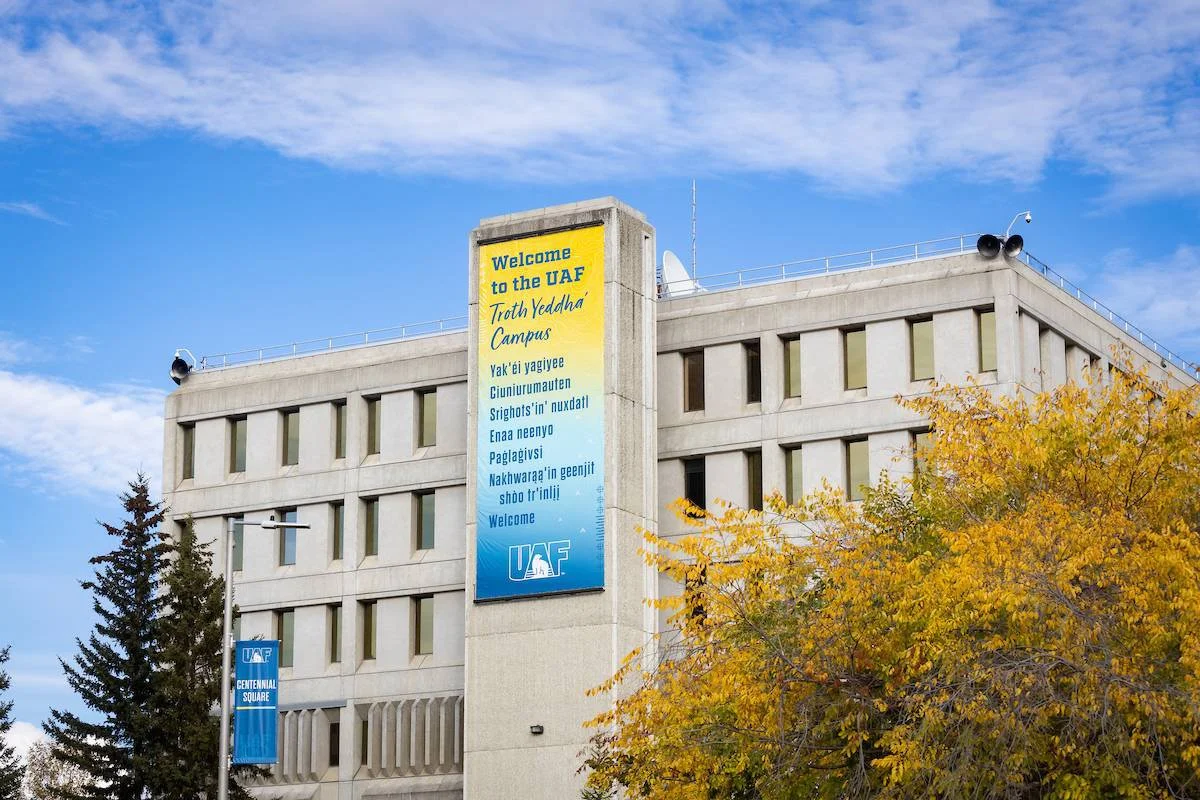
Photo courtesy of University of Alaska Fairbanks
The Gruening Building, constructed in the early 1970’s.
The University of Alaska Fairbanks is reviewing the history of its Gruening Building and has shared information with the Alaska Department of Health following reports of cancer among people who have worked in the building.
Sine Anahita, a former UAF faculty member who worked in Gruening, has compiled information about cancer cases among people she says worked in or were otherwise associated with the building. The figures come from Anahita’s records and have not been independently verified by The Sun Star.
Aaron Thomas, who contributed reporting to this story, directly interviewed one family member about a cancer case involving a former Gruening employee. Other people identified in documents provided by Anahita may be able to provide additional firsthand accounts, but those accounts had not been independently confirmed by The Sun Star as of publication.
UAF stated on Sept. 25 that it became aware of the concerns regarding the building after the issue was raised publicly on social media.
“UAF does not have any evidence of an environmental hazard in the building,” the university said in a statement.
The university said it is reviewing Gruening’s history for evidence of potential environmental exposures and has shared information with the Alaska Department of Health. According to UAF, the state will compare the information with data from the state’s cancer registry to determine whether there are unusual patterns of cancer.
UAF said the assessment will likely take several months.
How the reports began
Anahita said she initially knew of seven people associated with Gruening who had developed cancer. She posted about the issue on Facebook around Labor Day, after which former and current members of the UAF community contacted her with additional information.
In documents provided by Anahita, she listed 29 reported cancer cases and nine deaths involving people she identified as former occupants of the building. The Sun Star has not independently confirmed those figures or reviewed medical records.
Her records include reports of several types of cancer, including breast, brain, colon, lung, ovarian, prostate, stomach, thyroid and uterine cancers. The records also categorize reported cases by floor level, though those locations have not been verified by The Sun Star.
The reported cases alone do not establish that environmental exposure caused the cancers. Determining whether the number or types of reported cancers are unusual requires comparing the cases with expected rates in a comparable population.
According to UAF, that comparison will be part of the state’s assessment.
One family’s experience
Machell Duke said her late husband was a professor in UAF’s Department of Justice.
Duke said he began working at UAF in 2011 and was diagnosed with thyroid cancer in 2014. She said the cancer later returned and spread to his lungs and brain. He died in 2021.
Duke believes he worked on the fifth floor, although she was not certain about the location of all of his offices.
She said she does not know what caused his cancer and does not blame UAF. Duke said her husband had no known family history of cancer, but the family had previously wondered whether exposures from his earlier career as a California police officer could have played a role.
“I don’t know who I would hold responsible for it,” Duke said.
Questions about the building
Gruening was constructed in the early 1970s, raising questions about materials and activities that may have occurred there over its history.
Arthur “Art” Nash Jr., an energy specialist with UAF’s Cooperative Extension Service who works on issues including radon and indoor air quality, said environmental testing on campus is generally handled through UAF Facilities, based on his understanding.
Nash said radon testing is relatively inexpensive and cautioned against assuming radon is responsible for the reported cancer cases. Radon commonly enters buildings from the ground, and concentrations are often higher on lower levels. Nash said the reported cases on upper floors make radon entering directly from the ground a less obvious explanation, although ventilation could affect how air moves through the building.
“The ONLY way you'll know if you have problem in your home (building), is to TEST!” Nash wrote in an email.
Nash also said buildings from the period when Gruening was constructed sometimes contained asbestos-containing materials, but he did not say whether such materials are present in Gruening. He said UAF Facilities would be the appropriate source for information about the building’s asbestos history.
Anahita has also raised questions about Gruening’s early history. She said former UAF faculty member John Lehman told her that science departments once occupied the building and that radioactive materials and other chemicals were used there. Those claims have not been independently verified by The Sun Star.
Anahita has also raised concerns about PCBs, or polychlorinated biphenyls. The Sun Star has not established whether PCBs or other potentially hazardous substances were ever present in Gruening at levels that could pose a health risk, or whether anyone was exposed to them.
Past health complaints
Anahita said she experienced recurring skin rashes and breathing problems while working on the sixth and seventh floors.
She said UAF eventually investigated complaints about bird mites and found infestations in walls and ceilings.
The bird-mite reports do not establish a connection to the cancer cases.
What happens next
According to UAF, the Alaska Department of Health will analyze information provided by the university alongside data from the state cancer registry.
The assessment could help determine whether the reported number of cancers is unusual for the population of people who have worked in Gruening and whether particular types of cancer occur at higher-than-expected rates.
UAF said it will share relevant findings as the assessment progresses and take appropriate action if a health concern is identified.