

NASA administrator Jared Isaacman visits UAF for a student Town Hall on Alaska’s growing role in space exploration.
By Adisen Thomas
Photos by Amber McCain
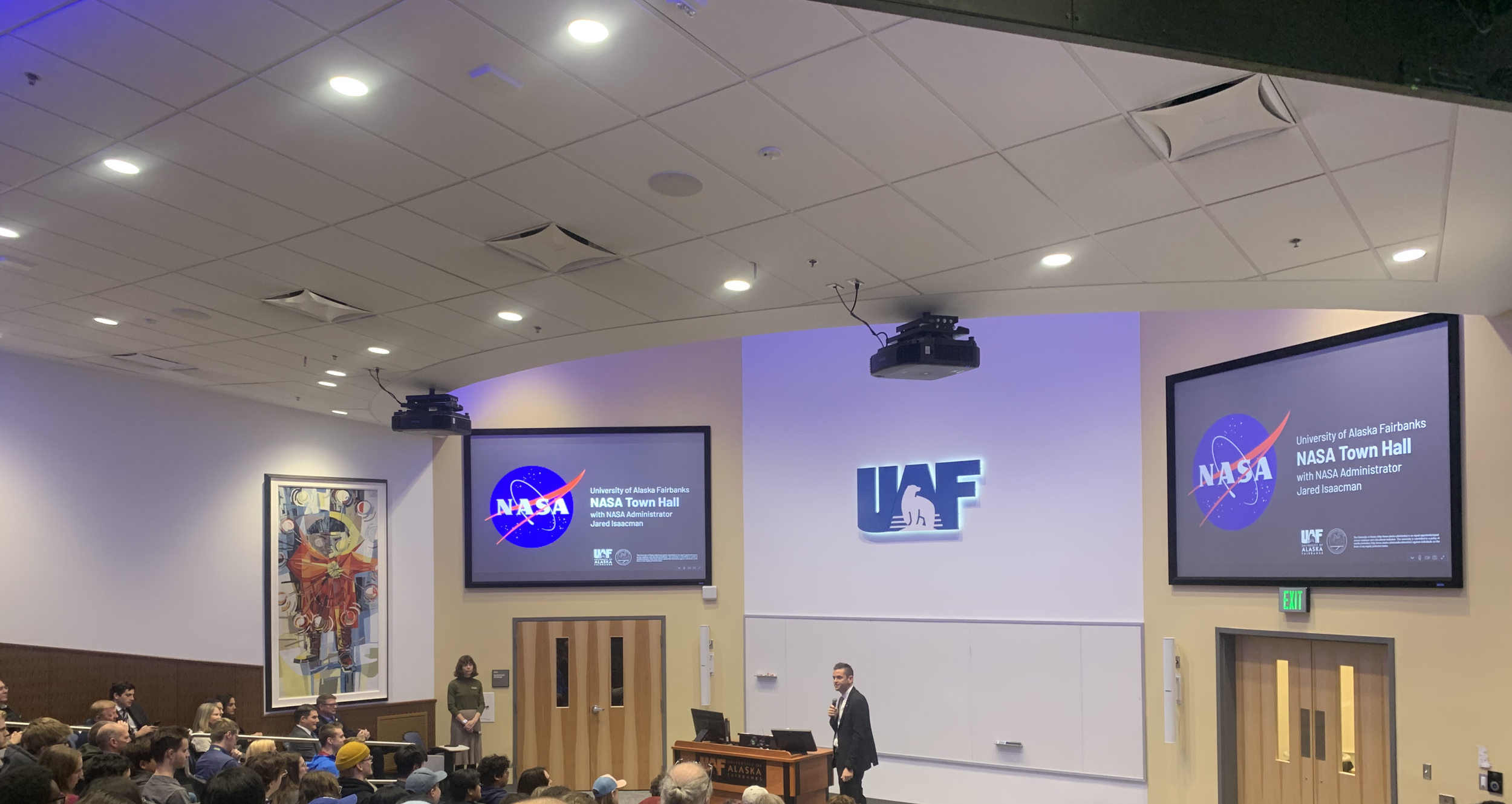
NASA Administrator Jared Isaacman speaking to UAF faculty, students and research staff in a packed auditorium during the town hall event in Schaible Auditorium on Oct 5.
Speaking to a packed audience in Schaible Auditorium alongside Chancellor Russ Vander Lugt and U.S. Rep. Nick Begich, NASA Administrator Jared Isaacman discussed Alaska's growing role in space exploration.
UAF plays a growing role in Alaska's space research, particularly through Poker Flat Research Range, the world’s only university-owned rocket range. A new five-year partnership between the university's Geophysical Institute and Alaska Aerospace Corp. could expand launch opportunities at Poker Flat Research Range.
UAF participates in the Alaska Space Grant program, which supports science, technology, engineering and mathematics education and research across Alaska. The program can help students pursue research opportunities and apply for NASA internships and fellowships.
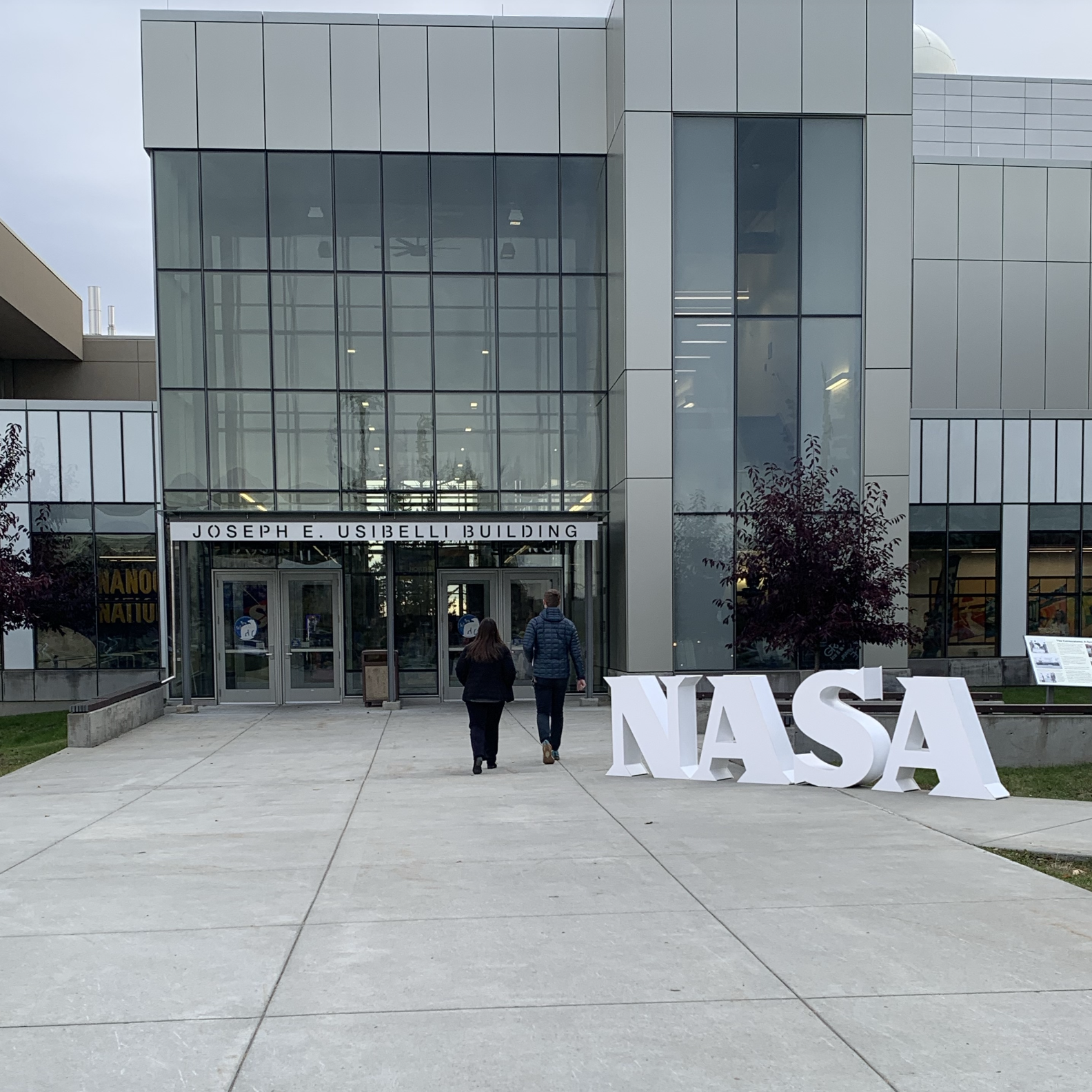
Attendees head into the Joseph E. Usibelli building for the student town hall meeting with NASA administrator Jared Isaacman, passing a NASA sign at the entrance on Oct 5.
NASA provided $24.7 million in research funding to UAF in 2024.
The Geophysical Institute offers students opportunities to study aerospace and space sciences. Researchers there study space weather, magnetospheric activity, and the northern lights using computer simulations, sounding rocket launches, satellite data, and ground-based observations.
Alaska’s unique and strategic vantage point makes it well suited for research on space weather, the aurora and interactions between Earth’s atmosphere and space.
Owned by UAF’s Geophysical Institute and maintained under contract to the NASA Wallops Flight Facility, the Poker Flats Research Range is a sounding rocket range about 30 miles northeast of Fairbanks. PFRR provides UAF students with unparalleled hands-on opportunities.
Two NASA projects are scheduled to launch from the range later this month: the INtegral Field far-Ultraviolet Spectroscopic Experiment and DUST III.
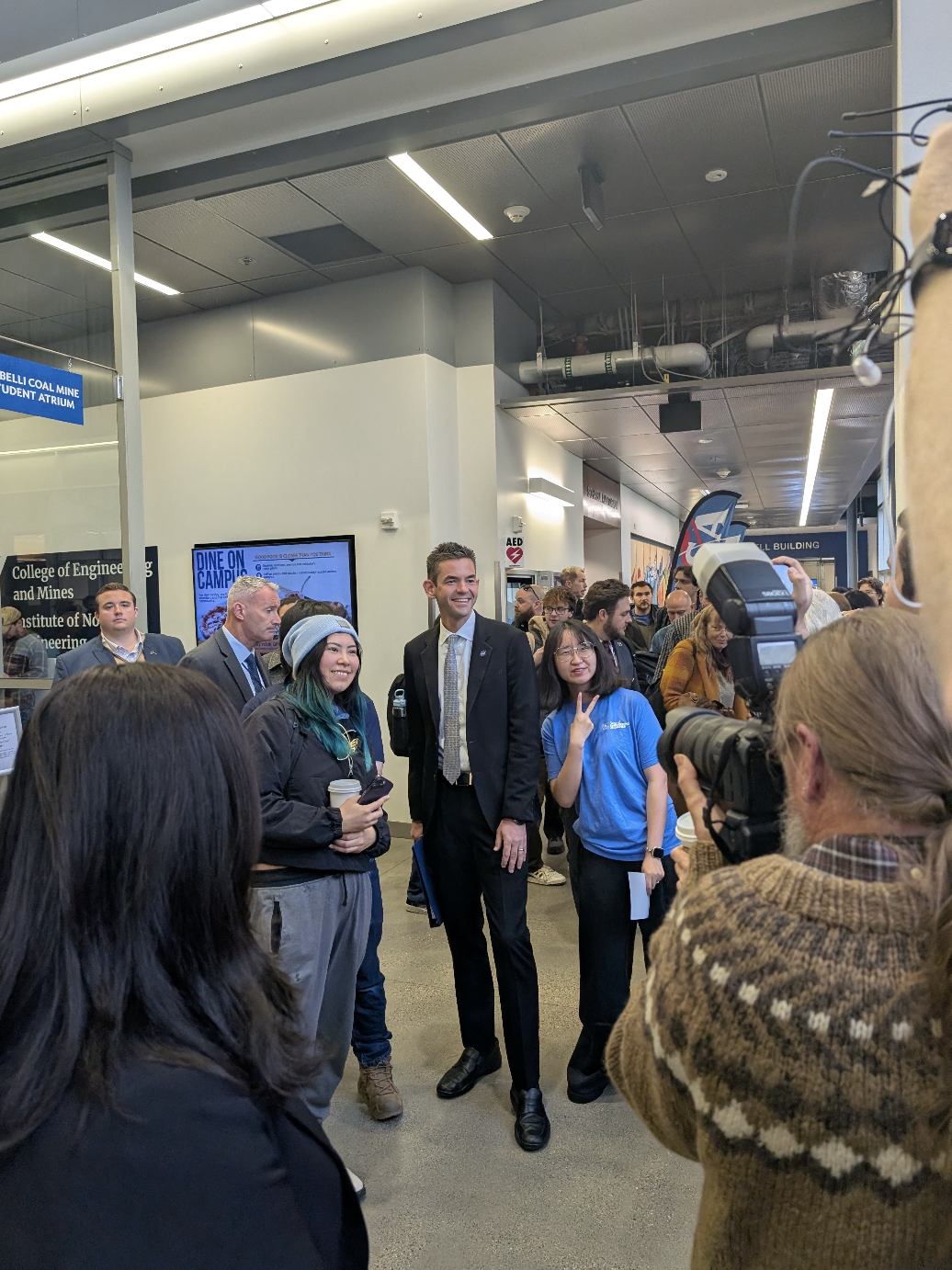
NASA Administrator Jared Isaacman poses with two attendees for a photo inside the Usibelli building after the student town hall on Oct 5.
“We’re going to mature some of the technology right here at Poker Flats,” Isaacman said.
Poker Flat Research Range has traditionally been used to study the aurora. However, a five-year memorandum of understanding between UAF’s Geophysical Institute and the Alaska Aerospace Corp. could open the door to other types of launches. The partnership could create opportunities for larger commercial rockets to launch from the range, expanding its potential uses beyond scientific research.
Another major launch facility in Alaska is the Pacific Spaceport Complex-Alaska on Kodiak Island. Owned and operated by the Alaska Aerospace Corp., the spaceport serves both commercial and military purposes.
“Alaska is on the frontier, and it’s on the forward edge of our nation’s defense,” said Vander Lugt.
Launch sites like PFRR and PSCA play an important role in the future of space exploration and research in Alaska. “Together, Poker Flat and Alaska Aerospace can extend and expand our launch capabilities in the United States,” Vander Lugt said. “More launches, more often, from Alaska.”
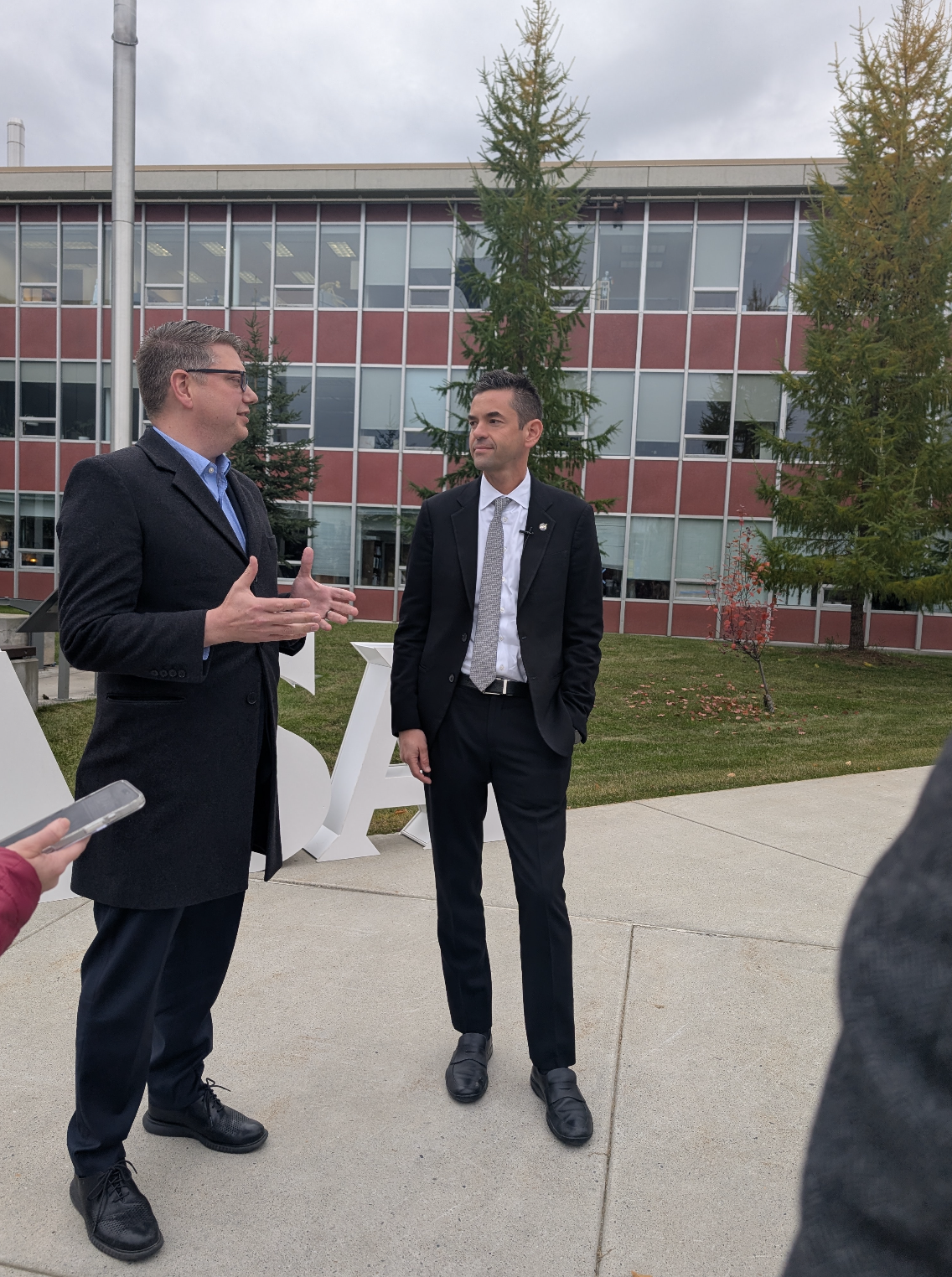
U.S. Rep. Nick Begich (Left) and NASA Administrator Jared Isaacman field questions from journalists outside of the Joseph E. Usibelli building after the student town hall on Oct 5.
At the national level, Isaacman said the Working Families Tax Cut Act provided approximately $10 billion in long-term supplemental funding for NASA on top of appropriations, with some of that funding going to the Artemis program. Artemis II, which launched earlier this year, went around the moon in a flyby mission — and is just the beginning. Artemis III is planned as a crewed low Earth orbit test mission, currently scheduled for 2027. Artemis IV is scheduled for 2028 and is intended to return astronauts to the Moon for the first time since Apollo 17.
The Artemis program is intended to help prepare for future human missions to Mars. Isaacman said that NASA is “dusting off playbooks from the 1960s” to continue lunar missions in the coming years.
Isaacman emphasized that UAF students will play a key role in the future of space exploration and Artemis missions.
“We are returning to the moon,” Isaacman said. “We are back.”