

The Fight for Women’s Rights in Alaska
By Katie Everett
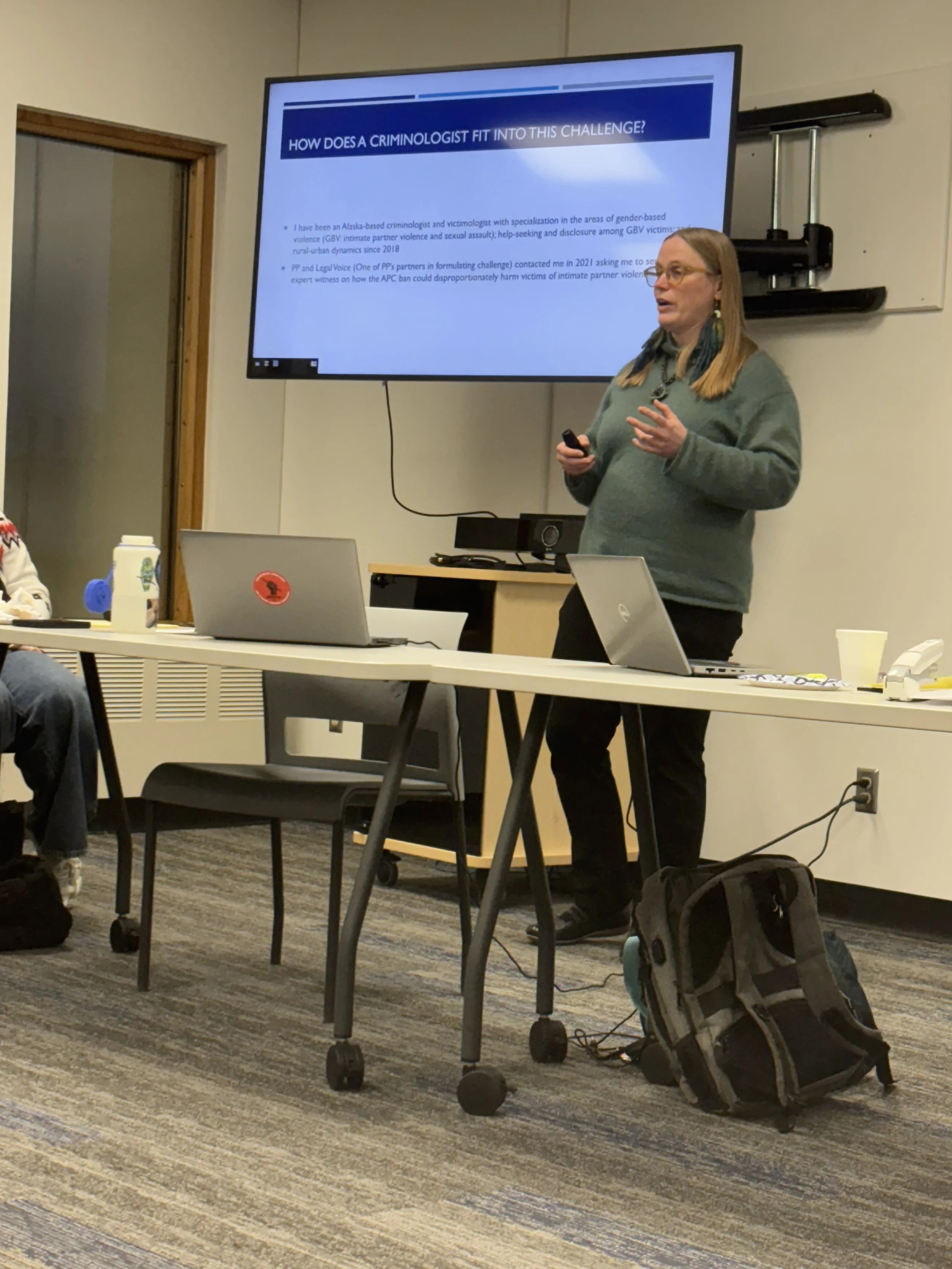
Photo by Katie Everett
Ingrid Johnson presents on how a criminologist assists in legal cases
The University of Alaska Fairbanks is home to many important researchers, from forensic anthropologists to criminologists and victimologists. Ingrid Johnson, a criminologist and victimologist on campus, teaches classes and conducts research involving domestic violence in the state of Alaska. Johnson earned her bachelor’s degree at UAF, and went on to earn her PhD in Philadelphia, Pennsylvania. After school, Johnson worked at the University of Alaska Anchorage’s Justice Center, and her research focuses on gender-based violence, specifically looking at intimate partner violence (IPV) and sexual violence. Johnson is now a professor at UAF, and on November 5, she gave a talk discussing her involvement in the Planned Parenthood case and how her expertise helped.
Since the overturning of Roe v. Wade in June 2022, the fight for women’s rights has escalated significantly in the United States. Most states passed more strict laws on abortion access, with some even banning it completely. A select few states, however, have continued to uphold access to abortion. One such state is Alaska, where abortion rights are legally protected under the state’s Constitution. Under the current administration, abortion rights are at a greater risk of being taken away.
The Alaska State Constitution protects abortion, but with limitations. There was previously a ban known as the Advanced Practice Clinician, or APC,ban, which stated that it was prohibited for any advanced practice clinician to perform an abortion, and that the procedure had to be done by a medical doctor.
Planned Parenthood is one of the only clinics that provides abortion in Alaska, and it only has clinics in Fairbanks and Anchorage, and only offers abortions when legal medical doctors are in office, making it incredibly difficult to not only travel to an abortion clinic but to also obtain one at convenient times.
In 2019, Planned Parenthood challenged the APC ban, arguing that the ban limits the availability of abortions by dictating who can provide one. Planned Parenthood argued that advanced practice clinicians were just as qualified to provide safe, legal abortions.
In 2021, Planned Parenthood reached out to Ingrid Johnson, a criminologist and victimologist at University of Alaska Fairbanks, and asked her to be an expert witness and testify about how the APC ban affects women who are in abusive relationships.
Johnson earned her bachelor’s degree at UAF, and went on to earn her PhD in Philadelphia, Pennsylvania. After school, Johnson worked at the University of Alaska Anchorage’s Justice Center, and her research focuses on gender-based violence, specifically looking at intimate partner violence (IPV) and sexual violence. Johnson is now a professor at UAF, and on November 5, she gave a talk discussing her involvement in the Planned Parenthood case and how her expertise helped.
Johnson first provided the state of Alaska statistics of women who had experienced violence in relationships.
“Almost 70% of women in Alaska have experienced either physical violence, psychological aggression, or coercive control and entrapment behaviors,” said Johnson.
In her time at the University of Alaska Anchorage Justice Center, Johnson was the lead investigator for the Alaska Victimization Survey, which was sent out to adult women and asked them questions about their relationship experiences. The survey asked about physical and emotional abuse, as well as stalking, coercive behaviors, or entrapment in relationships. Additionally, it asked women to disclose whether or not they had experienced reproductive control in their relationships.
“We can say that about one out of five have had a partner who’s tried to control their reproductive health in their lifetime,” Johnson said of the women who participated in this survey.
In her report, Johnson focused on three main points. She highlighted that risk of unintended pregnancy or pregnancy complications is increased in violent relationships, violence may continue or increase due to pregnancy, and women in abusive relationships often face more barriers to obtaining an abortion.
Johnson found that abusive relationships correlated with reduced use of contraceptives, pregnancy coercion, and removing access to birth control. She also found that abusive relationships correlated with higher risk of miscarriage and longer hospital stays after giving birth, and can even affect the health of the fetus. In relation to violence increasing due to pregnancy, Johnson found studies that looked at the connection between pregnancy and homicide.
“Intimate partners commit over half of all homicides of women and an even greater percentage of homicides of pregnant and postpartum women,” Johnson explained.
As a result, a woman who is already in a violent relationship is at a much higher risk of being harmed by her partner after becoming pregnant. Unfortunately, abusive relationships often hinder a woman’s ability to access abortion care. Johnson explained that men who are violent partners are significantly more likely to try and prevent their partner from receiving an abortion.
The APC ban made it even more difficult for women in violent relationships to access abortion care, because it made it so that abortions were only available on days that a doctor was in clinic, which was only a few days per week in Juneau or Anchorage. Not only did it make it difficult for all women, the ban made it incredibly difficult for women living in rural areas.
Many communities in Alaska are not connected to a road system, so women living in these places had no choice but to either carry the child or find a way to get to these larger cities, using money and time that they may not have. These women would need to come up with some reason that they were leaving their home for multiple days, and they would need to be convincing enough that their partner was not suspicious.
“That limited availability of abortion care could basically prevent victims from accessing care within the gestational limit,” Johnson said, referring to the lack of abortion access combined with the difficulty of getting to places where that care was offered.
In 2021, two years after Planned Parenthood first filed their case, the court decided to allow APCs to perform abortions while the case proceeded. In November 2023, Johnson gave her testimony over a Zoom call, and in September 2024, an Alaska Superior Court Judge ruled that the APC ban was unconstitutional.
Despite the ban being ruled unconstitutional, the state appealed the decision and sent it to the Alaska Supreme Court last October. Now, the APC ban faces risk of being reinstated, after Planned Parenthood fought so hard to have it ruled unconstitutional.
Johnson’s involvement in the case and her expertise helped to make a difference in abortion care in the state, and it was a major step towards women’s fight for abortion rights. This fight is still far from over, though, as it faces challenges every single day. Despite all the challenges, women across the country are still continuing to fight for their reproductive rights.