

UAF at center of national security shift as Pentagon Defense and Marine Corps unveil new initiatives
Story and photos by Amber McCain
The University of Alaska Fairbanks hosted two major defense-related announcements Friday where federal and military leaders outlined plans to expand Arctic research, military training and technology development in the state.
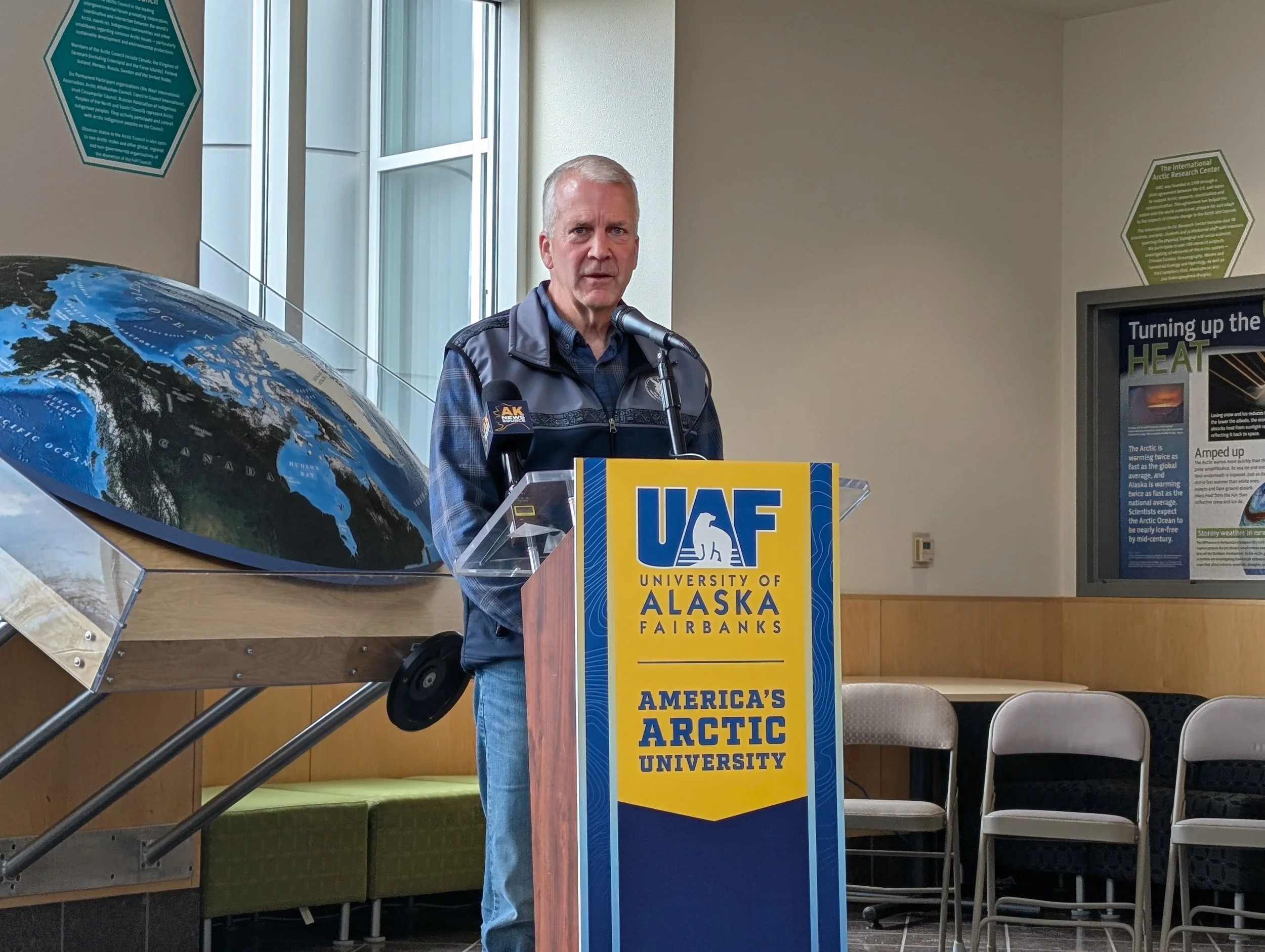
Sen. Dan Sullivan highlights Alaska’s strategic role in national security during a press conference at the Akasofu Building on Monday. Sullivan joined university and military leaders to announce a new research partnership between UAF and the Defense Innovation Unit.
The announcements included a new partnership between UAF and the Pentagon’s Defense Innovation Unit, or DIU, and a broader Marine Corps initiative known as “Campaign Alaska.”
At the university’s Troth Yeddha’ Campus, university officials signed a memorandum of understanding with the DIU, an organization that connects the Department of Defense with private-sector technology companies to accelerate military innovation. Officials said the partnership will initially focus on unmanned systems, energy security, hypersonics and space-related technologies.
“This is about strategic innovation in addition to what we know, which is our strategic location,” said U.S. Sen. Dan Sullivan. “The ability to have UAF as the center of gravity for that effort is so fantastic.”
University of Alaska President Pat Pitney said UAF already conducts a significant amount of Defense Department-sponsored research, ranking in the top 8% nationally for Defense Department-sponsored research, according to university officials.
“The Department of Defense is already a very important partner to us,” Pitney said. “This tiny University of Alaska Fairbanks is one of the defense department’s elite defense universities in the country.”
Leaders noted that Alaska’s environment provides a unique testing ground for cold-weather technologies, including drones and remote energy systems. Christian Whitchurch, director of the DIU’s Human Systems Portfolio, said the unit recently conducted maximum endurance testing for drones in the state’s harsh climate.
“When vendors say their technology can handle any environment, we take it to Alaska,” Whitchurch said.
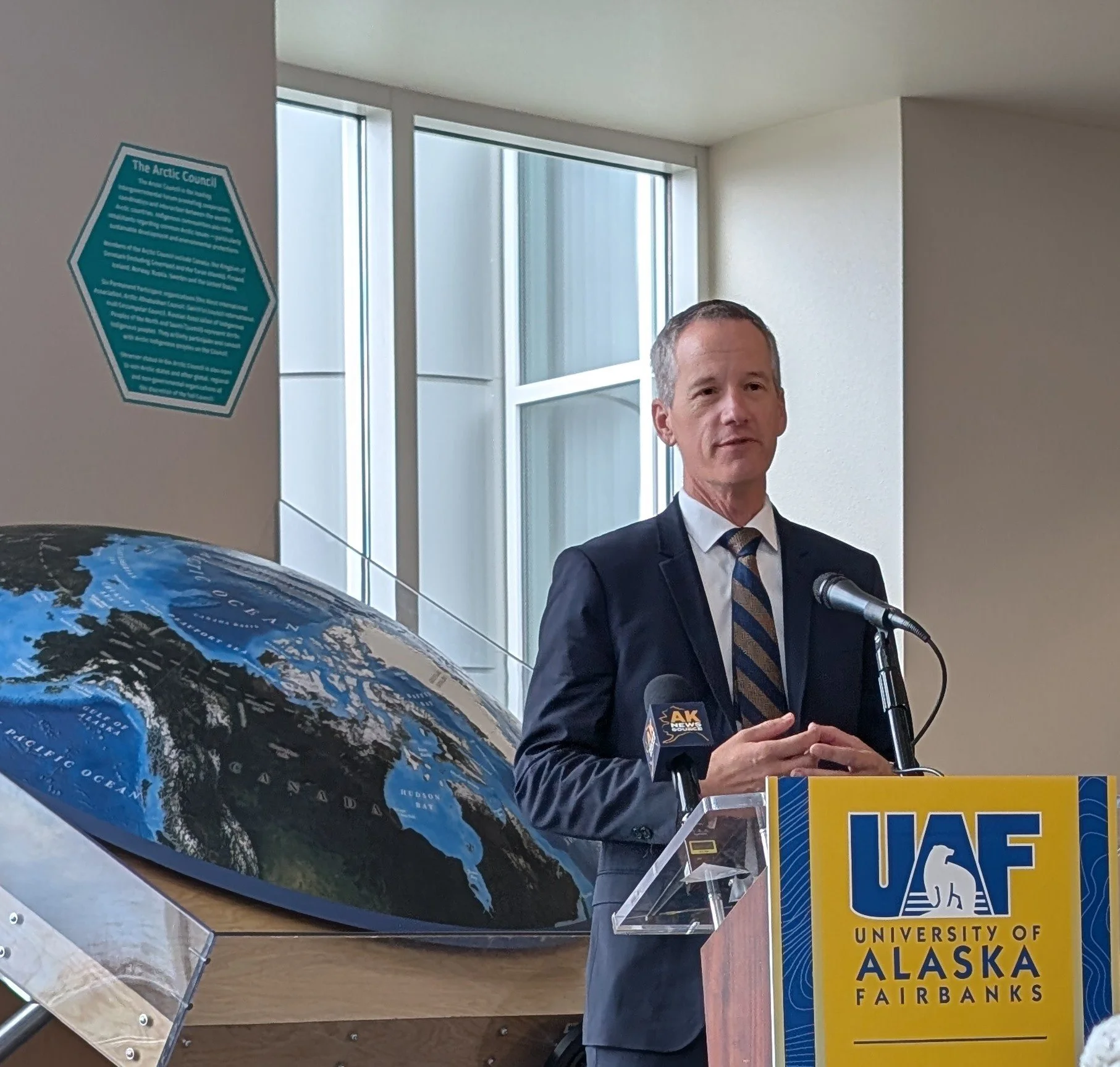
Christian Whitchurch, director of the Defense Innovation Unit’s Human Systems Portfolio, speaks at the Akasofu Building on Monday regarding UAF’s new partnership with the Department of Defense.
Later Friday, at the Rasmuson Library, Marine Corps leaders announced an initiative aimed at increasing training and operational activity in Alaska. Lt. Gen. Bobbi Shea, commander of Marine Forces Command and Marine Forces North, announced the establishment of Marine Rotational Force Alaska.
The initiative is an episodic training force intended to support Arctic operations, homeland defense and joint military exercises. Shea noted that Alaska’s 67,000 square miles of airspace and rugged terrain allow Marines to train at a scale impossible in the Lower 48.
“Alaska is an irreplaceable geolocation,” Shea said. “Its unique, unforgiving terrain and over 67,000 square miles of airspace on the ranges provide our Marines the ability to train exactly as they would fight.”
The Marine Corps also announced plans to establish an active-duty detachment from the 6th Air Naval Gunfire Liaison Company, known as ANGLICO, at Joint Base Elmendorf-Richardson. The unit specializes in coordinating air strikes, artillery and naval gunfire alongside allied and joint military forces, such as the Army’s 11th Airborne Division.
Sullivan, a retired Marine Corps reservist, described the ANGLICO Marines as highly specialized troops.
“You put three Marines with radios attached to a unit, and all of a sudden you have the hand of God with your unit,” Sullivan said.
While the Marine Corps expansion will rely primarily on temporary deployments rather than permanently stationing large numbers of troops, Shea emphasized that the forces would be ready to deploy directly from Alaska to global conflict zones if necessary.
“We should always be ready to deploy if you’re a United States Marine,” Shea said.
Sullivan said the dual announcements reflect a broader military investment in Alaska, pointing to recent expansions in the Air Force, Army and Coast Guard. He noted that the DIU partnership could eventually lead to a permanent DIU hub at UAF, helping to bridge the gap between academic research and a commercial defense-tech sector in Fairbanks.
“We have so much innovation, so much research, so much military,” Sullivan said. “But we don’t have that other piece, a commercial sector that can help commercialize it and get it out to the fleet.”