

Back-to-School: A Time of Renewal and Reflection
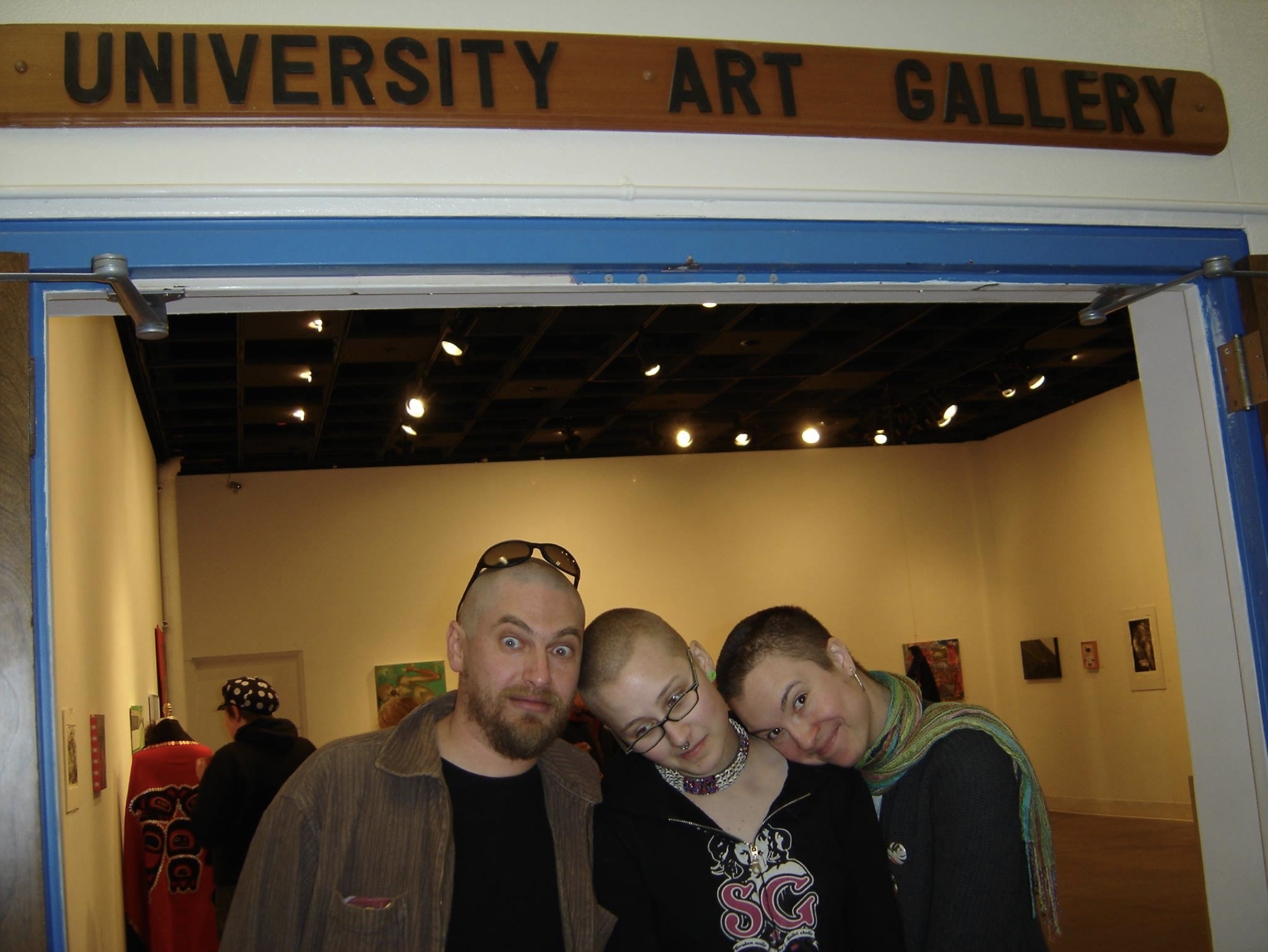
Igor Pasternak Tamara Wilson Hanna Tawde ca 2005.
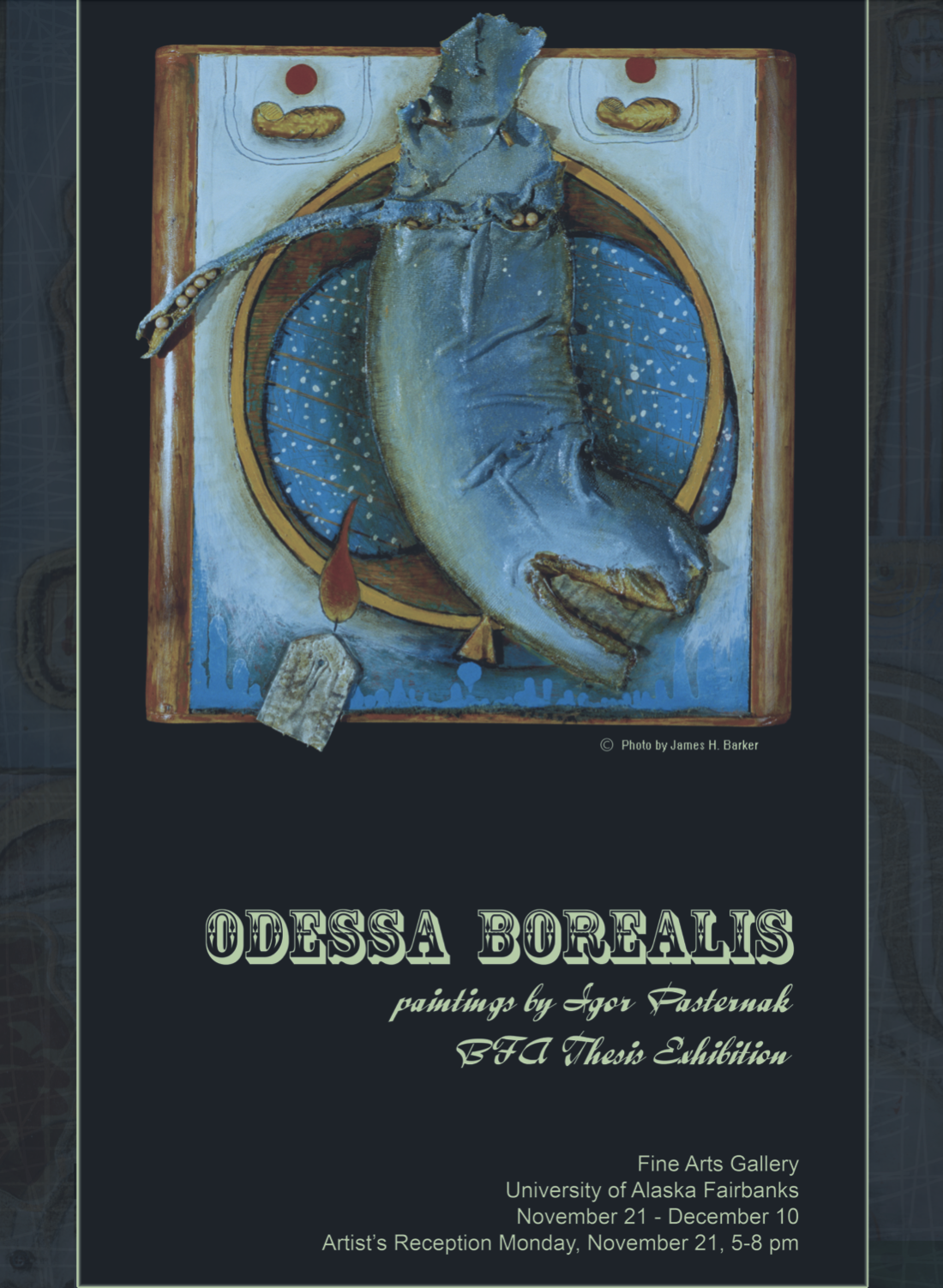
Odessa Borealis Igor BFA Poster.

Igor Pasternak Chutzpah Art Faculty Show.
In getting ready to welcome Rosh Hashanah, the start of the Jewish New Year, I am also excited to celebrate a personal anniversary of a very meaningful professional milestone: twenty years since the completion of my BFA degree at UAF. Shortly after the onset of the current millennium, I felt like the luckiest person on Earth to be a Painting and Printmaking student at the UAF Art Department, living in Alaska as a newly confirmed US citizen (at that time a recently asylum-granted refugee), having experienced firsthand the mandatory service in the Soviet Army and the collapse of the country that enforced that mandate.
My family of dissidents were never patriots of the USSR. And due to the structured endemic antisemitism, per the confession of its own administration I could not be admitted to the university program I was qualified to attended because of the (unofficial but very real and strictly observed) form of prejudice known as “the Jew quota.” Yet, as I convey in much of my art and writing, we loved our home city of Odessa/Odesa, Ukraine. When I came to Alaska, I knew I don’t have to love every political persuasion I encounter here in order to love my adoptive homeland and experience all the evidence of it loving me back. Alaska’s acclaimed and dearly missed photographer James Barker photographed my BFA show entitled Odessa Borealis in honor of my forever two beloved homes. I used Jim’s photos in my exhibition poster and in the portfolio submitted with my grad school applications.
Over time, several media outlets have taken interest in my journey as an ex- Soviet Jewish refugee, artist, scholar and instructor for the UAF Art, Anthropology, and Ethnobotany programs, contributor to the locally spored Fairbanks Fungi Festival, and an outspoken critic of the mass-scale terror in my native Ukraine suffered at the hands of dictator Putin. I am a complexly positioned and diversely experienced human who, like most of the Jewish people whose stories I read in various social media groups, identifies as “Jew first.” It is important to understand that Jewish belonging extends far beyond a religious practice. Being Jewish, for me, is one inextricable part of all the personal, professional, social, and cultural dimensions of identity through which I connect with the world, relate to others, and am able to be self-aware. In the words of actor Jason Alexander (George Costanza on Seinfeld), my Jewishness is a “shirt I can’t take off.” That does not mean the shirt is always visible for what it is or that it is liked by others. Jewish identity is a subject of a large body of research that speaks provocatively to the ambiguities of ethnicity and race. My wife’s mentor and Johns Hopkins University and our dear late friend luminary anthropologist Sidney Mintz (who also was Jewish and a fellow enthusiast of fly fishing), was once lecturing on this subject in one of the classes he taught at Yale, when, not in a particularly callous way, a student interjected “I know a Jew when I see one.” “That may very well be” said Professor Mintz, “the question is would you know one when you don’t see one?”
The antisemitism I experience – independent of any politics, policies, or world events - is at the heart of these words. The frequent crescendos in my speaking voice, my fondness of debate and constructive conflict, my manner of carrying a conversation known among linguists for its impassioned storytelling and “cooperative overlapping,” are some of the distinct embodiments and expressions of Jewish culture celebrated in books, movies, and art all over the world and especially in my birth city of Odesa, Ukraine. I enjoy being a bearer of this fast-paced, inquisitive, argumentative, satirical even when serious, vocal expression of the pan-Jewish culture that is especially amplified along the stretch of the coast of the Black Sea where I grew up. Overwhelmingly, the student feedback on my courses suggests my communication style is also a reason many in the UAF community appreciate my teaching, my art, and my company.
Sadly, the very same gifts of my birthplace and ancestors can sometimes be censured with prejudice, where my Jewish Odesan manner of interacting is besmirched with “loud” as a character flaw. The distinct and celebrated expression of the Jewish style of communication unfortunately has a long history of becoming weaponized as a negative stereotype, used to dehumanize the Jewish people. So much so, that it is among the concerns noted in the Jewish Community Relations Council Consensus Statement on Antisemitism.
That is why my contribution to this year’s Art Faculty Exhibition, held at the same University Art Gallery which twenty years ago hosted the show I did for my BFA Thesis, is entitled Chutzpah – a Yiddish-English term that reflects and educates on our cultural pride. The curriculum in the Inuit Art course I teach during fall semesters includes a deep study of the legacy of the Inupiaq artist Angokwazhuk, born in 1870, who was known widely under his artist name Happy Jack. He lived mostly in Nome, Alaska. One of Happy Jack’s many famous works, is called New Year Greeting, where the Hebrew script engraved on a walrus ivory tusk extends a traditional Rosh Hashanah blessing: may you be inscribed for a good year. The piece is believed to have been commissioned by a Jewish couple depicted on the tusk, who in the time of Happy Jack ran a store in Nome. The engraved Hebrew calendar year 5671 corresponds to the Gregorian calendar year 1910. The Jewish year we are about to welcome is 5787.
Like the holidays of cyclical renewal observed in many spiritual traditions, Rosh Hashanah is a time of reflection. With a personal celebration of the twenty-year anniversary of becoming a UAF alumnus in Fine Arts – a major milestone that shaped the course of

Happy Jack Rosh Hashanah ivory card Public Domain Jewish Museum.
my life – I gratefully reflect on the Jewish experience in Alaska captured in many unique historical documents, including Indigenous Alaskan art. For me, Happy Jack’s walrus ivory Rosh Hashanah card is the most unique of the blessings there are. On behalf of my wife Sveta Yamin-Pasternak and myself: happy start of classes to the UAF community and happy 5787 to all. May you be inscribed for a good year.
Igor Pasternak, UAF Fine Arts alumnus (2006), instructor in the UAF art, anthropology, and ethnobotany programs.
gipasternak@alaska.edu