

By Caidan Walker Pilarski
Caidan Pilarski, MFA in Creative Writing, discusses UAF’s approach to AI in comparison to other universities and discusses his own experiences with AI in art and academia.
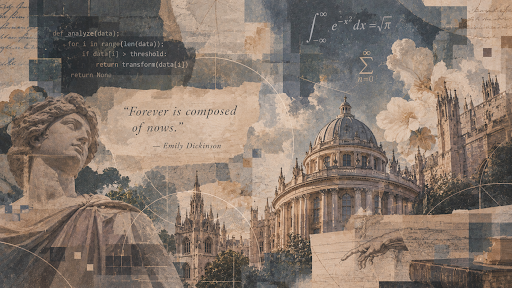
Generated using ChatGPT on November 5th, 2026.
Before I officially arrived on campus for the first time this year, one of the first big things I had heard about UAF was how on January 13, 2026, UAF student Graham Granger ate AI art off of the wall at a gallery for MFA students. As an MFA student myself, I take no offense (although I operate within the written arts, not visual). I found it utterly amusing. This is exactly the sort of thing I like to see: protest that matters, protest that is also poetic. I mean this unironically, but I don’t ignore the humor in the situation. It made me want to come here even faster. It also made me interested in how UAF has approached AI. A recent article by the Sun Star discusses the lack of a unified AI policy at UAF. The most critical part of that article, for me, states: “AI uses vary widely across academic fields. ‘A real challenge for AI policy is we cannot just make blanket policies,’ Carroll said. Because the technology changes so quickly, the policy must remain useful as AI tools evolve.” Artificial intelligence is ultimately a tool capable of great harm as well as great aid. You may have noticed that the image paired with this article was made with the help of our good friend ChatGPT. It isn’t half bad either—I will get back to this at the end of this article. As the previously mentioned article correctly identifies, one of the main concerns with AI policy is academic integrity. Perhaps students are lazy and seek shortcuts to get their degree and get out of here. Perhaps students feel pressured by degree inflation and expectations and feel they need to do whatever they can to get their degree to survive in the modern world. Perhaps AI is inherently addictive and affects the human psyche in ways we may not fully understand. Perhaps students were encouraged by others, thinking it okay if everyone was doing it—argumentum ad populum—or maybe it’s new and thus exciting. Above all, we know that we want students to learn effectively. AI cannot be a substitute for critical thinking or effort. Instructors across the university and across the globe should recognize these truths and develop ways to emphasize critical thinking and effort, in spite of the existence of AI. It will not go away, so we must learn to work alongside it.
Massachusetts Institute of Technology, also known as MIT, released a report earlier this year on AI in the classroom. Within, we find multiple suggestions for adapting policies to work around the urge and ubiquity of AI. One of the biggest takeaways is this:
We urge instructors to consider forms of assessment that are less vulnerable to AI, and more valuable for learning, such as oral exams, semester portfolios, and out-of-class assignments paired with in-class conversations. This likely means that resources such as TAs and class time will become more central to evaluation and also raises the question of whether we should find ways to limit class sizes. (Section 3.1.2)
In my experience as a student, oral exams did an excellent job of challenging me. It is no surprise that many graduate degrees require an oral dissertation. On top of this, semester portfolios, such as in my own taught course, WRTG F111X: Writing Across Contexts, could be more useful across all courses. All of my fellow F111X instructors are required to have an AI policy, and everyone has approached it differently; we are still in the experimentation phase of AI. In my class, for example, I have mostly banned AI use, though I do allow it for instances where it can correct grammar and spelling, like with Grammarly. While I do allow this, I urge students to understand that AI is not perfect and I want to see their own language skills. I have devoted several lectures to giving them the tools they need to become more masterful writers, including grammar refreshers. These sorts of rhetoric courses are essential at a university and I am glad that this course is required for all associate’s degree and bachelor’s degree students.
While there is much we can do to alleviate the negative impacts of AI, it can certainly have some positive impacts. I knew many students who would use it to help them study. I must reiterate, again, that it is not going away. Some universities have taken note of this reality. Cornell University, my alma mater, has decided to offer free AI tools for students, faculty and staff. ChatGPT, Claude and Google Gemini will be offered at no cost starting in early 2027, as well as tools like ChatGPT Codex, which specifically helps with coding. Princeton University is also offering AI tools to their students: “The University will provide all students, faculty and staff access to ChatGPT Plus or Pro, a paid version of OpenAI’s premier large language model.” Across more scientific fields such as computer science, astronomy or medicine, AI has the power to make discoveries and accelerate human scientific growth in ways we could not have presently imagined. We want and need to be careful with the boundaries we set with AI for ourselves and, if we are instructors, in our classrooms. As a culture, as a society, we must not forget the value of human intelligence and how it differs from artificial intelligence. One of the most striking examples of this difference is in the arts and humanities.
Art is utterly tied to emotion. It evokes—there is nothing to evoke in an AI language model. What can it possibly know of despair, of bliss, of wonder? Certainly it can mimic these things, but is a mimicry as valid as a human outpouring of emotion? More importantly, is art defined by how it’s made or by what it does to those who experience it? Both are important. This nuance is what causes someone to put up a gallery of AI art. This is also the nuance that causes someone to walk up to said AI art gallery and proceed to chew and swallow at least 57 of the images in the gallery. Personally, I do not like AI as a substitute for human art. I do not like its growing ubiquity. It does not deserve as much focus or care as human art because we are humans and we need art born out of us and bleeding back into us. It is an inherently human conversation. Though it might be curious if a stranger speaking a different language interrupts it, it does not help in the long run. Still, forgive my humanization of AI models for a second, there is something flattering about ChatGPT mimicking human art. Look back at the image at the beginning of this article—I brought it into this world. It exists. Do you embrace it or shun it?