

The Growing Importance of Literature and Language Programs
By Caidan Pilarski
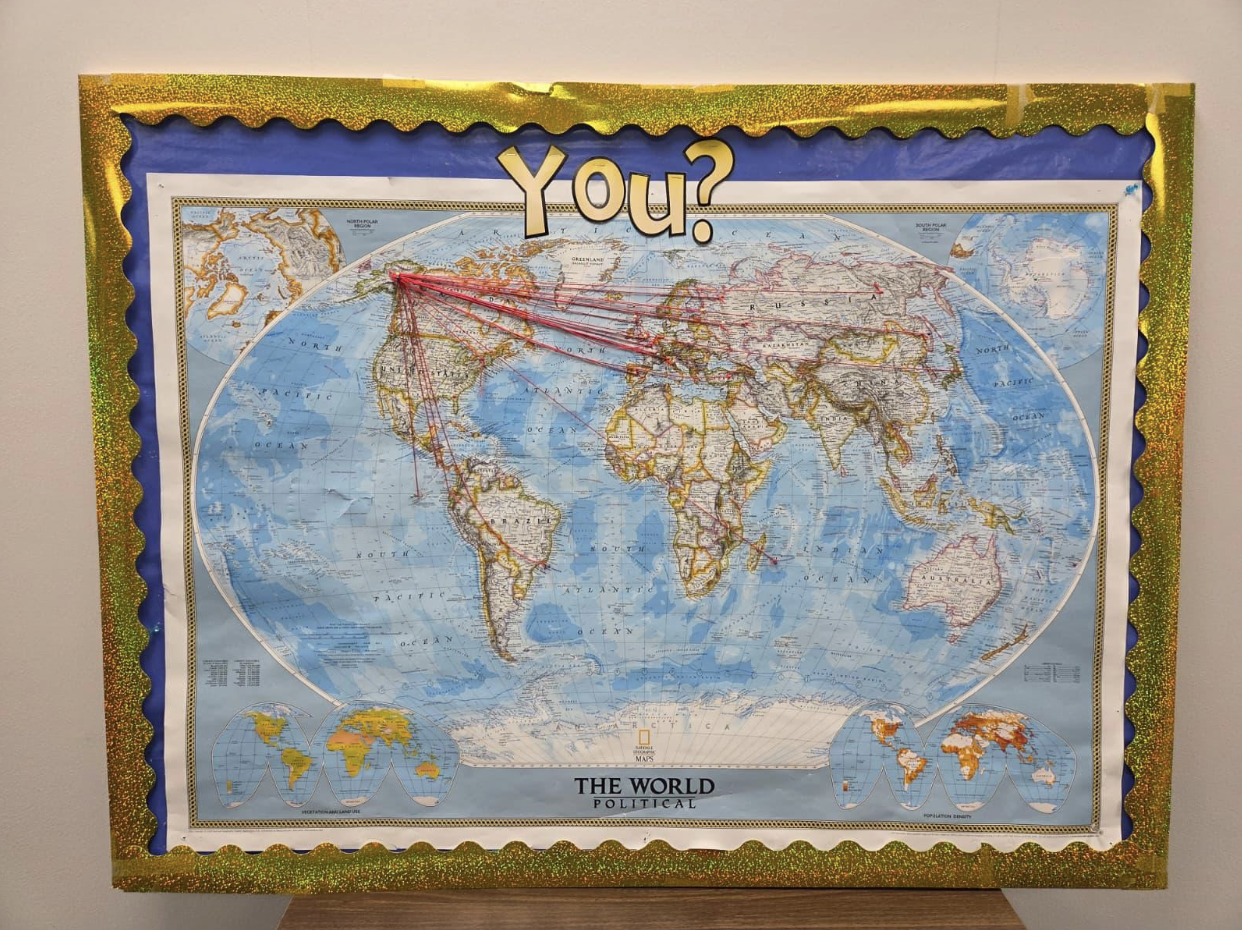
Photo courtesy of Caidan Pilarski
A map showcasing the diversity of the student and faculty body, on the 6th floor of Gruening in the Global Languages office.
On the 17th of September, The Herald published an article titled “Full list of the 90 Edinburgh University programmes scheduled to close.” Before I even opened the article, I had a feeling that it would look like a huge blow to the humanities—it was. Some of the programs listed in the article include: Religion and Literature (MSc and MTh, full-time and part-time), Law and Celtic (UG), Scottish Ethnology and Scandinavian Studies (UG), German and Russian Studies (UG), Spanish and Classics (UG), Portuguese and Linguistics (UG), Chinese and Economics (UG), Persian and Social Anthropology (UG), Arabic and Ancient Greek (UG). The University of Edinburgh is ranked 35th in the world by the 2027 QS World University Rankings. It is well known for its humanities programs, and thus, it is deeply unsettling to see that these programs in particular were targeted. I understand that, in these cases, there are unfortunate fiscal realities that have been dealt with in some logical fashion, but the purpose of the university, especially a prestigious university such as Edinburgh, should be to do whatever it takes to cultivate the acquisition and dissemination of knowledge and wisdom. Perhaps this is a short-term solution and a long-term solution is in the works, one that will see the revival of these programs. However, I must make it clear that this is a growing pattern at universities around the world. This article in The Guardian discusses a mock funeral that students at Montclair State University in New Jersey held for administrative decisions to consolidate certain humanities departments. This DutchNews article reveals that “Utrecht has confirmed it is planning to cancel its German, French, Islam and Arabic, Italian, Celtic and religious studies from the 2026-2027 academic year.” This Montana Free Press article uncovers how Montana’s flagship university has cut its literature master’s program, which is “one of the oldest on campus,” and it “could adversely affect the creative writing MFA program.” As an MFA student here at UAF, this makes me slightly nervous. To be fair, I was aware of the state of humanities programs—I have been continuously nervous for quite some time.
UAF is one of many universities to deal with logistical and financial troubles within the languages and literature departments. I spoke with Helga Wagenleiter, an instructor of German at UAF, who told me about the struggles retaining Gwich’in studies in recent years. She clarified for me that UAF teaches Japanese, Russian, German, Spanish, and French, as well as Italian, Latin, and Chinese, though these latter languages are online programs. Of course, we have an incredible English department, with excellent faculty, staff, and graduate students, all of whom are constantly fighting to keep the department strong and energized. These programs, as well as the indigenous language programs, are essential to UAF and Alaska as a whole. We stand at the outskirts of the United States, of the world, and we must recognize the importance of communicating effectively, through both science and the humanities, within academic papers and passionate art, that the diversity of modes of communication is one of the many intricacies of humanity and that allowing the education of these topics is a necessity above all, particularly in a world running rampant with AI (artificial intelligence). When we replace our desire to cultivate our investigative, critical, and discursive language and literary skills with AI, we rot our minds and ruin our capacity to both comprehend and communicate anything at all.
As well, certain language and literature programs have a certain cultural significance depending on the university. Gwich’in, of course, is particularly significant to UAF, among other Alaska native languages, while any and all Scottish literature programs are particularly significant to Edinburgh. On top of this, any and all languages at a given university allow for diversity of cultures and intersection of language in a way that allows for an intersectional education that simply cannot be found anywhere else because of this intersection. Wagenleiter made an excellent point as well: “Even a global language has lots of native languages [or dialects].”
While this is a widespread global phenomenon, we have seen within the United States that federal funding changes have made it difficult for universities to operate ideally. The current administration has made decisions that have clearly diminished American educational prowess, and it is necessary to make that connection so that we can urge local and federal government leaders to hear us when we say: we all need these literature and language programs.
Caidan Pilarski, MFA in Creative Writing candidate, discusses the recent program cuts within the University of Edinburgh, explaining the relevance to UAF and emphasizing a message to all of the importance of literature and language programs.