

Olympian & Nanook Rosie Fordham reflect on games and career
By Gabriele Rigaudo
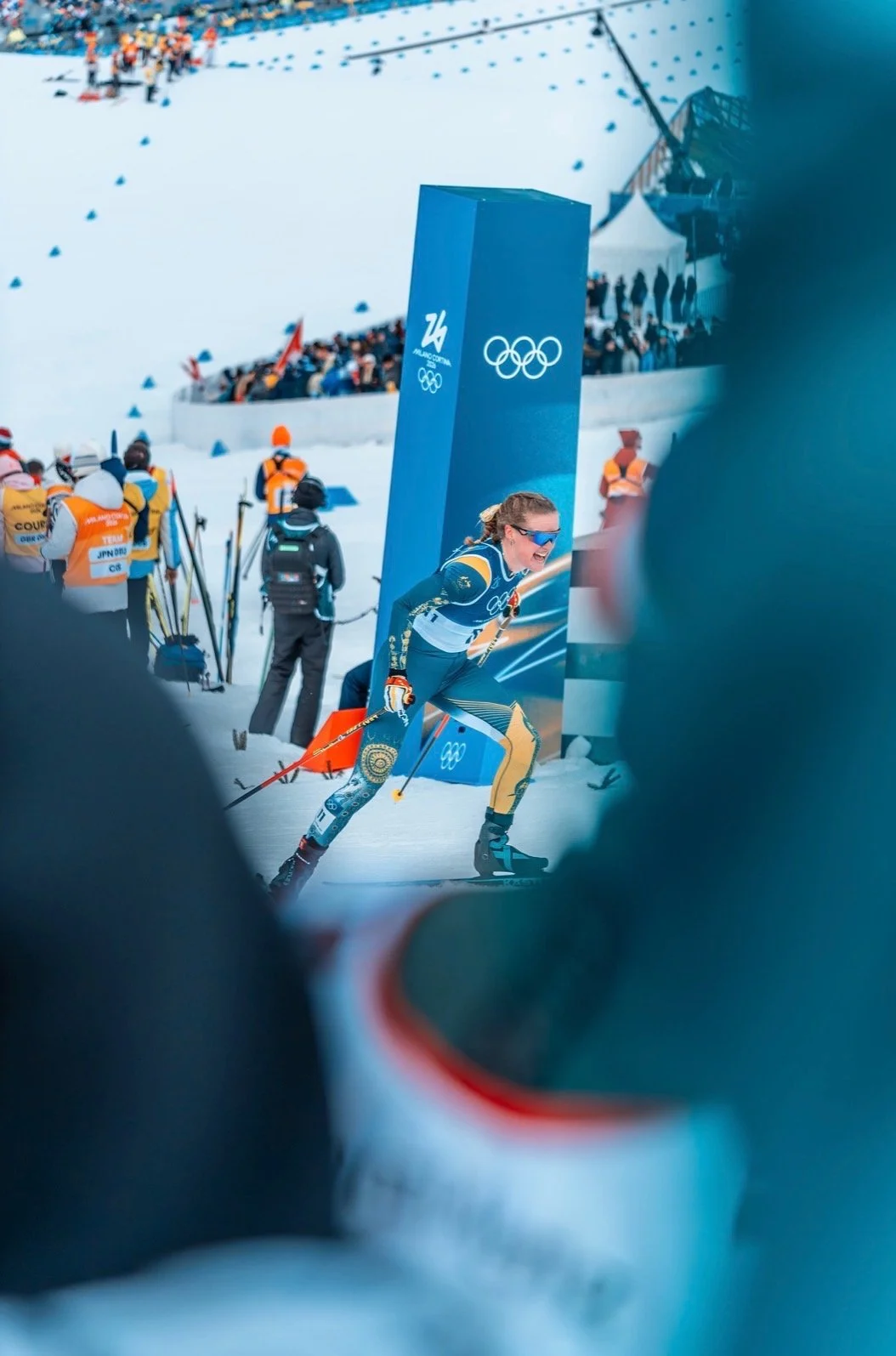
Photo courtesy of Tobias Albrigtsen
Fordham in action during the 10km skating race at the Olympics, in which she finished 33rd place.
In February UAF’s Nordic skier Rosie Fordham competed at the XXV Winter Olympics in Milano-Cortina. She took part in 5 out of the 6 events dedicated to nordic skiing for the Australian team. Fordham sat down with The Sun Star to reflect on her training process, Fairbanks’ upsides and downsides, and offered insights on ways UAF could support the development of its endurance athletes.
“I think my consistency in training was— and still is —the most important thing,” said Fordham when asked what got her to the fitness necessary to compete in the Olympics. “I never truly take long periods off.”
Fordham explained consistency allowed her to prevent injuries and illnesses.
Fordham believes that her 700 hours of training each year are sufficient. Although other competitors in her field might exceed the 1,000 hours/year mark, the comparison doesn’t bother her. In Fordham’s opinion, the difference is not because of practicing as often as possible, but rather by following her body’s needs. Fordham’s decision-making process, whether to push hard or rest that day, relies on three factors: sleep, resting heart rate, and feeling. If she experiences a bad night of sleep, together with an increased resting heart rate, she avoids going out for the day. Getting the most – quality wise – from her session is her number one priority.
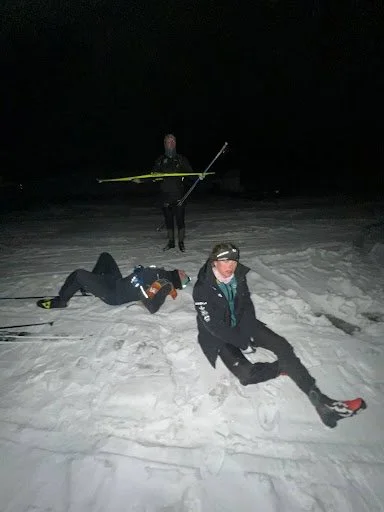
Photo courtesy of Tobias Albrigstein.
Rosie Fordham, front right, after the 130 miles ski covering the entirety of the Denali Highway. Erling Bjornstad, standing in the back, Peter Hinds, laying down, and Tobias Albrigstein took part in the ski with Fordham.
Fordham’s Strava profile— the number one media platform for endurance sports, where athletes upload the details of their training sessions —is the place where all of her training adventures get posted. For example, she once skied the entirety of the Denali Highway in one day, covering more than 130 miles all at once. “The Denali Highway adventure was so much fun,” Fordham said. “I don’t think you need to do such crazy days if you want to compete at the highest level. I do them because I really enjoy the feeling of it, and it makes me rethink what my limit is, both physically and mentally.”
A big part of Fordham’s NCAA career, which is coming to an end after this year, is running. “I believe that running intensity gives you something more than just skiing.” Fordham explained that running allows her to stay in a higher-effort zone for a long, continuous period of time. Although her highly decorated NCAA running career ended last year, with a GNAC championship win and an All-American finish at the NCAA championships, she decided to keep at least one hard running practice every week throughout the fall.
Still, one last weekend of ski racing as a Nanook is left for Fordham, who will try to get an NCAA championship win for the ‘Nooks in Soldier Hollow, Utah.
Fordham will complete her master’s in Statistics this spring. “The math department always supported and understood my efforts,” said Fordham. “Having such collaborative professors, I was always able to stay on track with my classes, even if it meant taking midterm exams in the Olympic Village.”
Troth Yeddha’ has been Fordham’s home for the last five years. In her opinion, trail accessibility is the biggest upside of living in Fairbanks. “I got to work countless hours on my ski technique thanks to that.” When asked to point out what the biggest problem within the athletic department, Fordham said food. “We should really have some high-protein food available after each session. Nutrition after an effort is the best way to enhance recovery.”
Fordham suggested that what UAF is also lacking for endurance athletes is some instrumentation to measure physiological values. Many institutions across the country use their athletic programs as an opportunity to conduct world-class science, and Fordham sees this as an opportunity for UAF. “I believe sports scientists could conduct really cool research while also helping us athletes keep track of our training progress.”
Scott Jerome, an assistant professor in the Department of Chemistry and Biochemistry and former head coach of the UAF ski and cross-country team, has done studies on both human and canine subjects.
Jerome said our lack of an exercise science, sport science, or exercise science physiology program at UAF represents the main limiting factor when trying to pursue research projects in the field.
“I can't say that we are behind other universities when it comes to sports science because we are not even in the arena. A skier with no bib is not really in the competition. We have no bib,” said Jerome.
Both Fordham and Jerome pointed out that having a sports science department at UAF could benefit athletes and eventual researchers/students interested in the field. As mentioned by Jerome, UAF is home to excellence in endurance sports, and experts in sport physiology at our institution could conduct multiple sorts of endurance-related research such as performance monitoring and effects of cold temperatures during exercise. Fordham pointed out the benefits that such a program would bring to the athletes. Instrumentation able to perform performance monitoring would be a powerful tool in adjusting training planning and quality.