

Engineering open house marks 60 years of cool science
By Amber McCain
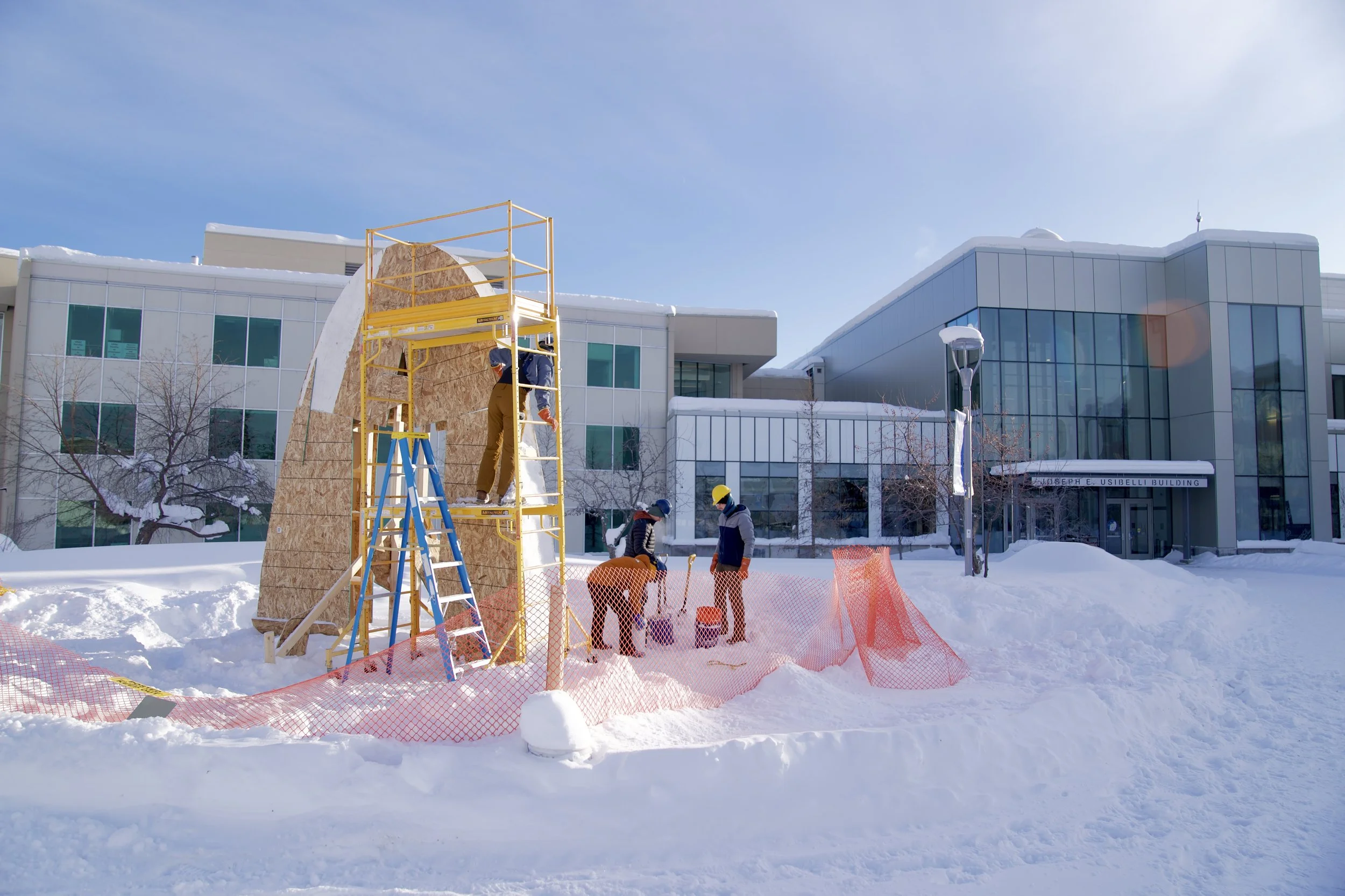
Photo by Lizzy Hahn.
Left to right, Griffin Bailey, on the ladder, Matias Ramirez, Landon Stroh and Axton Siekmann build the ice arch on Feb. 21, 2026. The members volunteered 30-40 hours of their time to build the 60th annual ice arch.
Hundreds of visitors rolled through the Usibelli Building on Saturday as the University of Alaska Fairbanks College of Engineering and Mines marked the 60th annual ice arch during its 2026 Engineering Open House. Families, K-12 students, and prospective college students explored hands-on activities, live demonstrations, and engineering projects across the building’s four floors on the Troth Yeddha’ Campus.
“This is an open house for kids and prospective UAF students to come check out all the cool things we’ve got going on on campus,” said Katelin Avery, outreach and engagement officer at the College of Engineering and Mines. We want to make engineering feel accessible and fun for everyone.”
One of the event’s highlights was the 60th annual ice arch, a UAF engineering tradition. Students and faculty spent hundreds of hours building the structure outside of the Usibelli building on UAF. “We start with the false work, which is a framework of plywood and timber, and build the shape of the arch,” said Matias Ramirez, UAF student and member of the American Society of Civil Engineers, or ASCE. Ramirez and other ASCE members Lori Kromm, Ryder Skaaren, Axton Siekmann, Imanol Olivares, Griffin Bailey, and Landon Stroh constructed the arch, with professor Wilhelm Muench helping oversee the process. They filled the falsework with a slush of water and snow. “Once it’s completely frozen, we remove the false work, and that’s how the ice arch stands on its own,” said Ramirez.

Photo by Amber McCain.
Emily Lipscomb and Hannah Hausmann make ice cream out of whole milk, sugar, ½ & 1/2 , water, and liquid nitrogen at the 2026 engineering open house. An annual event inviting curious community members to get a glimpse into the UAF STEAM curriculums.
Ramirez described the teamwork involved: “It’s about a handful of people, about six or seven, dedicating time and energy. For each individual, it’s roughly 30 to 40 hours, and in total, probably 200 to 300 man-hours go into building it.” He said the arch can last three to four weeks, depending on the weather, with the record being about two months. “It’s a great way for students to get hands-on experience with construction, engineering design, and collaboration.”
Senior mechanical engineering student Stuart London added, “It’s made of ice. I can’t tell you much about the design, but I can tell you it’s pretty sweet. You can’t knock it down with a trebuchet though, it’s too violent for that!”
The fun didn’t stop at the ice arch. Another hands-on favorite was the liquid nitrogen ice cream station.
“It’s always a hit. The liquid nitrogen creates a cool show and leaves everyone with a sweet taste of engineering,” London said. At −321 °F, the nitrogen produced smoky clouds that visitors could safely touch as it whipped with milk, sugar, and water into ice cream. Guests topped their creations with sprinkles or chocolate chips, making science both interactive and delicious.
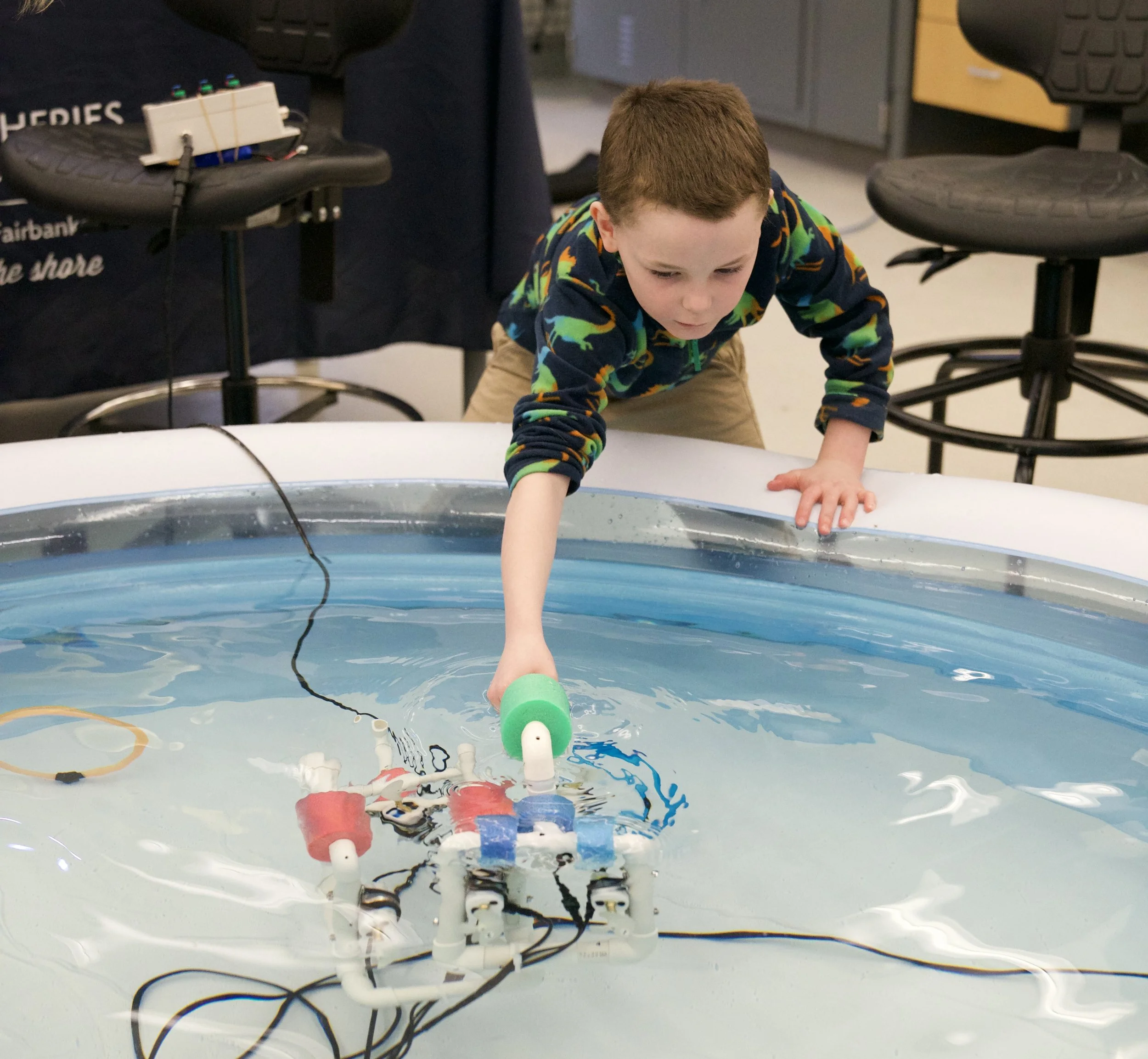
Photo by Lizzy Hahn.
Eight year old Thomas Lohse pulls out his self built rover at the College of Fisheries and Ocean Sciences station.
The event brought a live DJ, DJ Siren, a photobooth-– sparkly background, silly props, and photos printed within minutes. Attendees could try building gumdrop bridges, see 3D-printed concrete, and be part of wind tunnel demonstrations, Lego builds, rocket launches, and autonomous underwater vehicles.
Eight-year-old Thomas Lohse showed off his self-built rover modeled after a swordfish. “I had to readjust the motor and add some buoys so it wouldn’t tip over,” he said. “This is my favorite station, but I’m going to check out the other ones too.”
The open house also gave participants a chance to win door prizes and scholarships, including two $2,000 awards sponsored by Golden Valley Electric Association and Alaska 529. Free snacks and T-shirts were available while supplies lasted.
“This year, we have projects from multiple disciplines, including civil, aerospace, mining, and mechanical engineering,” Avery said. “It’s a great way for visitors to see how these fields come together to solve real-world challenges.”