

Environmental journalist Nijhuis speaks on pluses and minuses of field, what is needed for future
By Jonathan Wasilewski
Michelle Nijhuis, an environmental journalist who has worn many hats over her career, gave a lecture on the positives and negatives of modern journalism and what is needed in industry.
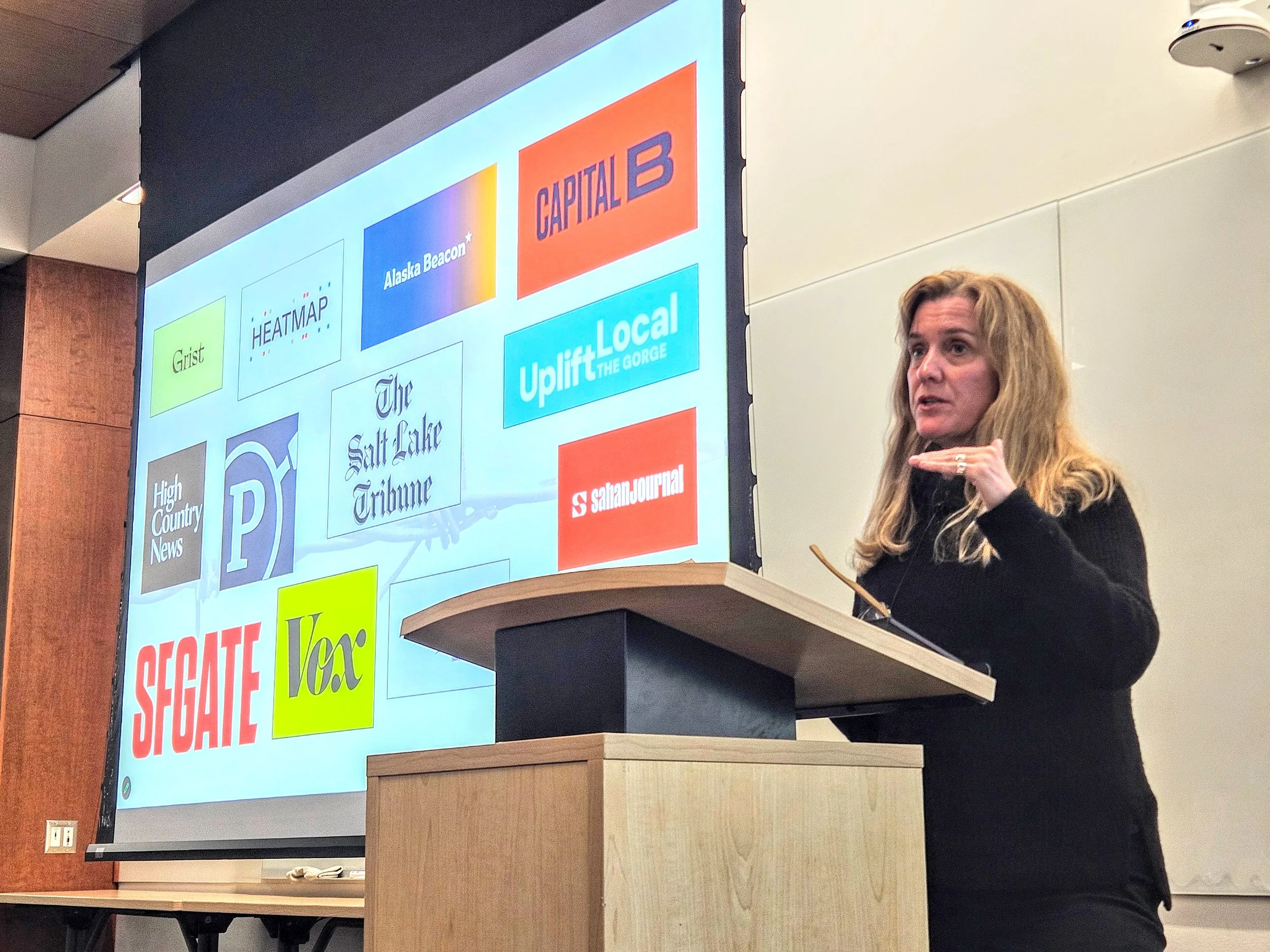
Environmental journalist Michelle Nijhuis speaks about news organizations Feb. 26 in the BP Design Theater.
On February 26 at 7 p.m. in association with the UAF Department of Science and Environmental Journalism and the Snedden Chair lecture series, the public was invited to attend Nijhuis’ lecture in the BP Design Theater on the University of Alaska Fairbanks campus. The theater was filled with enthusiastic, smiling guests.
Nijhuis obtained an undergraduate degree in biology from Reed College in 1996, and spent some time working as a field biologist. After realizing that she did not have the same focus for scientific questions as her bosses, Nijhuis obtained an internship and then a job with High Country News, an independent magazine based in Colorado, in 1998.
Nijhuis still freelances for High Country News and is a contributing editor although she has dabbled in other publications, including National Geographic, Scientific American, Nature, Audubon and Orion. In 2021, Nijhuis published a book titled “Beloved Beasts: Fighting for Life in an Age of Extinction.”
Environmental journalism was “love at first draft” for her. She enjoyed talking to a “diversity” of people about many questions, and was able to knit questions together into a story.
Nijhuis spoke on the state of the journalism field when she started versus today.
When she began at High Country News, Craigslist was just a few years old and it was already disrupting classified advertising revenue for newspapers. At journalism conferences, she noted, there would be a “whole generation of people” mourning their colleagues who had left the profession or were laid off. Her “mirco-generation” of journalists were the first to start work knowing that they would probably not retire at the same publication. For many decades prior, she said, working at the same publication was typical.
“Journalism paths were new and uncertain,” she said.
Nijhuis also talked about the plusses and minuses of today’s journalism. One conclusion was that the journalism industry is still being disrupted by new technology and is now just more flexible and less afraid. She said that current worries lie around the topic of AI, not about Craigslist.
She mentioned that disinformation is now spread not just by manufacturing and industry but by friends and neighbors through social media. According to Nijhuis, people used the natural uncertainty of science to dispute climate change, and editors told journalists to illustrate both sides of a story. To satisfy editors, she said that the quick thing to do was to quote a climate denier and a climate scientist without context. The strategy planted doubt in the public’s minds.
“The only solace we have is that we’ve seen [disinformation] before,” she said.
Nijhuis noted multiple times in the talk that environmental stories are depressing to many and are seen as slow emergencies.
However, she said that there is more good news than people think. Covering environmental stories, which are urgent, she told the crowd, gives a sense of purpose.
One major plus Nijhuis noted is that the environment is no longer combined into a single beat. In the journalism world, a beat is a specific genre that focuses on an issue, sector, organization or institution over time.
“The environment is part of the sports beat; it’s part of the business beat; it’s part of the style beat,” she said. “Anything you can think of has an environmental or climate change angle to it.”
Other positives Nijhuis mentioned about the state of journalism included the variety of media types environmental stories are told in, journalists being savvier about misinformation, citizen reporting by new organizations like Uplift Local and publications by ProPublica that have kept investigative journalism alive.
Nihjuis mentioned things that are needed now in journalism. One included fewer stories about individual heroes.
“People are dependent on other people,” she said. If the stories were widened, they would show the people others rely on.
Nijhuis said that longer attention spans for both media and consumers, better pay for journalists and overall having more journalists could help the industry as a whole.
“Journalism is never boring,” Nijhuis said. “That’s what keeps all of us going.”