

The Good, the Bad and the Toxic: Navigating Alaska’s Mushroom Season
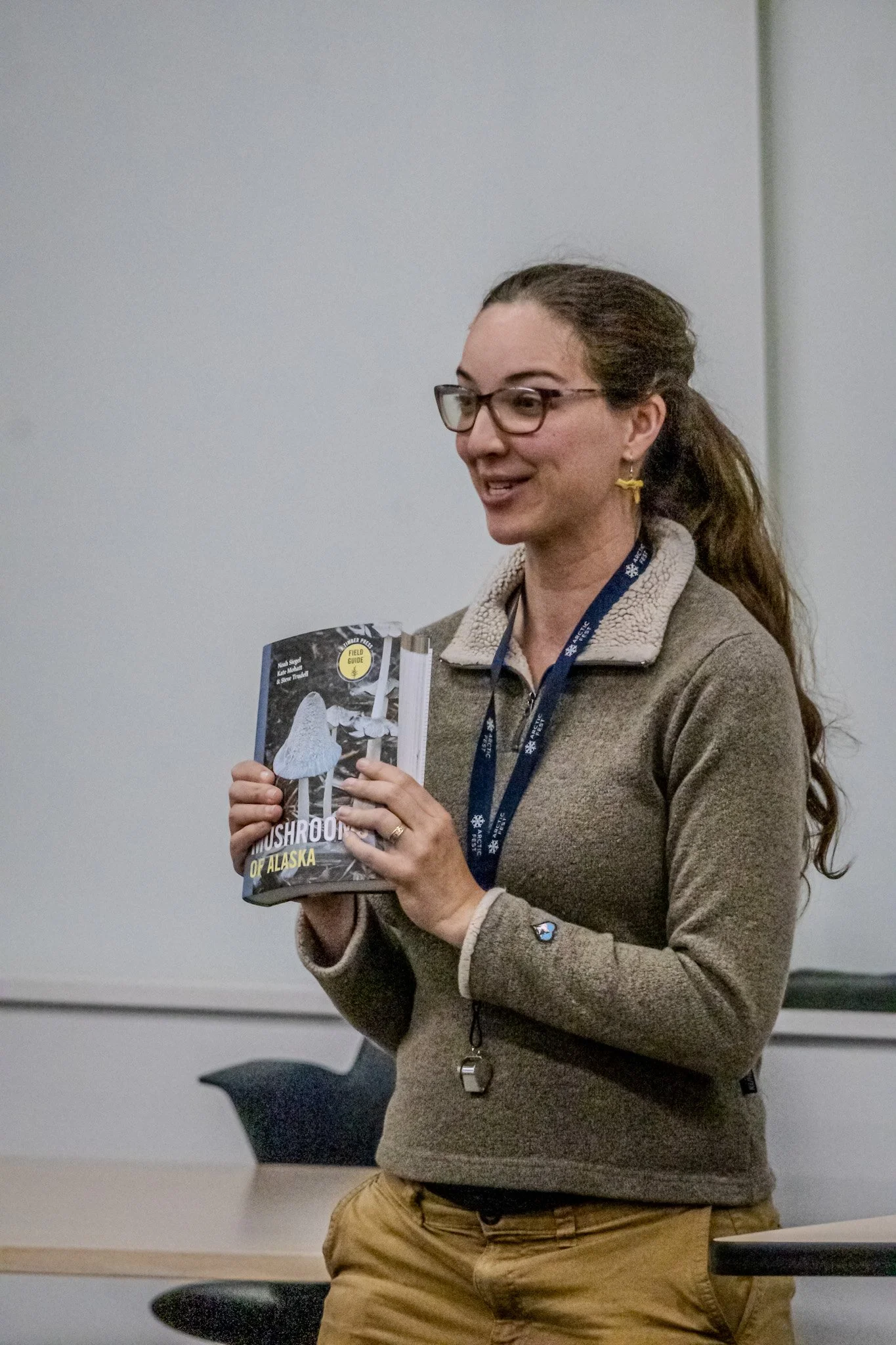
Photo by David McCain
Local mycologist Christin Swearingen gives the crowd a taste (not literally!) of “Mushrooms of Alaska” before handing it over to the “fun guy” of the night, Noah Siegel during the Fairbanks Fungi Festival pre-event lecture held in Murie Auditorium on Aug. 22, 2025.
By Amber McCain
Mycologist Noah Siegel, co-author of “Mushrooms of the Redwood Coast” and a nationally recognized fungi expert, spoke to over 100 attendees at the University of Alaska Fairbanks’s Murie Auditorium on August 22, 2025. His free public lecture, held ahead of the annual Fairbanks Fungi Festival at Ester Park, urged both novice and seasoned foragers to tread carefully during what he called “a prolific mushroom season” in Alaska.
With a slideshow projected behind him, Siegel guided the audience through a colorful tour of Alaskan fungi, from prized chanterelles and polypores to obscure coral fungi and the little brown mushrooms.
“Don’t eat the little brown mushrooms,” he said bluntly. “It’s a good rule. That one mistake could ruin your day, or worse.”
Siegel emphasized that safe mushroom foraging requires a hands-on approach.
“There’s no substitute for cutting a mushroom in half, checking the gills, smelling it, even tasting a bit, without swallowing,” he said. He explained that flavors, whether peppery, bitter, or fishy, can act as a useful field diagnostic tool.
He also addressed some regional specifics: chicken of the woods remains rare in Interior birch forests, while blue chanterelles thrive in the wetter Southeast. Still, he urged caution even with familiar-looking species, pointing out that coral fungi and false morels, both common in parts of Southeast Alaska, can be dangerous.
“False morels, definitely a good idea not to eat,” he cautioned. “They can be brain-shaped, spring-fruiting, and toxic. Easy to misjudge.”
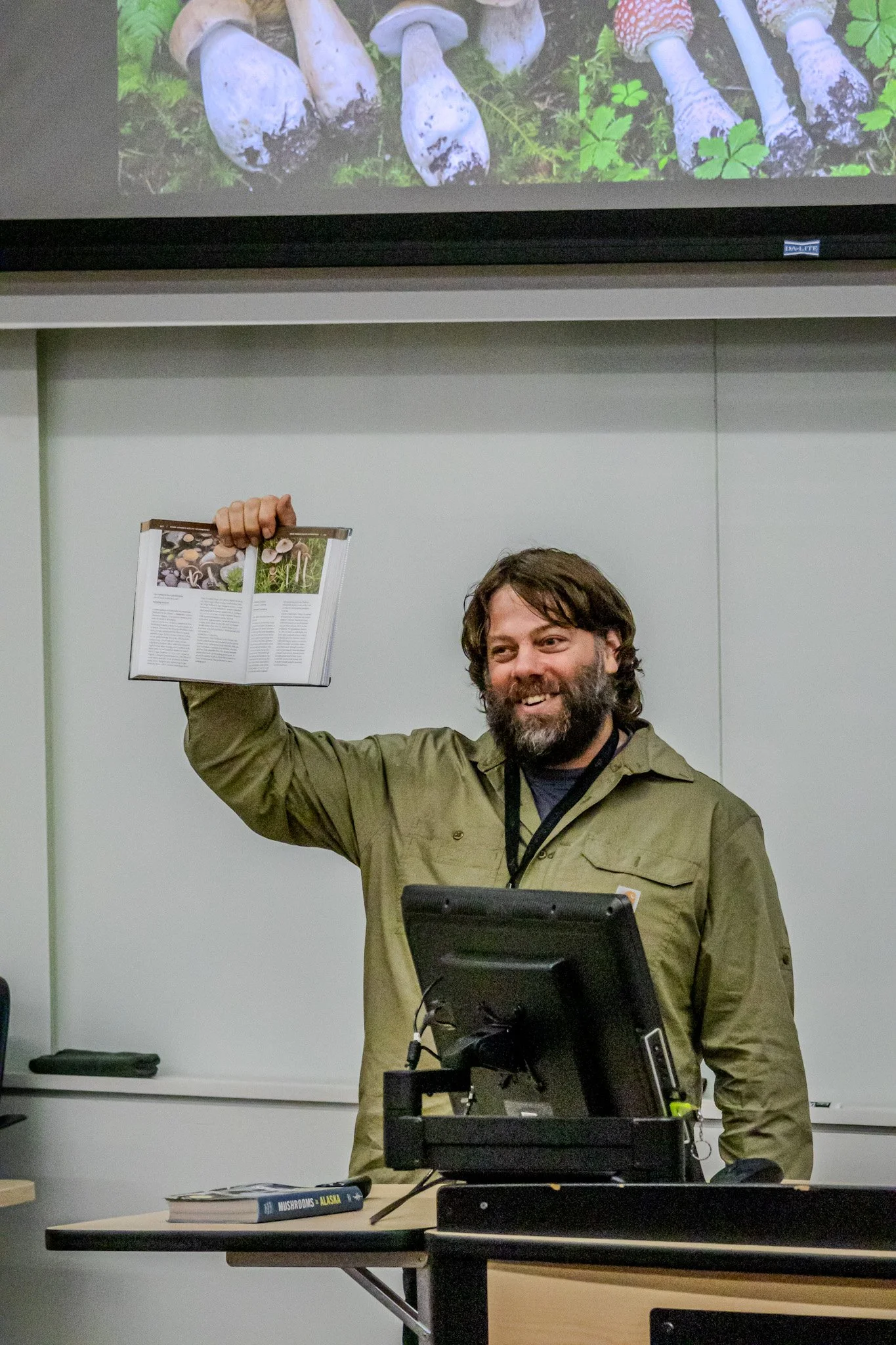
Photo by David McCain
Noah Siegel’s spore-tacular lecture in Murie Auditorium brought fungi fans to UAF for a deep dive into Alaska’s mushrooms, the good, the bad and the toxic.
Siegel also touched on the artistic and cultural uses of fungi. Certain dye-active mushrooms can produce brilliant purples or greens depending on the pH of the dye bath. Meanwhile, the increasingly popular chaga tea may be “palatable,” he said, but its health claims remain scientifically unproven.
“I’m skeptical,” he added, “but it makes a very good tea.”
Siegel also previewed his forthcoming book, “Mushrooms of Alaska”, co-authored with Steve Trudell and Kate Mohatt. The guide, scheduled for publication in October, compiles over eight years of fieldwork across Alaska’s diverse ecosystems and includes full-color images, identification tips, and regional notes.
“I know I’m an outsider writing this,” Siegel acknowledged, “but I know your mushrooms. And I want you to know them too.”
As the talk wound down, Siegel returned to his core message: that fungi are as fascinating as they are risky, and beginners should go slow.
“There are deadly mushrooms in Alaska. They’re rare. They’re brown. And you probably won’t recognize them unless you’ve trained your eye,” he said. “So go slow. Taste carefully. And maybe skip the little brown ones.”