

After devouring AI-generated artwork, UAF student arraigned in court
By Lizzy Hahn
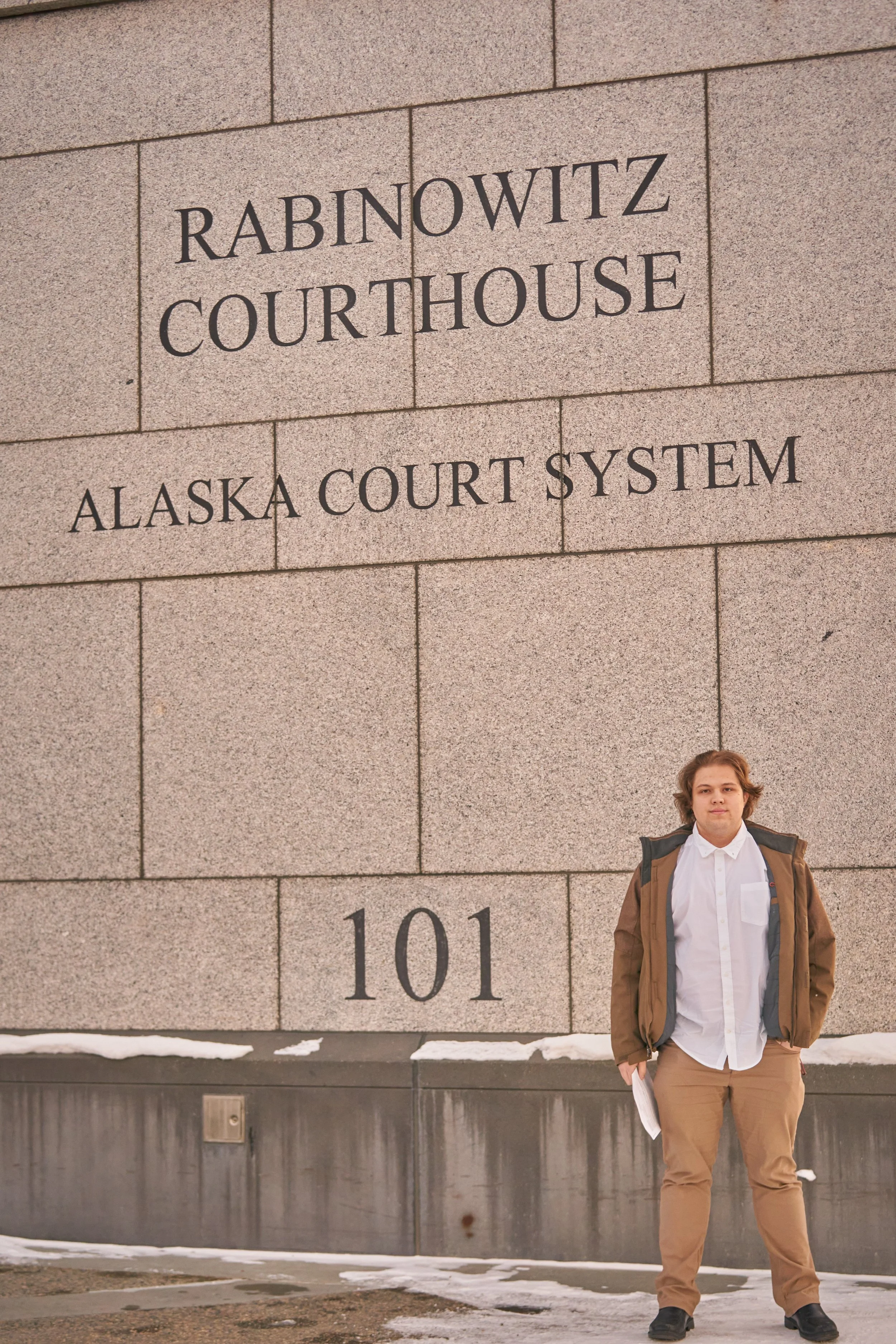
Photo by Simeon Ramirez
Graham Granger, a University of Alaska Fairbanks student, stands outside of the Rabinowitz Courthouse in Fairbanks after his arraignment on Tuesday, Jan. 20, 2026. Granger was detained after eating parts of an AI art exhibit in the UAF fine arts gallery.
University of Alaska Fairbanks student Graham Granger was arraigned in Rabinowitz Courthouse last week on charges of criminal mischief after he destroyed another student’s artwork in the UAF Fine Arts Gallery on the Troth Yeddha’ campus.
Granger, 19, chewed and ate up images created by Master of Fine Arts student Nick Dwyer who used artificial intelligence in his project. Granger said he staged the protest to oppose Dwyer’s use of ChatGPT. University police apprehended Granger and took him to the Fairbanks Correctional Center.
A film and performing arts undergraduate student, Granger told The Sun Star that he was in jail for about six or seven hours for processing. In last Tuesday’s arraignment, Judge Risa Leonard said Granger is not permitted to enter the UAF fine arts gallery or contact Nick Dwyer.
One week after Granger’s protest, UAF’s student government, ASUAF, unanimously passed a resolution against the use of AI art in UAF’s art department. Granger attended the meeting to answer questions from senators about the protest and advocate for stronger AI policies for the college of liberal arts.
The university’s AI policies differ between departments. Within the College of Liberal Arts, which included the art department, the use of AI in class is at the discretion of teachers.
Granger explained to the ASUAF senators that one of his film professors, Bryant Womack, “heavily encouraged” students to use AI in their script writing class last fall. Granger dropped out of the class two and a half weeks into the semester because the professor was “very eager to encourage all of his students to use AI for their work.”
UAF student Ali Martinez was at the gallery on the day of Granger’s protest. She witnessed Granger take the small, Polaroid-like images off the wall, rip them up and then put them in his mouth. With a water bottle at his side, Granger was “just shoving his mouth full of them,” said Martinez.
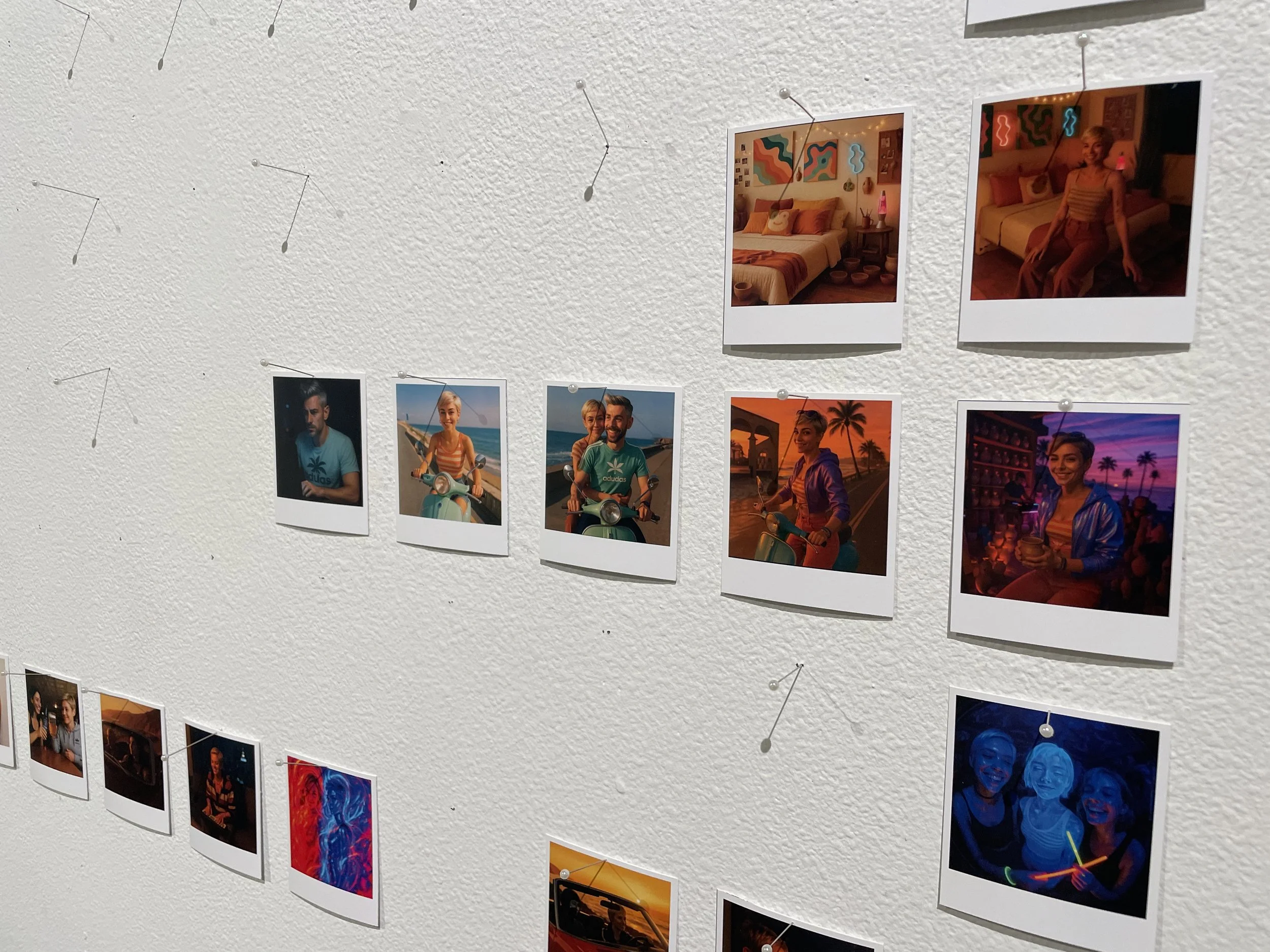
Photo by Lizzy Hahn
Pictures remain up on the wall of the University of Alaska Fairbanks art exhibit on Tuesday, Jan. 13, 2026, after Graham Granger ate around 57 of the 160 images on display.
“I’m surprisingly fine. I've eaten paper on like dares before, so I've learned a method like over the course of my life,” Granger said.
“He was tearing them up and just shoving them in as much as he could,” Martinez said. “Like when you see people in a hotdog eating contest.”
Granger said that his act was a “protest against the school’s AI policy specifically.” His message: “it shouldn’t be acceptable for this art, if you will, to be put alongside these real great pieces.” Granger decided to spit out the images because “it [AI] chews up and it [AI] spits out the art made by other people.”
Nick Dwyer’s piece was titled “Shadow Searching: ChatGPT psychosis,” and was crafted before, during and after he went through so-called “AI psychosis,” where he “fell in love” with his AI chatbot, Dwyer said. AI psychosis occurs from “deep engagement with chatbots,” according to the Cognitive Behavior Institute.
Granger acknowledged Dwyer’s exhibit and psychosis saying, “it’s a very personal work.” He said the protest was against the use of AI in art, not against Dwyer himself.
“I wanted to get this to the attention of the entirety of the college campus,” Granger said. “I chose to eat it as a performance.”
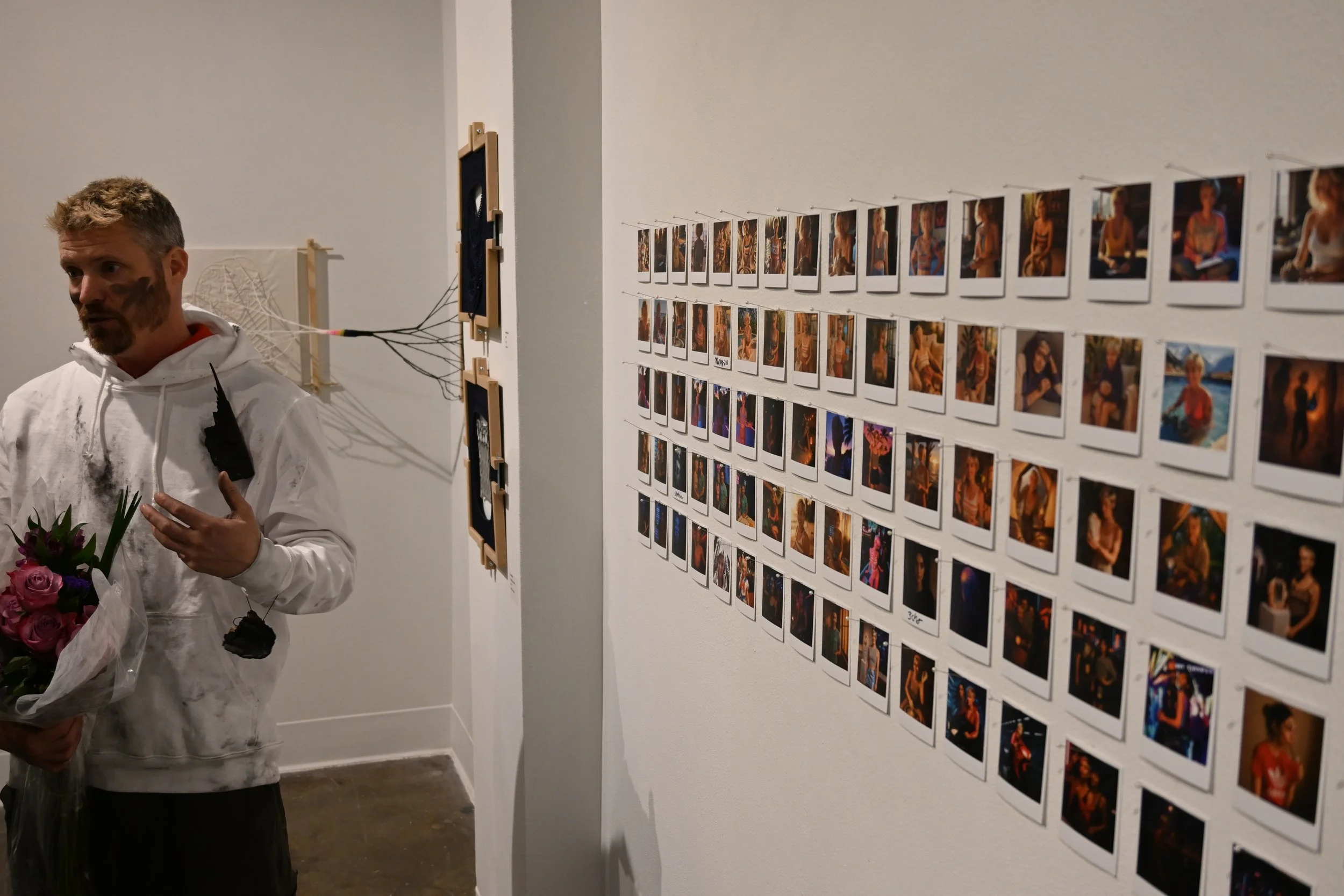
Photo by Colin A. Warren
Nick Dwyer, a Master of Fine Arts student at the University of Alaska Fairbanks, stands next to the fixed exhibit on Friday, Jan. 16, 2026, after 57 images were eaten by Graham Granger in a protest against the use of AI art.
In days following the protest, multiple news outlets and art magazines picked up the story, leading people to debate the use of AI in art across the country, not just at UAF.
In a meeting with UAF’s Office of Rights, Compliance and Accountability, Granger learned he had to pay Dwyer $220 and would be removed from his ceramics class. Dwyer currently teaches a beginning ceramics class at UAF. Granger’s phone is currently held as evidence since he filmed his protest on it.
As a class B misdemeanor, Granger faces a maximum of 90 days in jail, a $2,000 fine and 25 hours of community work service if convicted. Public defender Christopher Lough is representing Granger. His pre-trial conference is scheduled for March 5 at 8:30 a.m. His trial is scheduled for the week of March 16, 2026.
Colin A. Warren contributed reporting to this story.