

Alaska Native Language Center exists in name only as languages face extinction
By Amber McCain
This article was temporarily taken down to allow for additional reporting and fact-checking after receiving responses from the University of Alaska Fairbanks. It has now been updated with new context from both UAF administration and current and former faculty. We removed it briefly to ensure accuracy and fairness, not to censor reporting, and will continue to provide full, transparent coverage of the Alaska Native Language Center.
Please scroll down to see an updated response to UAF’s assertions about the center.
Original story:
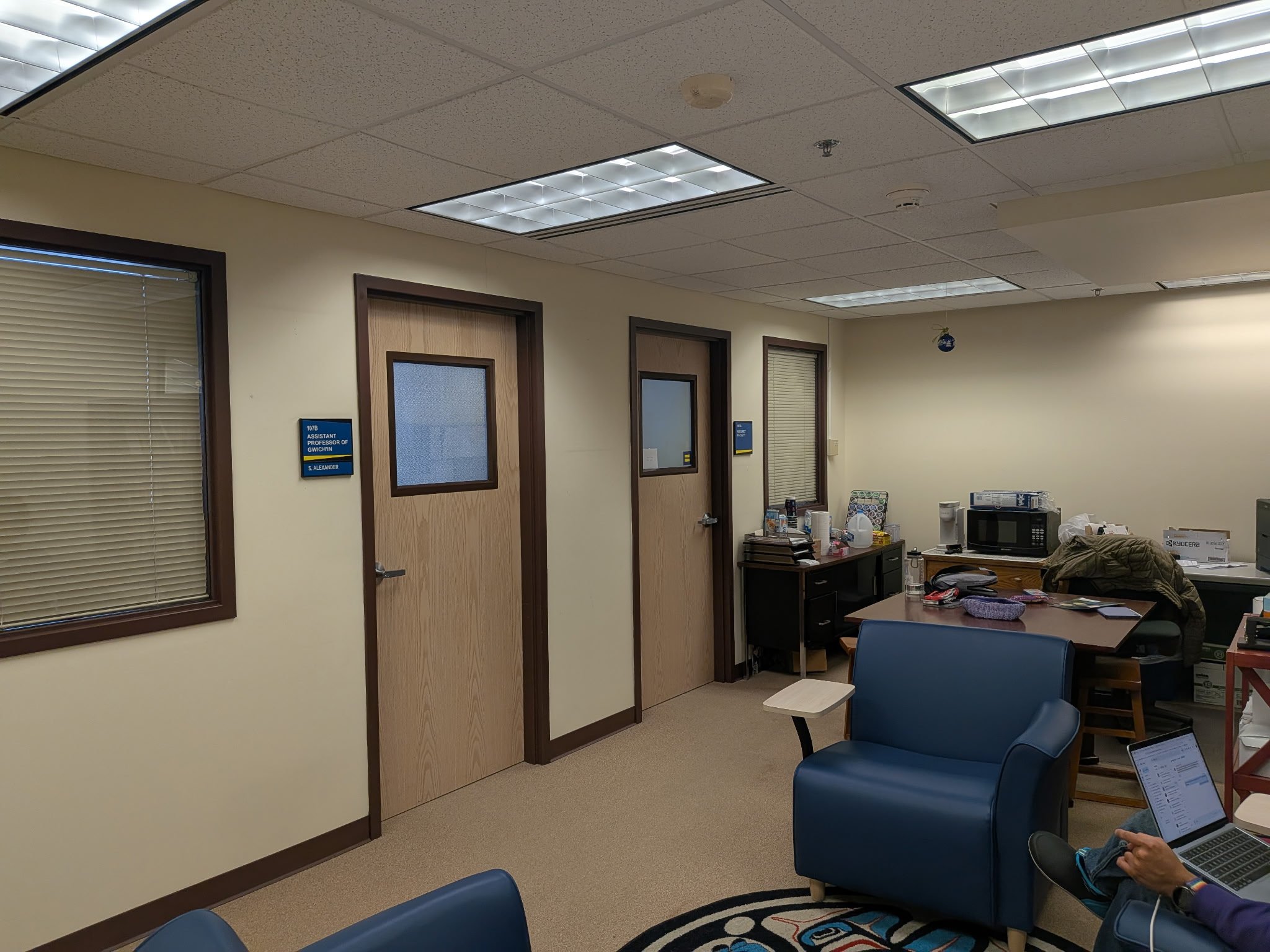
Photo by Fin McCain
The Alaska Native Language Center offices are located on the first floor of the Brooks Building, March 19, 2026.
After more than 50 years of preserving Alaska Native languages, the Alaska Native Language Center now faces budget cuts, staffing shortages, and a gap in leadership. These challenges threaten decades of progress in the efforts to preserve languages on the brink of extinction.
“ANLC is an empty shell. It exists in name,” said Professor Anna Berge, the center’s only remaining full-time faculty member. “We have done an amazing job of upholding the mission that the legislature put forward, but we can’t do it without being valued and supported.”
Established in 1972 by the state of Alaska, the ANLC’s mission is to study, preserve, and revitalize Alaska Native languages. It is legislatively mandated to document languages, develop literacy materials, assist in translations, promote Alaska Native literature, and train speakers to work as bilingual teachers.
The center operates within the University of Alaska Fairbanks system and is administratively housed under the College of Indigenous Studies, or CIS, which oversees Indigenous and rural academic programs and student services such as Rural Student Services. Because ANLC is part of CIS’s structure, decisions about staffing, funding, and administration directly affect its ability to carry out its mission.
Sam Alexander, assistant professor and department chair of the ANLC, said that recent cuts threaten the center’s ability to achieve its goals. “If ANLC publications goes away, then our ability to develop literacy materials and provide for the development and dissemination of Alaska Native literature is gone. We just can’t do that,” he said.
The center has no researchers heading into the fall semester, and few qualified candidates exist to fill the roles, Alexander added. “For Dene languages, there’s probably 10 specialists in the world, and of those, maybe three are under 50.”
This shortage has made it difficult for faculty to offer language instruction. “When I teach, I develop all my own materials, and I also have to figure out the grammar myself, with the support of our in-house linguists,” Alexander said. Without trained research staff, developing comprehensive teaching materials, especially for complex languages like Dinjii Zhuh K’yaa (Gwich’in), becomes a huge challenge.
Short-term relief has come in the form of temporary extensions for two staff positions. After an op-ed in Anchorage Daily News, the publisher position was extended through December, and the one remaining research staff member received an extension as well. After that, the research staff member will need to secure grant funding to continue. Meanwhile, CIS is currently advertising a new paid administrative position.
Alexander also raised concerns about the ANLC website, which the center does not control. It inaccurately lists languages that haven’t been offered in years. “It says we teach Unangam Tunuu. That’s completely incorrect. We haven’t taught it in at least a decade,” he said. “The person on staff who does know Unangam Tunuu has never taught it, and she’s been here for 26 years.”
He also expressed frustration over adjunct faculty, particularly those teaching Yup’ik. “We have some adjuncts teaching Yup’ik, and CIS will not offer them full-time faculty roles, even though that’s our largest language in terms of number of students,” Alexander said.
The ANLC has been without a director since 2022, leaving the center without a strong advocate for its needs. “If we had a director, they could fight for us. But I’m a department chair, and raising money isn’t part of my job. The director is external-facing; they’re the ones who can search out funding and build partnerships,” Alexander said.
Berge explained that teaching Alaska Native languages without sufficient research support is daunting. “If you’re not a native speaker and you’re trying to teach the language, you have no existing knowledge of how the language works, and you are going to need learning materials. It took me 16 years of documenting Unangam Tunuu to create learning materials from scratch, and five years working on existing learning materials of Alutiiq to create a resource grammar. This is the level of work that teachers need for endangered languages.” She added that the center has been “functionally closed,” talking about how staffing cuts and administrative changes have eroded ANLC’s ability to fulfill its mission.
Teisha Simmons, dean of CIS, pushed back against rumors about the ANLC’s future. “I just want to be really clear that we are not making any plans for significant reductions in positions or offerings at the Center for Alaska Native Languages,” she said. Despite public speculation, Simmons said, the center is committed to expanding offerings, including meeting the needs of local communities and stakeholders.
“We’re still making plans for the 2026–2027 academic year,” Simmons explained. “ I can assure you that we are not reducing staff or cutting programs. We’re actually looking to expand.”
Simmons said the center is modernizing its materials distribution by partnering with the University of Press Colorado, making books, maps, and other resources easier to access. ANLC continues documenting elder speakers, developing literacy materials, and supporting translation efforts, keeping these efforts aligned with its mission.
Former UAF faculty member Gary Holton, author of the opinion piece, now at the University of Hawaii, expressed concerns about the long-term effects of cuts. “The foundation that ANLC provides is essential to the ongoing efforts to revitalize and preserve Alaska Native languages,” he said. “We have seen significant progress across the state, but that progress is only possible because of the resources ANLC has provided.”
Holton warned that without a strong ANLC, years of progress could unravel. “If we lose that support, we may not see the immediate effects, but eventually things will fall apart. It’s akin to cutting funding for the National Science Foundation; over time, you lose the ability to innovate and support critical work.”
Alexander is calling on students to take action. “If we want to show that we truly value our Alaska Native languages, then the university needs to put its money where its mouth is. Students should demand that the state put this into law. The state created the ANLC because the people of Alaska demanded that there be an Alaska Native Language Center,” he said.
He stressed that students influence the center’s future. “Students have power. If they want these languages to survive, they need to demand the support we’re not getting. It’s not enough for the university to say the center is still open, we need action.”
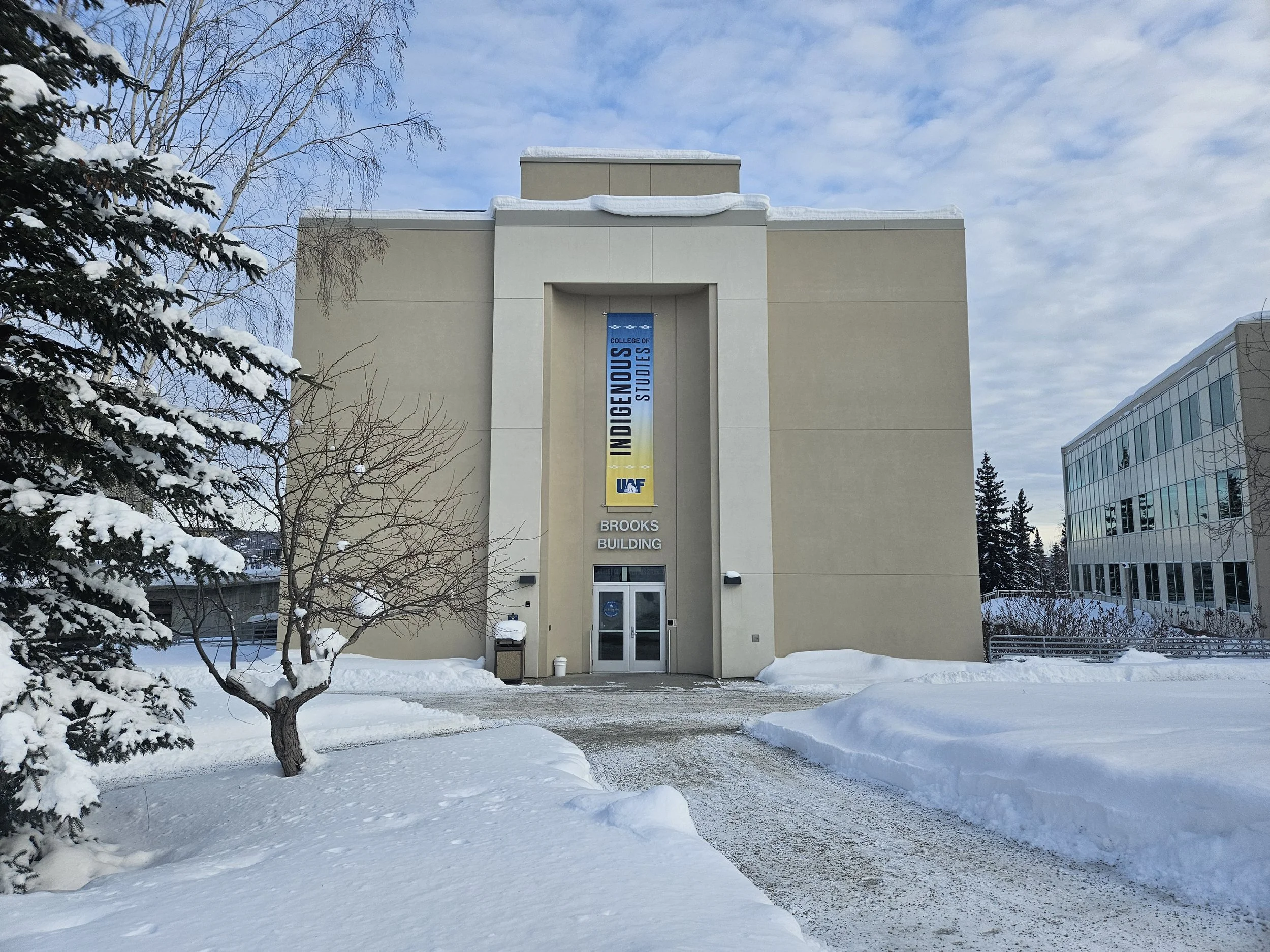
Photo by Jonathan Wasilewski
The Brooks building houses the College of Indigenous Studies, on February 17, 2026.
Update as of March 22, 2026:
Since this story was first published, the University of Alaska Fairbanks has disputed several claims including descriptions of staffing levels, budget changes, and the center’s leadership.
Mike Sfraga, interim chancellor wrote in an email March 19:
“The Alaska Native Language Center is not closing, nor is its capacity being reduced. Today, the center has two tenured faculty members, one tenure-track faculty member and two term faculty members. Additionally, three staff members and a team of adjunct professors conduct and support research and offer courses spanning at least a half dozen languages. ANLC’s work must continue. I agree. It must continue. It will continue. That is a commitment from me and from this institution.”
“Faculty are demoralized, afraid to speak, and losing rights and autonomy,” Berge responded. “The university is putting on a misleading public face.”
Marmian Grimes, UAF communications director stated: The ANLC currently has five full-time tenured or tenure-track faculty members. University officials also said the center has not experienced budget cuts and has seen overall funding increases over the past decade. However, the projected FY26 budget is currently reduced by more than 15% from FY25 budget; the university chalks that up to “expenditures” and retirement and they committed to raising ANLC’s FY27 budget.
Grimes also asserted that the ANLC was led by a director until spring 2025.
Walkie Charles, ANLC’s most recent director, clarified via email that he served as director from July 2021 to 2023, then as interim director until 2024. Since August 2024, he holds the title of Faculty Fellow of Indigenous Language Revitalization and no longer performs administrative duties. Charles wrote that all substantive decisions during his interim period were made by university administrators, and the director position officially remained unfilled despite two qualified applicants. He described his departure as stemming from “subordinate treatment from the administration.”
Grimes said UAF is not planning to hire a new director for the center.
University officials defended the center’s research capacity. Teisha Simmons, dean of College of Indigenous Studies, spoke on the value of applied, community-based work.
“Some might feel like we aren’t doing research per se the way that it has been historically done, in a more linguistic fashion,” Simmons said. She went on to say they value research that isn’t necessarily what she would call “traditional Western research” as it’s more applied and community-based.
Anna Berge explained the limitations on research due to teaching.“I am the only research faculty left. The difference is, my position is supposed to be 75% research and 25% teaching, but I am being pushed to teach three to four classes a year. Without full-time research-focused positions, the center’s ability to produce and sustain scholarly and archival work is being diminished”
Sam Alexander described the situation for endangered languages.
“Jason Harris, the only Dene language specialist in the Interior of Alaska, will not stay on after June. They offered him to stay until December, just to kick the can down the road, and he refused. Anna Berge, another researcher, is being pushed toward retirement and will not return unless ANLC moves. That leaves zero full-time researchers. The only remaining faculty technically listed for research is Chelsey Zibell, who has no prior research experience or linguistic training. Once Anna and I are gone in the fall, there will be effectively no research capacity left.”
Alexander added that adjuncts are filling faculty lines that have not been replaced, including full-time Yup’ik and Gwich’in instructors.
Regarding publications, UAF states “ANLC has a partnership with UA Press, which is part of a consortium of academic publishers under the umbrella of the University of Colorado. The ANLC editorial board will still exist. As you noted in the original story, the editor will still be on staff. The ANLC and/or the author (ANLC will make this decision) will retain copyright. The thing that is different is that authors and their work will have access to the larger distribution and marketing resources of UA Press.”
Employees of the center expressed disagreement with this statement about the new publishing agreement, citing a move towards for-profit publication is not in the interest of linguistic preservation.
The archives will be moved to be part of Rasmuson Library, creating barriers to accessing archived language materials for ANLC, according to Alexander.
Alexander also contested UAF’s budgetary claims stating that “even if the university claims funding is sufficient, we don’t control or have access to it.”
Berge also spoke about ANLC’s budget saying the center has not had access to their own budget for years. “We have been controlled and dismembered by CIS.” Berge added that “state-mandated funding for ANLC is not reaching ANLC directly from the university.”
Regarding Unangam Tunuu, UAF stated the language would be taught in the fall. Berge clarified “Back about a month ago, the Dean of CIS had a long talk with me about my workload. I was being pushed to become more of a teaching faculty.” Berge declined to teach, agreeing to create materials to support teaching, but not teach the language herself. “I am not a qualified language teacher. The university later changed the ANLC website to say we teach UT, which is factually incorrect. ANLC does not control its own website or messaging.”
Alexander also spoke on staffing shortages and the limited pool of qualified candidates for endangered languages. He added that without trained research staff, developing comprehensive teaching materials becomes a huge challenge and that “maybe three of the 10 remaining Dene language specialists are under the age of 50”.
Alexander added, “If we’re not doing research, we are functionally closed. Keeping a few classes on the docket does not make us a functioning language center.”
Faculty stressed that while community-based work is important, it does not replace dedicated research roles focused on linguistic analysis, publication, and long-term documentation, the foundation upon which ANLC was originally built. They said vacancies, short-term contracts, and administrative decisions continue to affect the center’s ability to fulfill its mission.
Alexander said there has been retaliation from CIS. He has been non-retained. He stated Walkie Charles was pushed out and other faculty are afraid of retribution. “Leadership here is bullying,” he said.