

Hardscrabble Holmes takes back-to-back Iditarod wins
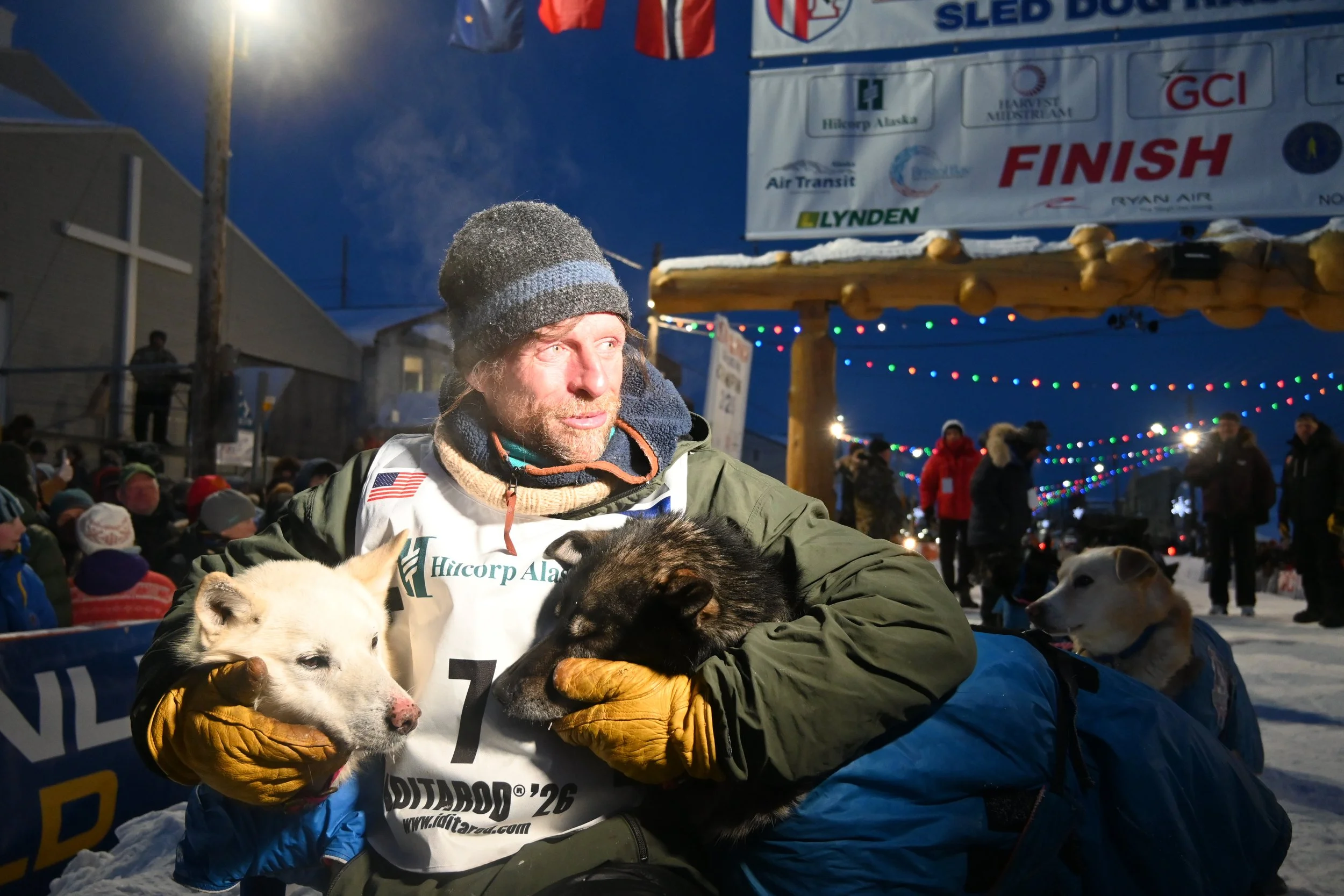
Photo by Colin A. Warren Jessie Holmes holds his lead dogs, Polar and Zeus, at the finish line of the 2026 Iditarod on March 17.
By Colin A. Warren
When Jessie Holmes won his second Iditarod tonight, the year after he won his first championship, he achieved a feat only matched by race legends Susan Butcher and Lance Mackey.
“We’re blessed, grateful,” Holmes said with a windblown face, drooling, as he kneeled to kiss his dogs. “I want to cry so bad. I’m so happy.”
His team of 12 dogs-– led by Polar and Zeus —crossed under the burled arch in Nome in 9 days 7 hours 32 minutes. Dusk settled over the dynamic blue sky as the crowd chanted “Jessie, Jessie, Jessie!”
Holmes, 44, famous as a reality tv star from the show “Life Below Zero,” was born and raised in Alabama. He has spoken in the past of his troubled youth and he said tonight he hopes that his work ethic and success can inspire others that come from a hardscrabble life.
“It doesn’t matter where you start, it matters where you finish,” he told the crowd after his victory. “Never lose hope and always push forward.”
After his lead dogs were garlanded with traditional yellow roses on the winner’s podium, and he was handed an $80,000 giant winner’s check, he took time to meet with local kids that were all yapping his name in admiration, hoping to steal the champ’s attention for a moment.
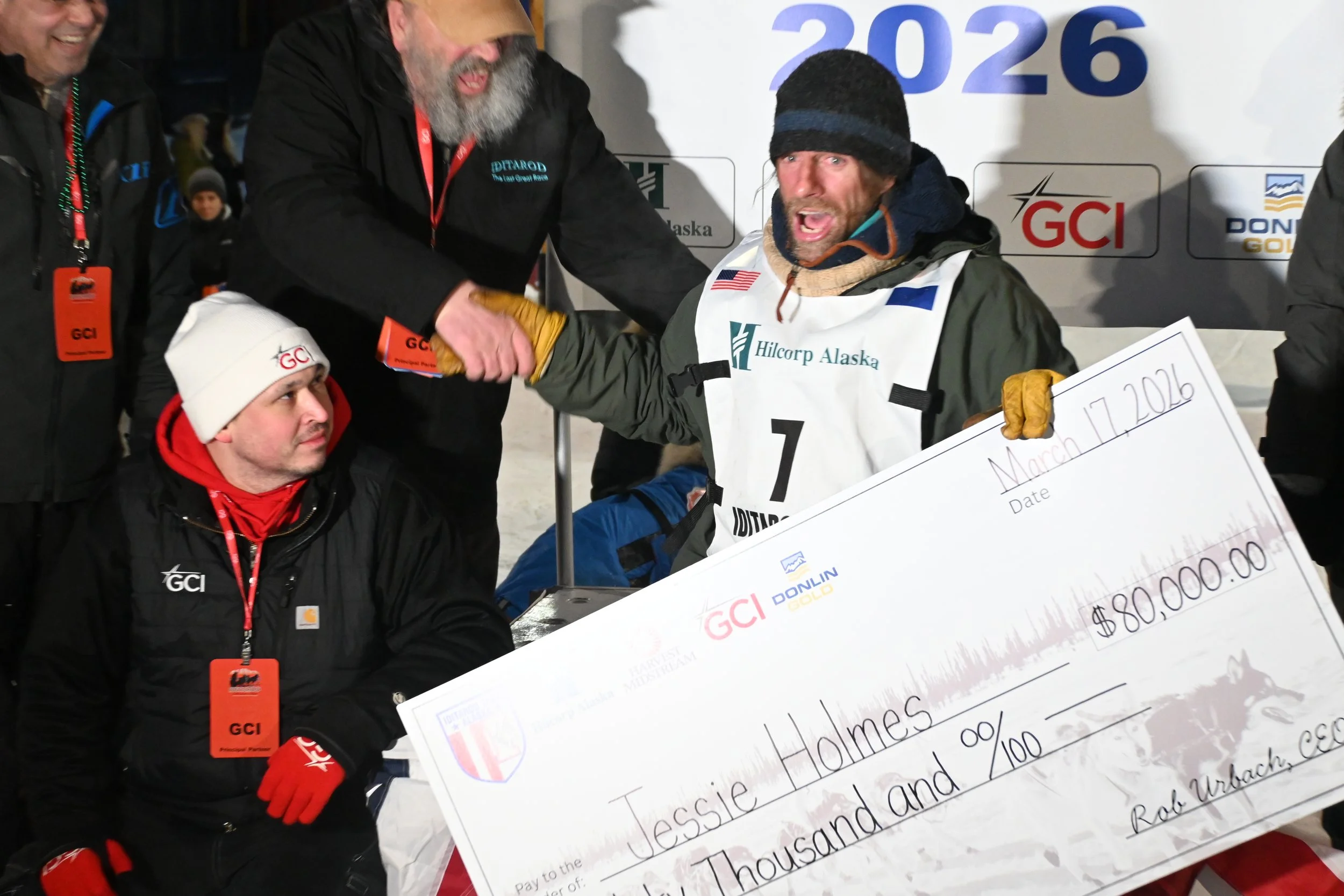
Photo by Colin A. Warren Holmes excitedly accepts his giant winner’s check.
The purse was enlarged significantly this year— up from $57,300 last year —because of Norwegian billionaire Kjell Inge Røkke.
Røkke entered the race in the first ever “Expedition Class.” He was not required to qualify for the race in the traditional manner, nor did he have to follow the trail rules that all competitive mushers must follow. Røkke gave over $300,000 to the Iditarod to enter the Expedition Class; the funds were split between increasing the purse, lessening the entry fee for competitive mushers, and donating dental work to children for every village that the race passes through.
Holmes moved to Alaska in 2004. While he originally began mushing as a means to run trapline in the Interior, he has dominated the mushing scene the last two years. He lives and trains on his property in Brushkana. He ran his first Iditarod in 2018, finishing 7th, and he has raced every year since, always as a contender, usually finishing in the top 10.
Holmes took a commanding lead early in the race and never lost it. Along the trail, awards are given to the first person at the checkpoints, and Holmes swept most of them, winning $5,500 in gold nuggets, $2,000 in fresh salmon filets, and a $2,500 check.
“I win the race by rest,” Holmes said in a post-race interview, explaining that lots of rest for his dogs is the best strategy.
He also said he doesn't care about legacy, even though he is already planning for a third win next year.
“I think [winning] is a bit more of a spiritual thing.”
Thirty-seven mushers started the race in Willow this year, taking the northern route through McGrath, Cripple, and Ruby before heading down the Yukon River to the coast.
As of Holmes’ victory late on March 17, only four of the 37 original mushers had scratched from the race. Rookie Jaye Foucher scratched in Rainy Pass. Jody Potts-Joseph, the first Native woman to run the Iditarod since 1993, scratched near Unalakleet, reportedly because several dogs suffered from kennel cough. Grayson Bunton, of Tok, scratched near Unalakleet as well. And veteran musher Mille Porsild scratched after a dog on her team died on the way to Elim.
Travis Beals finished second, arriving in Nome at 1:58 a. m. on March 18 looking dazed and happy. When asked about his mother passing this year he said she was with him on the entire trail. “I said, Mom, pretty good for your first Iditarod.” Beals was met by his wife and two children under the burled arch.
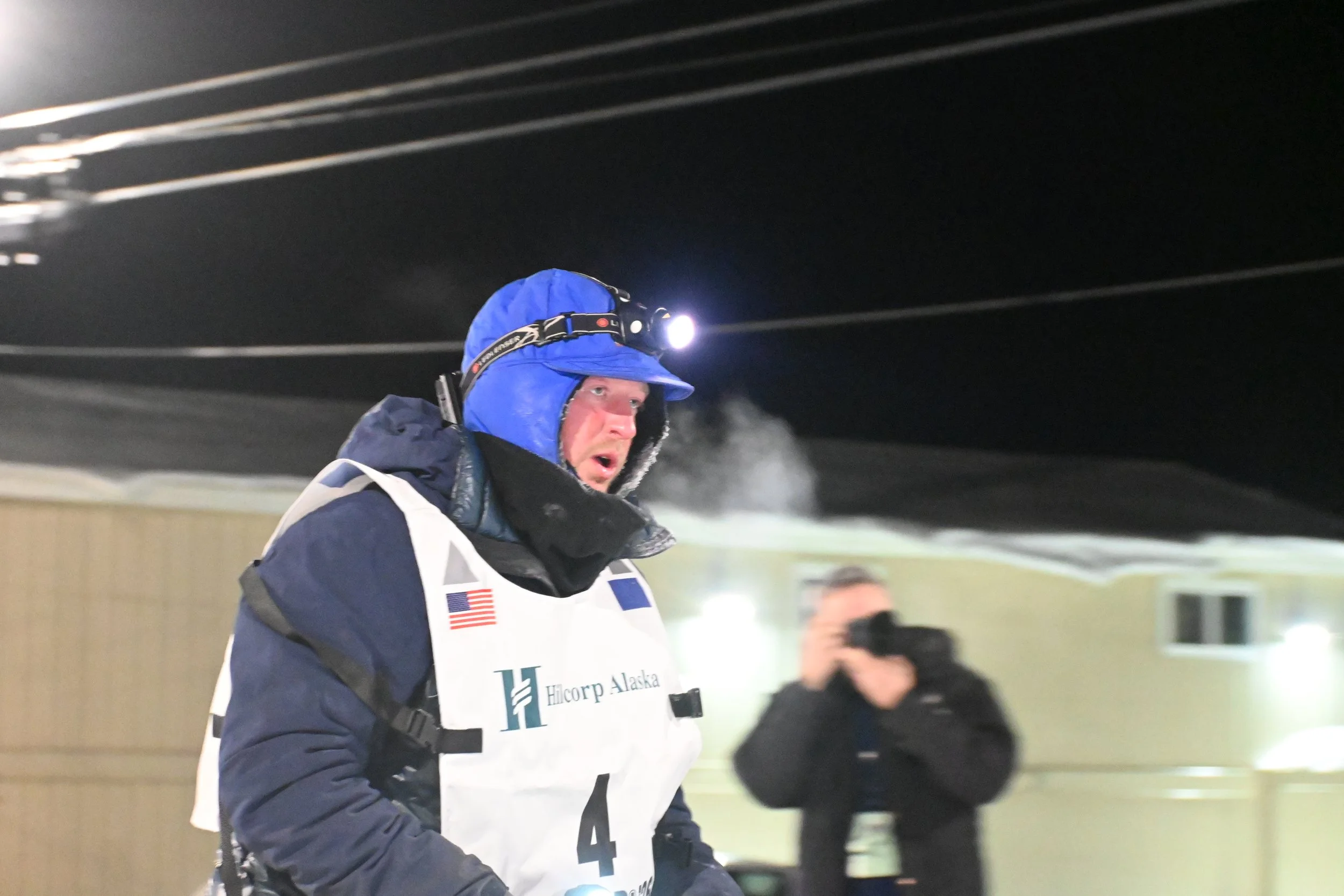
Photo by Colin A. Warren Travis Beals finishes the Iditarod in second place in nine days, 11 hours, 58 minutes, and 26 seconds.
Fairbanks-area musher Jeff Deeter finished third in nine days, 15 hours, 10 minutes, and 37 seconds. Paige Drobny was right on his heels, at least in mushing terms, finishing less than thirty minutes behind him coming in at nine days 15 hours, 38 minutes, and 48 seconds.
Matt Hall and Lauro Eklund, also Fairbanks-area mushers, finished in sixth and eighth, respectively
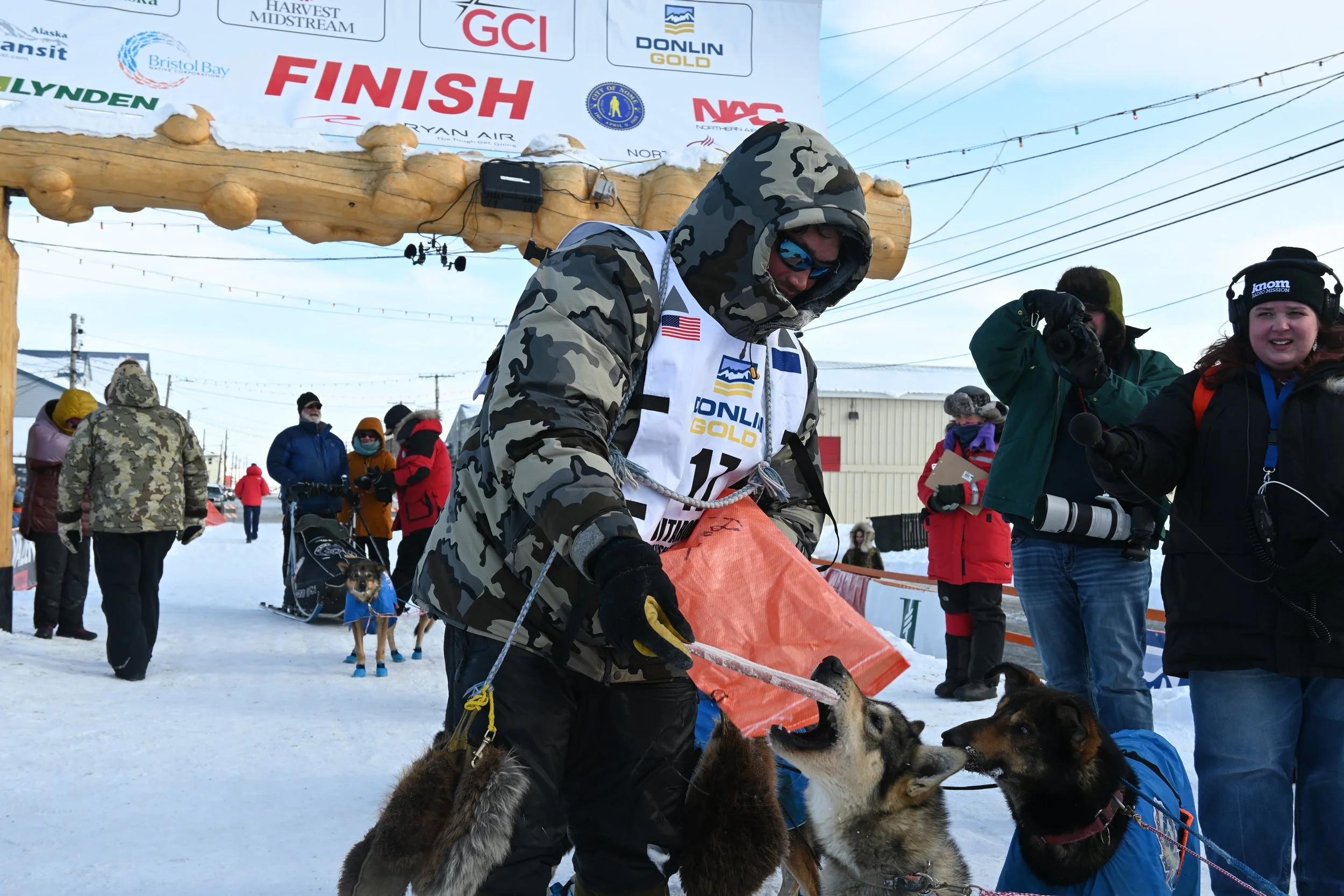
Photo by Colin A. Warren Lauro Eklund feeds his pooches a snack after finishing in Nome on March 18.
As of Wednesday night at 11:00 p.m. there are 13 mushers that have completed the race; there are still 17 mushers on the trail. There is a major wind event predicted for the last stretch of the race tomorrow Thursday March 19.
Check back in for updates to this story as more finishers reach Nome…