

UAF slashes Center for Teaching and Learning
By Anna Lionas/ Fairbanks Daily News-Miner
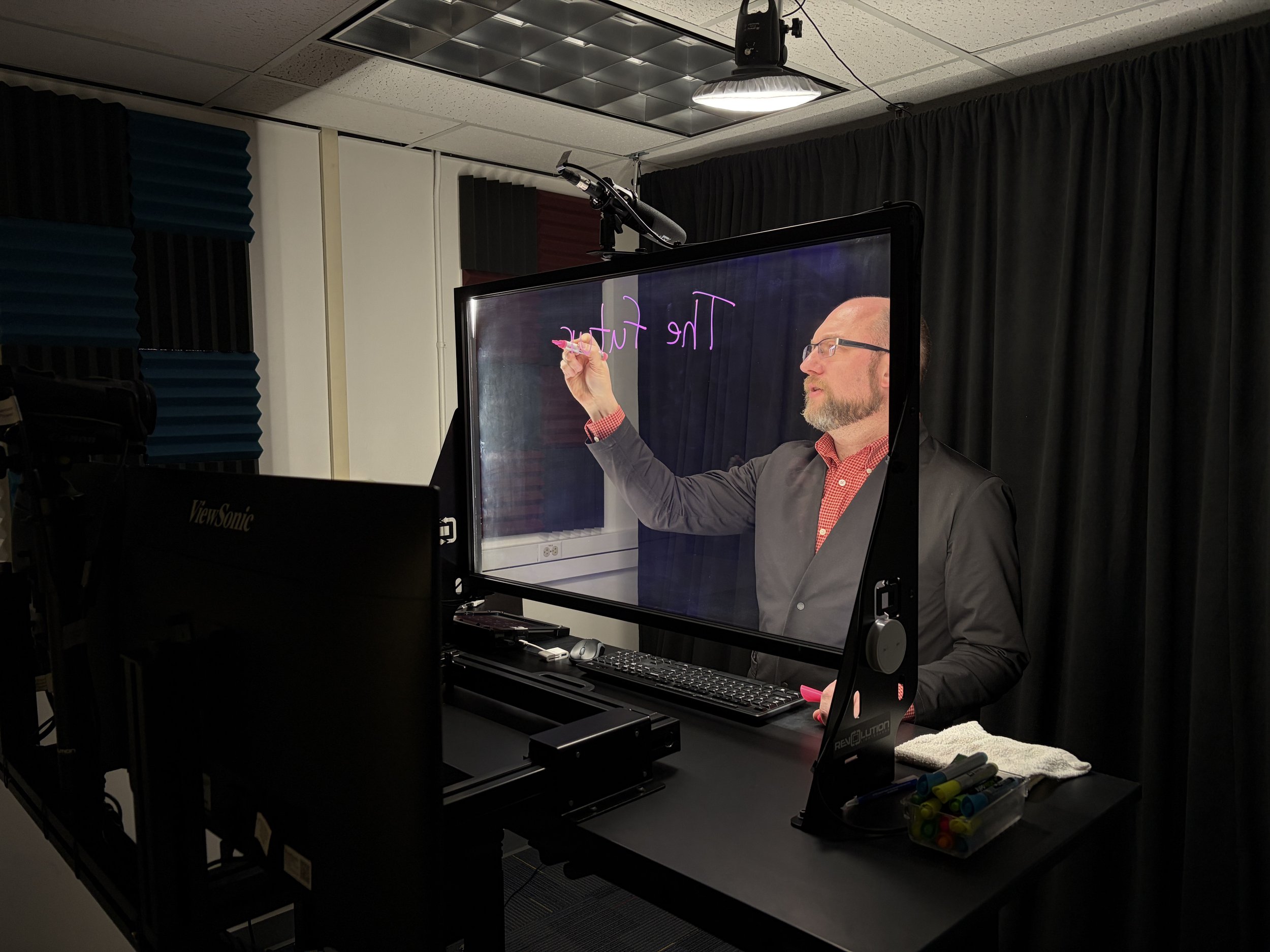
Photo by Anna Lionas/ Fairbanks Daily News-Miner
Sean Holland demonstrates the Learning Glass light board" room, a resource at the Center for Teaching and Learning's offices where faculty can record lectures with the help of CTL staff.
On Nov. 12 University of Alaska Fairbanks announced the reorganization of the Center for Teaching and Learning (CTL). It came as a shock to both CTL staff and the faculty who use them for a wide range of support services.
Over 120 faculty and teaching staff signed a letter to leadership expressing “significant concern, frustration, and outrage regarding the recent restructuring.”
In the aftermath it’s unclear if all programs offered will remain and, with 14 job losses and more staff leaving the university, where the knowledge and experience of the department will go.
What is/was CTL
CTL has been a part of UAF in many forms for decades as a support system for faculty and instructors, acting as scaffolding for the over 820 instructional workers. From setting up an online class, or holding workshops on burgeoning technology, to surveying students and building the feedback received into future curriculum, they were a one-stop shop for all things pedagogy.
They managed maker spaces, designed webpages, helped create course videos, provided best practices for using AI, and were on-call for pretty much any faculty need. Also the testing center for professional certifications was under CTL.
In 2020 when the Covid-19 pandemic hit and online classes were no longer an option but a necessity, CTL facilitated the transition training many faculty on how to continue their courses in a virtual setting.
“One of the things that I think both people who are initiating this reorganization and people who are sort of lamenting it can agree on is that our office did a lot of things,” said Sean Holland, formerly the CTL associate director of learning innovation. “...if not for us then it wouldn’t have been done.”
Years ago, under a different name, CTL developed the eCampus program, an online asynchronous education that offers over 60 degree program classes billed as in-state tuition. They also managed online synchronous classes. Over 70% of undergraduate students at UAF are enrolled in at least one online class.
This was how they received funding: every student who took an online class paid a fee though their tuition toward CTL. The funding evolved over time, but generally as tuition and enrollment increased so did CTL’s budget and they were able to hire more people to support not only the eCampus but operations as a whole.
Restructuring
One of the main reasons cited for the reorganization is the number of staff. Interim Provost and Executive Vice Chancellor Charlene Stern said the university looked at other institution’s models, including UA Anchorage which restructured their CTL years ago, and determined the department was too big.
“That really led to the decision to restructure it so that we could right size it and move some of those really critical resources to areas already within the institution,” Stern said.
When Stern was appointed to her position in May of 2025 she set out to cut the fat from departments across the university in anticipation of a decline in funding at both the state and federal levels.
“This was definitely one of the bigger restructures, and it also just reflects kind of where we're at as a university,” Stern said.
At the time of the restructure there were 26 people working at the CTL; administration billed it as a 31 person department but the five unaccounted for positions had either recently moved within the university or retired.
On Nov. 12 administration sat down the 26 CTL staff and told them of the change, shortly before the announcement was posted. Fourteen people were laid off while others were offered an alternative posting. Some of the people in management positions were offered a position with less pay. Not everyone offered a new position accepted it, including Kendell Newman Sadiik, former associate director of Transformative Teaching.
“I declined because the work takes a lot of creativity, and it takes a lot of heart, and the treatment from the institution and how they went about it was pretty upsetting, and pretty disrespectful, and pretty dismissive of what we do,” Newman Sadiik said. “And so I couldn't honestly take this job and try to do the work that it asks for.”
The initial estimation for how much money the restructuring will save was $1.2 million, but with not every alternate position offer accepted it could be more, Stern said. Where that money will be reallocated is still undetermined. It will likely go toward supporting critical areas that have been backfilled for years or recruitment and retention. Stern said there are no specifics yet.
“While this decision was not a popular one with a lot of people, I believe it was made with students in mind and at the center of decision-making,” Jackson Nelson, Associated Students of University of Alaska Fairbanks (ASUAF) president, wrote to the News-Miner. He explained that the student fee is essentially a tax on the students, and supports it being repurposed to better serve them, though he agreed with staff and faculty that the process of doing so could’ve been handled better.
Many of the staff will remain in their positions until Feb. 12, as it is UAF policy to provide three months notice, but the services have all but stopped as they work through the transition.
Where programs will go
Eight of the positions will remain under the title CTL and it will be brought under Faculty Affairs and Services. They will continue the support of certain programs like course development and design support. They'll also continue with orienting new faculty and providing professional development.
Those staying on, like Holland, are unsure how all the work CTL did will continue at the same caliber without the number of staff.
“It felt like the decision was able to be made more easily and more with less friction, by deliberately choosing ignorance over learning what we did,” Holland said.
The certification exams will now fall under the Community and Technical College Testing Center. One position will be moved under Trent Sutton, vice provost & accreditation liaison officer.
IT services will be restructured under Nanook Technology Services. The eCampus courses will continue to be offered, they’re now managed under Owen Guthrie, vice chancellor of student affairs. Stern said students shouldn’t see any change, but faculty are already lamenting the shift.
Faculty and student reactions
The letter in support of CTL from faculty was delivered to both UAF Administration and UA President Pat Pitney. It described the services CTL provided as both day-to-day and long-term ones that are integral to the work.
Latrice Bowman is an associate professor in the Department of Mathematics and Statistics, she used CTL services almost daily and cites them as transforming her instruction and efficiency.
“I've already felt their loss, you know, it's only been a couple of weeks and it's already been impacting things this semester,” Bowman said.
Faculty from every department have used CTL. Some just once but others, like Bowman, developed long standing relationships and were working on research projects. In the letter, faculty made it clear reorganization wasn’t just operationally upsetting, but disappointing in the way it was handled.
“Having our valued colleagues treated this way is an unacceptable failure on the administration's part and an embarrassment to the faculty and staff,” they wrote in the support letter.
Now what
Holland is hopeful for the future of CTL. He's staying on with a strong commitment to continuing the work he truly believes in.
"We're not product designers, we're not digital engineers, we're not programmers, but we understand academia. We understand digital pedagogy, online pedagogy," Holland said.
He said he's not against a reorganization, but the method of this one is questionable. Still Holland is aware of the shifting roles of CTL over the years and knows it will withstand this change. It just might not be with all the colleges he's grown in collaboration with for years.
"I have ideas for what will continue to change and I can't do that without preserving the team that I built to do the things that are essential now."
This story originally appeared in the Fairbanks Daily News-Miner.
Contact reporter Anna Lionas at 907-459-7545 or at alionas@newsminer.com.