

UA Regents advance housing projects amid enrollment surge
By Amber McCain
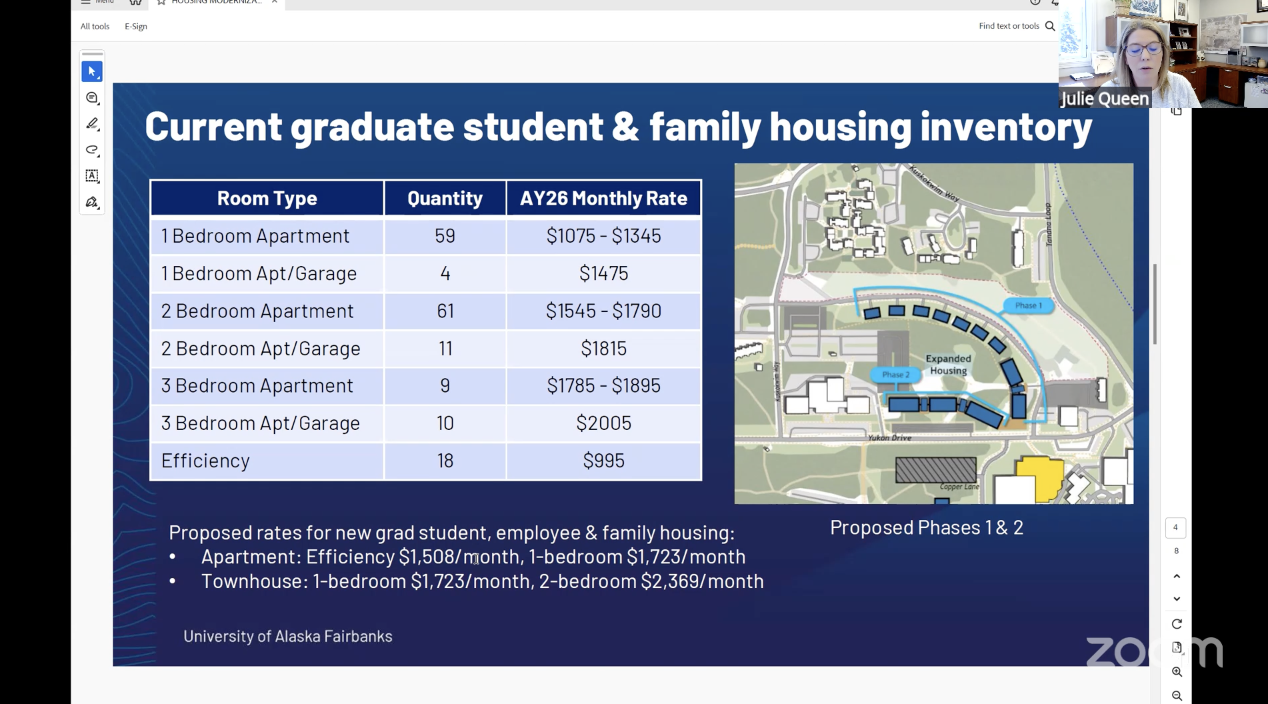
Photo courtesy of UA Board of Regents Zoom meeting
UAF Vice Chancellor Julie Queen discusses the housing expansions occurring at UAF during phases one and two.
Facing rising enrollment, housing shortages and mounting graduate worker concerns, the University of Alaska Board of Regents spent the week advancing major construction projects, reviewing tuition increases and hearing student calls for health insurance stability.
Students struggling to find campus housing, or hoping for more modern options, may see relief in the coming years.
The University of Alaska Board of Regents’ Facilities and Land Management committee voted unanimously Tuesday, Feb. 17 to advance major housing projects at both the University of Alaska Fairbanks and the University of Alaska Anchorage, citing long waitlists, aging facilities and enrollment growth goals. If approved in the coming months, the projects could bring hundreds of new beds by fall 2028.
At UAF, the focus is on modernizing apartment-style housing and expanding options for graduate students, families and university employees. University leaders reported housing 1,340 students in fall 2025, with 133 additional applicants on the waitlist. Demand is strongest for newer apartments, while many of the older units, some built between the 1950s and 1980s, face high maintenance costs or are offline entirely.
Phase I of UAF’s proposal would prioritize replacing older buildings. The plan includes demolishing outdated buildings and constructing 75 new apartments and 30 new townhomes in their place, resulting in a net gain of 146 units that would include kitchens and year-round leases. The new housing could support roughly 230 residents, depending on occupancy configurations.
The $55 million project relies on a combination of Alaska Housing Finance Corporation participation and university bonds. Administrators said financial models assume about 90% year-round occupancy and show the project generating positive cash flow while covering operating costs and debt payments.
UAF Vice Chancellor Julie Queen said modern housing is critical to recruiting and retaining graduate students, particularly as UAF works to strengthen its research profile. Leaders expressed concerns that outdated housing can put the university at a competitive disadvantage when prospective students are weighing options.
At UAA, student housing demand is rising despite higher costs. The fall 2025 waitlist reached 411 students, up from 267 the year before. This comes after a $1,000 per semester increase from eliminated discounts and higher room rates. UAA has 950 beds with some reserved for Alaska Native Science and Engineering Program, or ANSEP, and visiting programs. To address the shortage, the university is proposing a new residence hall near Gorsuch Commons and the Alaska Airline Center with construction beginning in summer 2027 and opening by fall 2028.
Beyond housing, graduate students from UAF pressed the Board of Regents on Monday, Feb. 16, to address what they described as a growing health insurance crisis for graduate workers.
Abigail Schiffmiller, a UAF Ph.D. student speaking on behalf of the Alaska Graduate Workers Association, AGWA, said 169 current graduate students signed a letter urging the university to return to health care negotiations “in good faith” and secure coverage for the 2026-27 academic year.
“We cannot do this effectively if we are constantly concerned about our physical and mental health,” Schiffmiller said, adding that the current plan leaves students uncertain about their futures and unable to recommend the university to prospective students.
Dakota Keller, a UAF master’s student, has filed more than 40 appeals over out-of-network charges that she believes should have been covered. Sarah Swanson, a UAF Ph.D. student from Fairbanks, called the uncertainty over next year’s overage “a matter of literal life or death” for graduate workers living near the edge of their financial means.
Students argued that inadequate coverage harms recruitment and retention and asked regents to prioritize negotiations before the next academic year.
During the Academic and Student Affairs Committee meeting, university leaders reported continued enrollment growth across the UA system.
Enrollment is up nearly 5% compared to last year, with full-time student enrollment increasing nearly 9%. First-time freshmen reached a 7-year high.
At UAF, total applications have increased approximately 80% compared to last year, with out-of-state admissions doubling. Administrators said the growth in enrollment is partly due to expanded national outreach efforts and partnerships with enrollment consulting with enrollment consulting firm Education Advisory Board. At the University of Alaska Southeast, initiatives to attract out-of-state students had contributed to a 20% increase in applicants.
Leaders also reported removing application barriers for nearly 586 active scholarships, streamlining awards and increasing the number of students receiving financial support. Officials said efforts are underway to better track student retention, including developing surveys to identify when and why students consider leaving.
Regents reviewed a tuition transparency initiative aimed at simplifying how students calculate the cost of earning their degree. The proposal would move toward a program-based tuition model and eliminate separate lower-division and upper-division per-credit rates at UAA and UAF. The goal is to provide more predictable costs and reduce unexpected increases and students progress toward graduation.
Presenting the tuition project was UA Chief Financial Officer Luke Fulp. “We want students to know what their tuition will be from semester to semester and ensure they aren’t paying more for courses outside their major,” Fulp said during the Academic and Student Affairs Committee meeting on Feb. 18.
Subcommittees focused on student success, finance and communications are reviewing policy updates and implementation strategies. Leaders said they aim to simplify tuition calculations while acknowledging some students may seek lower-cost degree options under a program-based structure. Implementation is tentatively targeted for fall 2027.
The committee also received updates on modernization of the university’s Student Information System. Planned upgrades include improvements to UAOnline, course registration systems and scholarship platforms to create a more streamlined student experience.
Regents advanced plans to discontinue two low-enrollment programs at UAA: the undergraduate certificate in dental assisting and the Master of Science in global supply chain management.
University officials said the dental assisting program faced declining enrollment and increased competition from employer-based training programs, and resources will be redirected to the higher-demand dental hygiene program.
As enrollment climbs and recruitment efforts continue, regents acknowledged the difficulty balancing growth with affordability and student support.