

Beyond the siren: On patrol with UAF police
By Louis Seymour
Not everyone gets to watch a traffic stop from the passenger seat of a police car. For University Police Officer Jake Spencer, it is one of many responsibilities that comes with working in law enforcement. Spending a few hours with Spencer revealed less about emergencies and arrests than about what police work looks like when nothing is going wrong. That afternoon brought two traffic stops and one emergency call. Most of the patrol was spent talking about the other parts of his job.
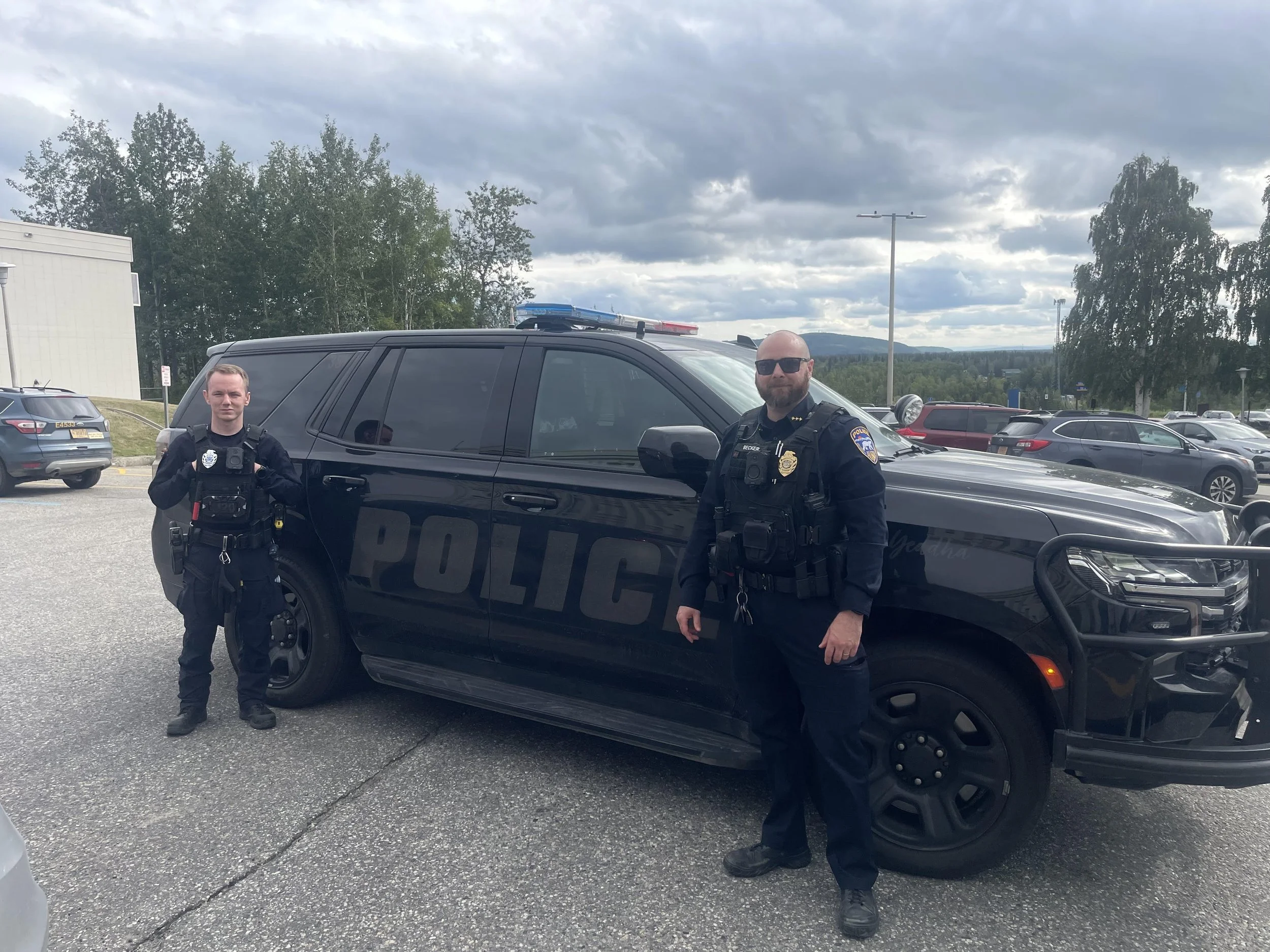
Officer Jake Spencer, left, and Chief of Police Max Becker stand with one of the department’s patrol cars after returning from an emergency call.
For Spencer, police work at UAF goes beyond emergency response and includes building relationships. Sitting down with Chief of Police Max Becker, that emphasis became even clearer.
Becker highlighted the importance of a police department dedicated to the university, saying that “having the University Police Department allows us to be responsive to incidents that occur on campus quickly,” and added that it “allows us to tailor our policing style to the needs of the university.”
A university campus brings its own challenges, including mental health concerns, alcohol use and student safety. This tailored approach also includes community outreach programs such as Coffee with a Cop, which gives the department opportunities to hear from students throughout the semester.
Becker emphasized communication and collaboration as part of the department’s approach to campus safety, adding that the department takes part in the CARE Team.
“So the CARE Team is a multiple disciplinary team for the University made up of ORCA, the Bursar’s Office, Disability Services, and Student Health and Counseling, for students that might be struggling with various different things—financial instability, mental health crisis, that kind of stuff,” Becker said.
According to the CARE Team’s website, they meet weekly during the fall and spring semesters to discuss student well-being and advise the Office of Rights, Compliance, and Accountability, or ORCA, on these issues.
For students who may have anxieties surrounding police, Becker said the department has worked with Disability Services to better understand their concerns. He said this communication helps officers understand what might upset students or escalate a situation.
The department also maintains an open-door policy, giving students an opportunity to learn how officers respond to different situations and what resources are available to them. Officers also participate in International Student Orientation, where they explain how the University Police Department operates to students from around the world.
“We kind of talk about the way things work for the University Police Department, because we have people coming from all over the world, and law enforcement is different all over the world,” Becker said.
When it comes to day-to-day work, however, the officers at the University Police Department aren’t always in the public eye. Becker estimated that “maybe a quarter of our tasks are going to be emergency calls for service.”
Because the department handles most of its own investigations, officers’ daily work can include interviews, evidence collection and processing. Officers also make daily patrols around campus and the surrounding community to maintain a visible presence.
Spencer offered a ride-along to show what these patrols can look like. During the roughly two-hour patrol, he made two traffic stops.
As he returned to the road near the Botanical Garden, he notified dispatch that he had issued a warning. He made a similar decision after stopping a second car for expired registration.
For Spencer, the traffic stops were opportunities to foster cooperation rather than animosity. He emphasized that the UAF community is a place where many people are still learning, and that leaving a traffic stop with a lesson learned can be more valuable than leaving it with a ticket. He also said that being unnecessarily hostile could make people less willing to cooperate with police in the future.
Toward the end of his patrol, Spencer received a call over the radio about a missing child north of campus. The conversation hushed, and Spencer turned the car around on the roadside. He looked up the reported address on his phone while other officers chimed in over the radio.
Because he monitors for calls from other local police, his work is not always limited to incidents on campus. As he drove toward the caller’s house, Spencer talked through his thought process: where to look, who to talk to and what to look for. Other officers spoke over the radio, providing updates and coordinating the response.
Before Spencer arrived, however, dispatch reported that a neighbor had found the child.
Returning to the station, Spencer pointed to one of his favorite parts of working in Fairbanks: the sense of community and partnership that drew him to law enforcement in the first place.
When it comes to opportunities that the department believes more students should be aware of, Becker highlighted the Community Service Officer program. As a paid student position with the department, Becker said that “it gives people a unique look into law enforcement that you might not get other places and also allows you to give back to the university community as well.”