

Celebrating Alaska poetry: Two local poets worth reading
By Caidan Pilarski
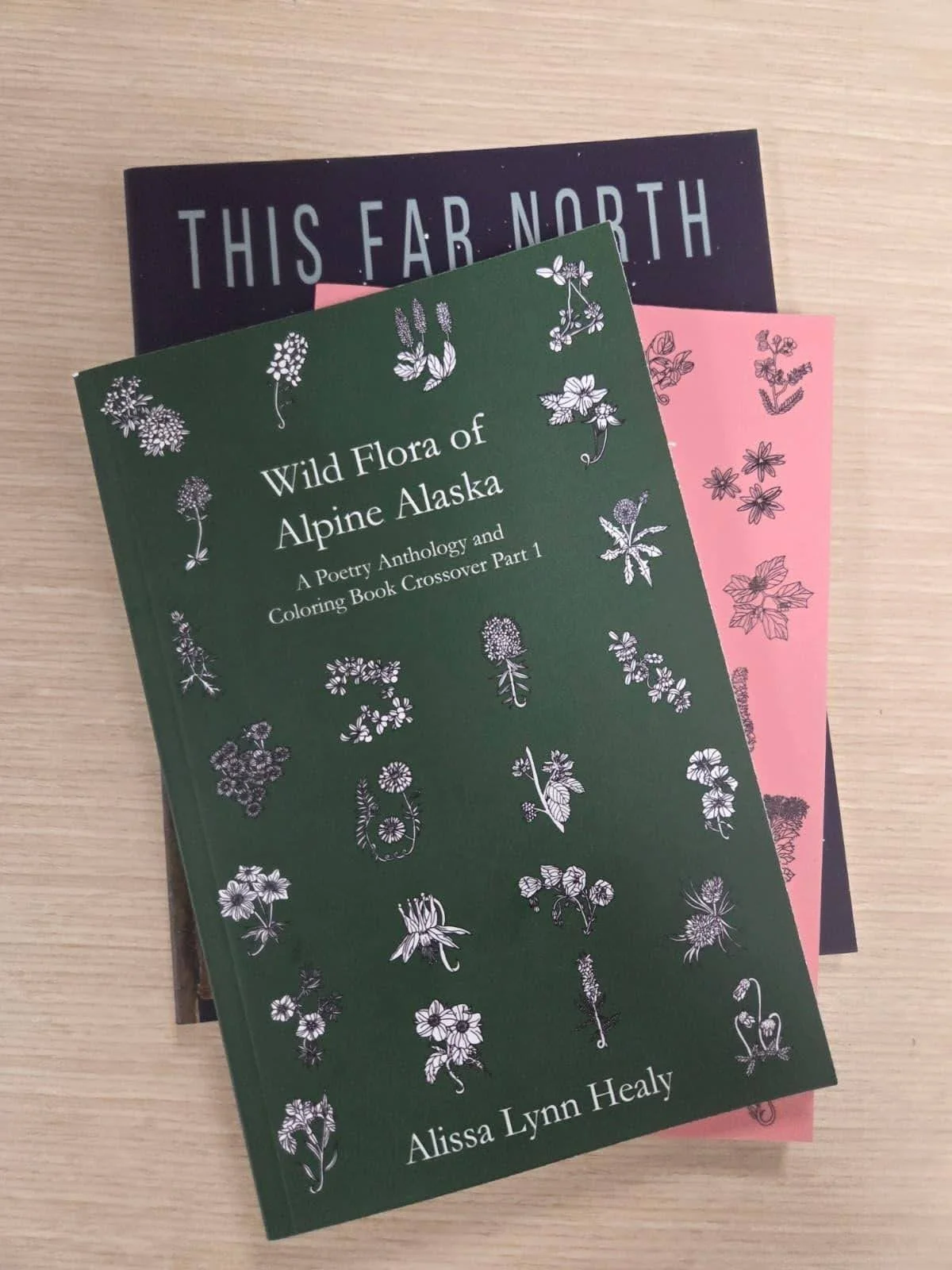
Alissa Lynn Healy Perez’s Wild Flora of Alpine Alaska: A Poetry Anthology and Coloring Book Crossover, Parts 1 and 2, stacked atop each other at the Creamer’s Field book fair on Aug. 23, 2026.
On Aug. 23, 2026, it was a particularly windy day at the Creamer’s Field Migratory Waterfowl Refuge. I visited for the first time, interested both in the beautiful sandhill cranes and in the book fair that was happening from 11 a.m. to 2 p.m. that day. As a poet and MFA student here at UAF, I knew what I needed to do— I shot toward the poetry.
I spoke with people at every stall and found joy in each interaction, making origami with some and discussing how we ended up in Fairbanks with others. Of course, there were several conversations about the literature present. I did grab some copies of the poetry at the event; I will begin with Alissa Lynn Healy Perez.
I had a wonderful time talking with this creative soul, who has ventured all across Alaska. In her adventures, she has taken note of the wild flora and turned her experiences into a series of wonderful books. The first is titled Wild Flora of Alpine Alaska: A Poetry Anthology and Coloring Book Crossover Part 1. The second is titled the same, but marked “Part 2.” As stated on the backs of the books, each one contains “49 hand-drawn species of flora and 49 original poems based on real-life Alaskan experiences and research.” In total, that is nearly 100 poems and drawings, combining science, art and poetry into an accessible creative experience.
This is, in part, therapeutic, in part, informative and utterly creative.
Examples of flowers mentioned in Part 1 of the series include the Alpine Forget-Me-Not, Bog Blueberry, Crowberry, Monkshood, Red Currant and Wild Rose. Each flower name also includes the scientific name next to it, and there are color photos of the flowers taken by Healy Perez at the ends of the books. These photographs can be useful for those who choose to color in the drawings next to each poem.
The poems themselves are quaint, some including bits of rhyme. One example is “Elegant Paintbrush,” which describes the flower through both its appearance and its growing season:
rosy and elegant
sometimes light yellow or cream
a tower of bracts
upon one or many stalks
of which reappear year after year
making June to August a living dream
This excerpt exemplifies the scientific approach that the poems take, choosing to use the space to note critical identifiers while also attempting to imbue a sense of rhythm into each page. The combination of scientific names, botanical illustrations, photographs and poetry makes the books feel almost like a field guide transformed into a creative experience.
Above all, the poems are accessible and informative. Healy Perez’s books offer readers a way to learn about Alaska’s flora while engaging with poetry and illustration at the same time.
Healy Perez lives in Fairbanks and attended UAF for her BA in Elementary Education. She currently teaches locally and has also self-published a coloring book titled Coloring the Turtles & Tortoises of the World: A Coloring Book for All Ages. Her website is alissalynnhealy.com.
After talking to Healy Perez, I ventured over to Susan Campbell’s table. She was also a joy to speak with. Her collection is titled This Far North, and it spans about 90 pages. It is split into three sections, titled as follows: “Not Too Far,” “This Far North” and “With Kindest Thoughts Of Home.”
One of my favorite poems in the collection is “Listen,” which uses repetition most effectively. Each stanza begins with “Listen” until the final couplet, where she leaves the reader with “You will hear your way home.” Her poem “Denali Litany” is most exciting to read as well, split into four sections representing the seasons and composed entirely of long couplets.
I would like, however, to leave readers with a portion of “This Far North,” which is the namesake of the collection:
We know summer’s profusion,
days drenched in light dissolve
into winter’s dark tunnel,
then finally,
always,
spring unfurls.
We listen.
The Tanana’s twined channels
pulse with salmon.
Moose scrape willows.
Chickadees skitter in birch.
A hermit thrush sings at dusk.
We know why we are here.
The beauty of this poem lies in the sentiment stored in the final line, one we all share. In fact, it uses the pronoun “we,” calling us together both at the very beginning and very end. This poem succinctly showcases that which is unique to Alaska and suggests that it is the sublimity we are drawn to, alluded to almost mysteriously in that final line.
We know.
Campbell calls Fairbanks her home. She is a poet, teacher, book artist and outdoor adventurer. Her work, like Healy Perez’s, is deeply connected to the landscape and experiences of Alaska. Her collection offers another perspective on what it means to live this far north, particularly through the changing seasons and the shared experiences of those who call Alaska home.
Both Healy Perez and Campbell offer readers different ways of experiencing Alaska through poetry. Healy Perez looks closely at the flora around us, pairing scientific observation with illustration and verse. Campbell looks more broadly at the landscapes, seasons and experiences that shape life in the North.
For readers interested in poetry rooted deeply in the Alaskan landscape and experience, both writers are worth seeking out. Their work reminds us that Alaska can be studied, illustrated, remembered and, perhaps most importantly, listened to.
Caidan Pilarski is a freelance contributor to The Sun Star and an MFA student at the University of Alaska Fairbanks.