

A whale, a sunken sailboat and seven hours on shore
By Lukas Syrene
How was my summer? Whaaaale....
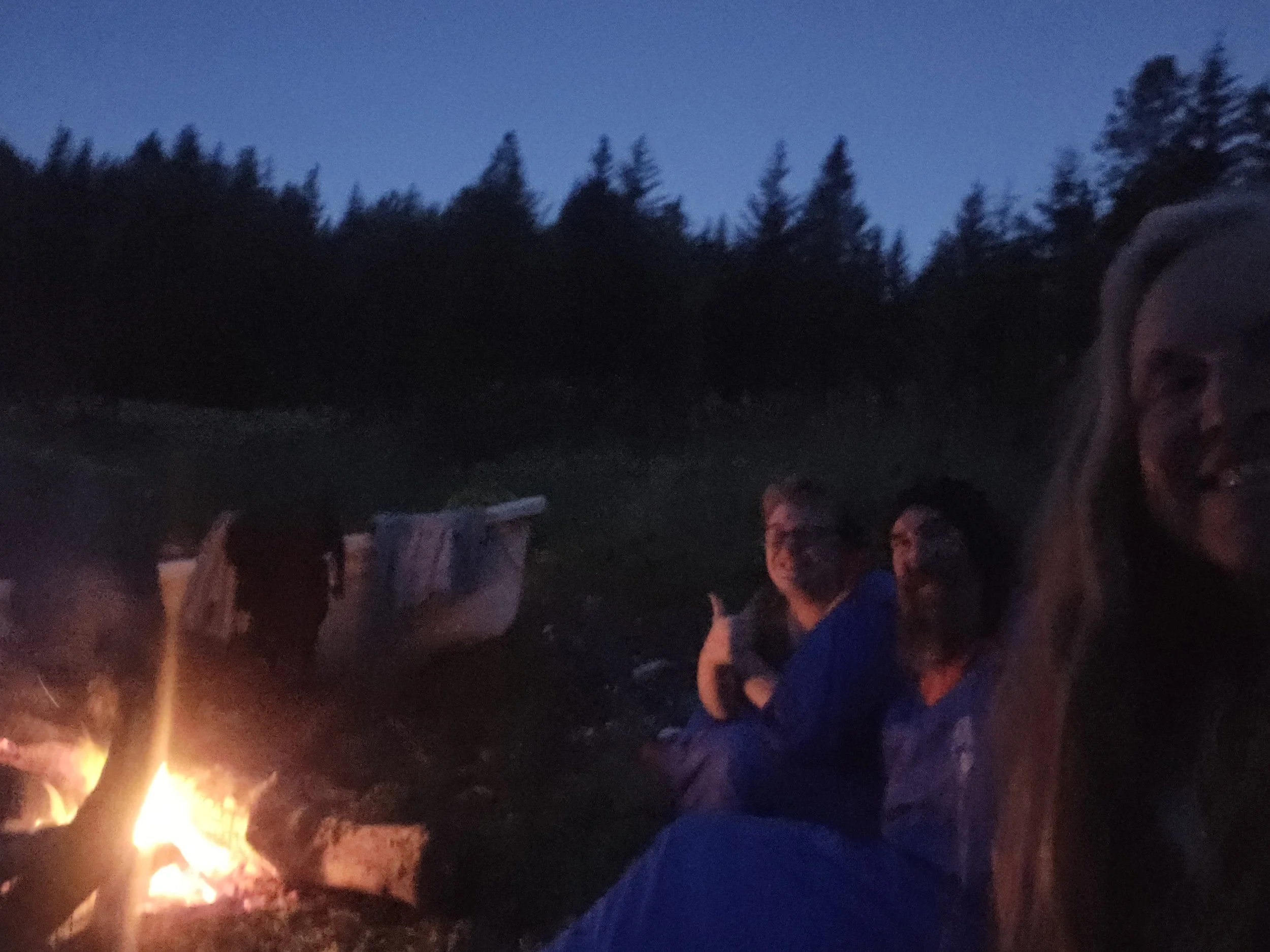
Photo courtesy of Lukas Syrene
"Once we calmed down enough, we did what we could to document the event. Not sure why we made ourselves smile, now it looks like a nice fun camping trip, not a near death experience," Lu said.
My name is Lu. I am a student here at UAF studying art and sociology. This is my fourth year studying here, so I am used to the welcome-back routine with friends, classmates and teachers. But this year, when people ask me how my summer was, I get to make a choice. Do I say, “Overall, pretty good! A few rough patches”? Or do I say, “My boat suddenly sank in the middle of the night, my parents and I had to escape and make it to shore, where we spent seven hours until we were rescued”? Or do I just tell them to read this?
My parents and I left Bartlett Cove the evening of Sunday, July 26. We were headed up into Glacier Bay National Park, a gorgeous environment where I had grown up boating, camping and exploring. My mother is a wildlife biologist for the park service and has spent decades studying the animals that live there. My father is an avid boatman, experienced in captaining and boat maintenance. We were on a leisure trip on our 25-foot sailboat, the S/V Windrush, a 1968 Westerly Windrush that was given to us by a family friend and that my dad had fixed and refurbished himself. We intended to return home that Friday, July 31.
As you can probably guess, we returned a little bit early.
We had an amazing first few days, boating from place to place, exploring glaciers and beaches, watching wildlife and sleeping on our boat at night. I spent most evenings staying up a bit late to read in my cozy bunk at the front of the boat, while my parents slept in the main cabin.
Tuesday, July 28, we were anchored in Reid Inlet. It was dark out when I heard whales coming up for air. I got nervous; they sounded very close and very big. I woke up my mom, asking if we should do something to make sure they knew we were here. She told me to knock on the hull, a strategy she knew of for letting whales know where you are if your motor is not running. I did this for a bit until the whales passed us by and I went to bed.
The next day, we talked about how low the possibility of that happening was. We talked about how, if whales couldn't somehow tell where we were, they would hit anchored boats all the time. They must be able to hear the rattle of the anchor chain or the waves hitting the hull of the boat. I was embarrassed to have been so nervous.
On the evening of Wednesday, July 29, we anchored in a small cove south of a landmark called Gloomy Knob, a popular anchorage for smaller vessels. We watched a blonde wolf stroll down the beach, a very cool experience. Around 8 p.m., we saw a whale feeding near the point of the cove, pretty far away. It was gone by the time we finished dinner. We enjoyed a gorgeous sunset on the back deck of the boat, played a card game for a bit, then my parents went to bed and I stayed up to read.
I did not hear any whale breaths, splashing or any other commotion until the impact.
We estimate it was about 11:30 that night when I heard a sudden, loud crash, and the boat was shoved violently to the side. I was immediately terrified. I threw off my sleeping bag and yelled to my parents, “What was that?” and “What happened?” Obviously, they didn't have an answer; they had just been sound asleep.
My parents say it was my yelling that woke them up more than the impact. My dad undid the door of the boat, several wooden slats in a frame, to try to get on deck to investigate. He noticed that our dinghy, which we used to get to shore, was flipped upside down, which should not have been possible as it was tied to the sailboat by the front and the back. He flipped the dinghy right-side up. My mom tried to help me calm down. It only took a few seconds for me to notice that water was rushing in, right from under where they had been sleeping. It was rising fast.
I yelled that the boat was sinking.
My dad activated our pump system, trying to get water out of the boat to stop the sinking. My mom grabbed anything nearby and shoved it in her waterproof backpack. She called for me to get to the back deck, where the dinghy was. I opened the top hatch of my cabin and crawled out onto the top of the boat, rather than crawl toward where the water was rushing in. I was clinging to the book I had been reading, and at some point I had grabbed my phone. I remember looking down into my cabin and seeing my shoes begin to float.
My parents told me to get in the dinghy. My mom hopped in with me, holding her backpack. My dad handed me a bucket and told me to start bailing. I did, but we quickly realized that the dinghy was still tied to the sailboat and was being pulled under as the bigger boat sank. My dad managed to untie it, but it was still full of water. My mom handed me her pack and took the bucket to bail, but it was so flooded that the cold water was coming in over the edges of the dinghy.
The back of the boat sank first, leaving the bow sticking up with the light from my reading lantern shining out the top hatch. We watched the light disappear into the water, and then it was dark.
My dad had moved from the cockpit to the top of the boat as it sank. We watched as the top also disappeared right out from under his feet, leaving him in the water. He held onto the dinghy's bowline as the mast disappeared as well.
The boat was gone.
The whole thing had happened incredibly fast. My mother estimates the boat sank in under two minutes from the impact. We had nothing but our pajamas, my mom's backpack and whatever she managed to shove in it, and my book and phone. We had no time to grab life jackets or shoes.
My dad tried to pull the dinghy toward the shadow of the shore, but it was extremely heavy with all the water. Whenever we shifted our weight at all, water would pour in over the sides until it was submerged, still floating, but completely underwater.
At this point, my dad realized he was getting dangerously cold, losing energy and strength. He attempted to get into the dinghy with us, where our top halves were still out of the water. The dinghy could not handle the extra weight, and it flipped. Now we were all in the water.
I am a strong swimmer, and I was worried that the dinghy was not going to support us all while also full of water, so I decided to swim.
I took my mom's backpack, which very luckily floated, and shouted that I was going to swim for it. I still had my book under my arm, and I put my cellphone in my teeth to keep it dry.
My parents managed to get the dinghy righted again. Getting flipped upside down had gotten most of the water out, enough that it was no longer submerged. They both managed to get in, my dad untied the oars, and they rowed to shore.
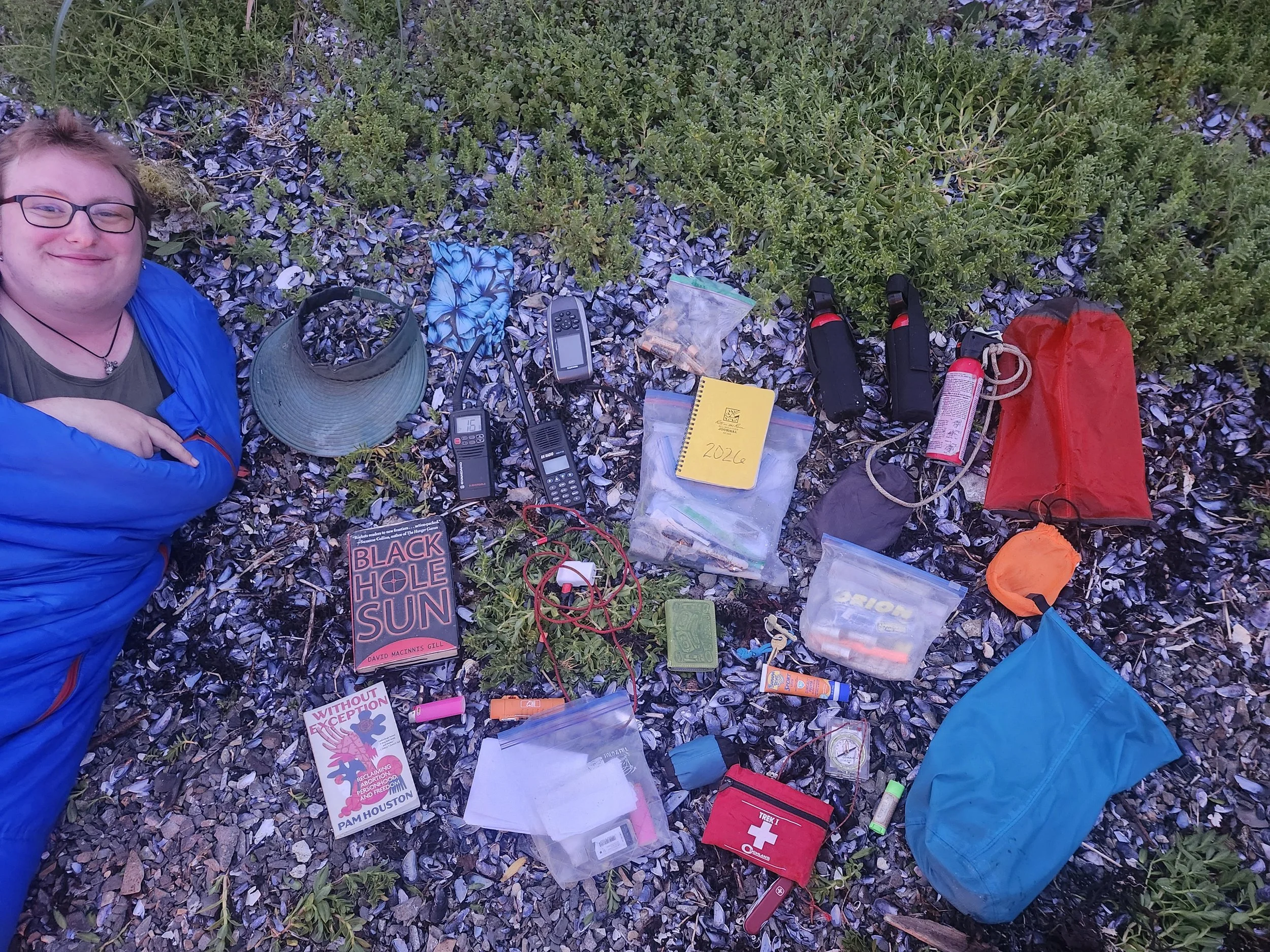
Photo courtesy of Lukas Syrene
Lu posing on shore with the belongings the family managed to save.
It was dark, and we couldn't see each other, so we shouted to each other to keep track of where we were and if we were OK. Like a high-risk game of Marco Polo. At some point, I noticed that the water around me was glowing with bioluminescence. For some reason, I decided to yell this to my parents. Even if it was a strange thing to notice at the time, the gorgeous glow gave me a bit of a kick to keep swimming through the dark, cold water.
We all arrived at the beach at about the same time. We estimate it took us a little over five minutes to get to shore. We were all wet, we were all cold. My dad, though, was shivering intensely. We struggled up the beach, my parents pulling the dinghy and me holding the pack until we were at the high-tide line. My mom took the pack and emptied it to see what she had managed to grab. Even though it was supposed to be waterproof, water had gotten in the top, so most things were at least somewhat wet, if not soaked.
We had: my parents' two light synthetic sleeping bags — soaked. A pair of my mom's light rain jacket and pants, also soaked. Two radios — one regular VHF and one NPS radio with the ability to hit park repeaters, radio towers that connected to the park emergency dispatch — both soaked but working. A handheld Garmin GPS with no communication ability. A small bag of pocket flares with a launcher. One light cashmere sweater — mostly dry. Three whole cans of bear spray. And in an emergency kit, which was in a dry bag and relatively dry — two lighters, an emergency blanket, a headlamp, a bug net, ChapStick, sunscreen, a compass, a Swiss Army knife, toilet paper and hand sanitizer, a very small first-aid kit (mostly for blisters), a small water filter, and a dry paperback book that my mom's friend had sent her. I had my wet hardcover book and my slightly wet but working cellphone.
My mom replaced her wet shirt with the dry sweater, which warmed her up enough to start working on a fire. My dad and I also stripped, as our wet clothes were only making us colder.
I took the task of calling Mayday on the radio, but we were tucked into a small cove, and no one else was in range. My dad huddled under the emergency blanket and one of the sleeping bags, which, even wet, still provided warmth. I took the other one.
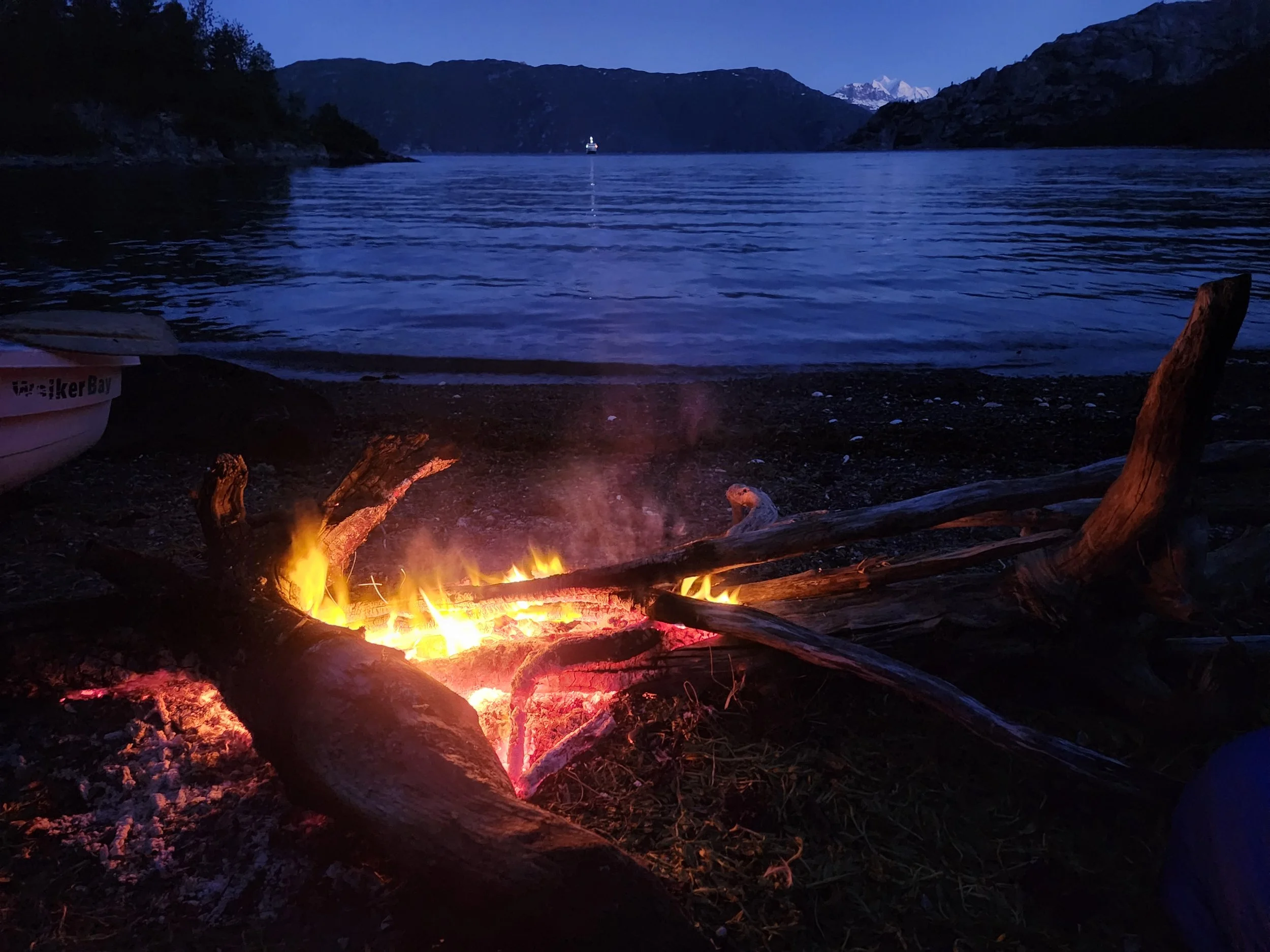
Photo courtesy of Lukas Syrene
The fire that was started to help to family dry off and warm up on Wednesday, July 29.
We were incredibly lucky in that there was an abundance of dry driftwood on the beach. My mom got a fire started using the pages from her dry book. I offered my book as well, but the pages were too wet to be any help. Luckily for the book. We all helped gather as much wood as possible until the fire was going strong. By the time we had all sat down and I had the thought to look at the time on my phone, it was 11:59 p.m.
My mom and I were worried about my dad, who was the coldest, but with the fire, the emergency blanket and the sleeping bag, he warmed up.
For a while, we focused on drying things off and collecting firewood, which was difficult with no shoes on the sharp rocks of the beach. We continued calling Mayday every 10 minutes or so, but it was clear there was no one close enough.
My parents came up with a plan. My mom, who was the driest and warmest, would put on as much dry clothing as possible, take the dinghy and row out around the point to try to connect her park radio to one of the repeaters, or to reach the cove across the way from us, which was a popular spot to anchor. I was really nervous about this. I didn't want her to go out in the dark, but I was able to hold onto the other radio and check in with her while she rowed. We could also see her headlamp occasionally, but it was only staying on for about 15 seconds or so, either low on battery or waterlogged.
When she got back, maybe 20 minutes later, she told us that she had managed to connect to a park repeater, but all the communication had been choppy and they had trouble understanding each other. Eventually, she understood that the park rangers had been notified, but we didn't know if they knew our full situation or even where we were. At one point, the person on the other end said something about our boat being stuck on the rocks, which was ... technically true. Just ... the rocks at the bottom of the cove. We hoped that they eventually understood that the boat was sunk, not just stuck.
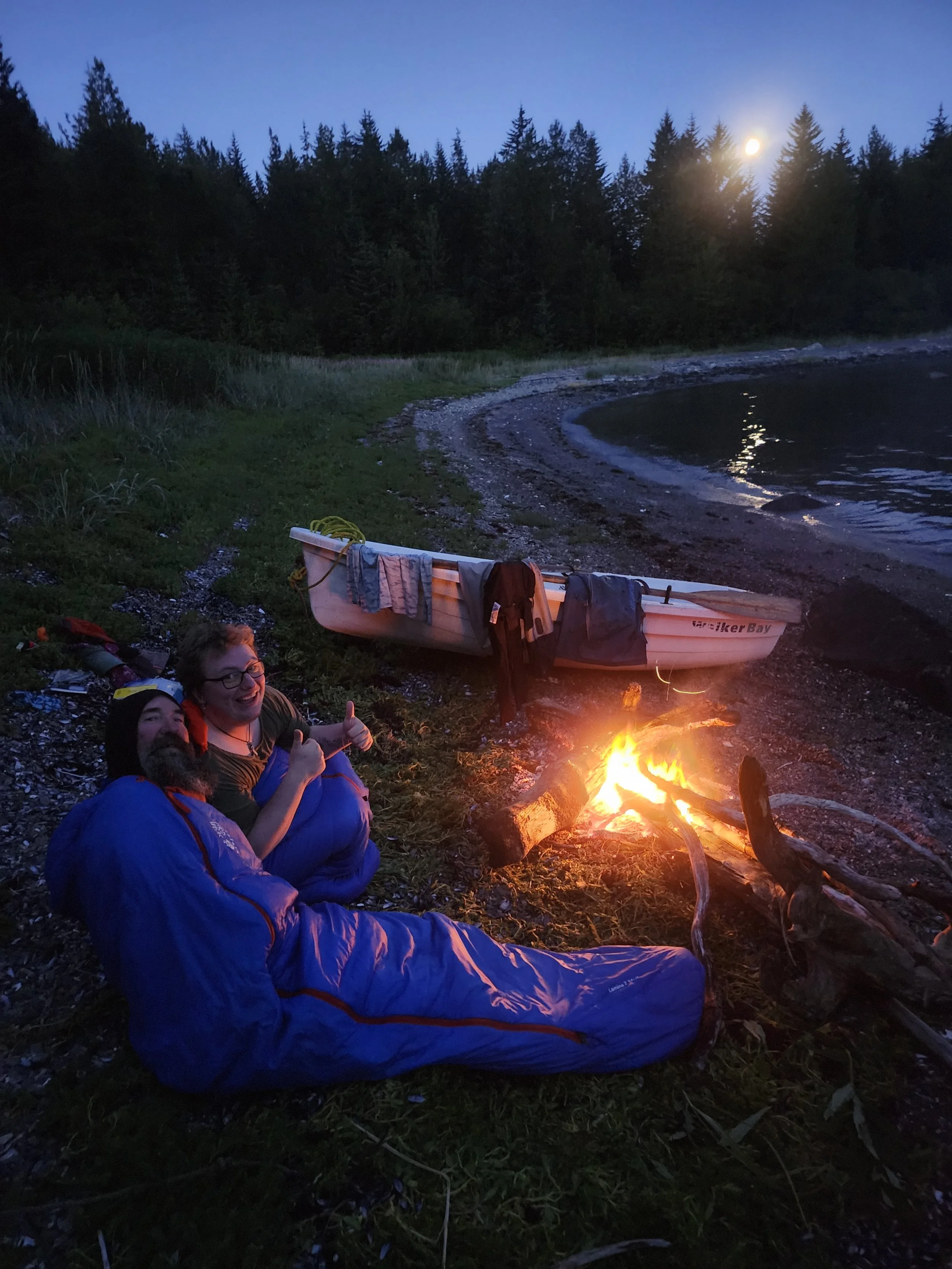
Photo courtesy of Lukas Syrene
Lu and his dad keeping warm by a fire on shore.
We spent hours on the beach, going over what had happened, filling each other in on our different perspectives and what we had been thinking, and what could have possibly sunk the boat.
We had been anchored in 40 feet of water, knowing we were safe from rocks thanks to our new depth sounder. The waves were very calm, not enough force for something like a log to get rammed into the hull. It sank fast, so the hole must be big.
The only possible thing that we could think of that could have happened was getting struck by a humpback whale.
I did not say, “I told you so.”
Around 3 a.m., we spotted a boat passing by the cove. We hailed them quickly. It ended up being a National Geographic tour boat, the Quest. They offered to come get us, but it was still dark, and somewhere in the water was a giant pointy sailboat mast. We were all safe, uninjured and had a fire, so we decided to instead ask them to connect to the park and make sure all of our information had been communicated.
They were able to confirm that there was a plan to come get us at first light, and they also told the park our exact location, who we were (my mom being an employee that most people knew) and how many of us there were (three), and the status of the boat (very much sunk). Knowing that there was a plan and the park rangers knew where we were, we let the Quest continue on its way and waited on the beach.
No one really slept. We talked, sang a bit, just tried to pass the time. My mood fluctuated between shock, despair and cracking jokes like “Well, I wanted to go swimming anyways.” Thankfully, my humor-based coping mechanisms helped my parents, too. There was a lot of “What the f--k” from all of us, said many, many times.
You know who swears more than a sailor? A sailor whose boat sank.
We got picked up by park rangers at about 6:30am. They gave us blankets and hot chocolate and helped us look at the beaches for any of our stuff that may have washed up. The tide had gone out, and right before we left, we found the mast of the boat, sticking up about 6 inches from the water, right where we had left it.
We arrived back at Bartlett Cove at about 9:30am, exhausted and traumatized, but unhurt. We got home around 11.
Eventually, when the boat was pulled out of the water by a salvage team, they found a 2 foot wide hole with a three foot crack, and several large rubbery chunks of humpback whale skin in the hull.
If you learn something from this, besides the fact that whales do actually sometimes sink anchored boats, learn that it is important to be prepared. The emergency blanket might have saved my dads life, the fire even more so. I carry fire starter with me now, given to me by my parents. If we hadn't had radios, we would have had to wait for a boat to come by and then just jump up and down and scream and hope they saw us. If we had our life’jackets, the journey to shore would have been much safer. If we had our shoes, navigating the beach would have been a breeze. We also learned later that there is some evidence that leaving a depth sounder on at night may help whales to know where you are, as they may be able to pick up on the sonar blips.
We were incredibly lucky. We all got out, no one got injured. We even got most of our stuff back off the boat, minus my brand-new hiking boots and one of my favorite comfy shoes. The beach had been full of dry wood, and it had been a clear night. My parents friend started a Go-Fund-Me to cover the cost of the salvage, about $24,000, and it was full within three days. Our community helped us so much, though the money and through making us food and supporting us while we dealt with the emotional aftermath. A local whale biologist even let us know that the whale was more than likely absolutely fine, only suffering the equivalent of a skinned knee.
I hold no resentment towards the whale, who was probably just feeding on the fish that eat the bioluminescence that we swam through. They are probably so embarrassed.
So, yeah, how was your summer?
Lukas Syrene is a fourth-year UAF student studying art and sociology.