

Students share URSA projects during research day
Story and photos by Jonathan Wasilewski
Undergraduate students from the University of Alaska Fairbanks gathered in the lobby of the Charles W. Davis Concert Hall Thursday to present projects funded by the Office of Undergraduate Research and Scholarly Activity, or URSA.
The fun began on April 2, UAF’s Research and Creative Activity Day. Free food and drinks were provided by Chartwells as presenters stood beside their large posters on bulletin boards under the room’s colorful, northern lights display.
Before presentations began at 4 p.m., URSA Director Lori Gildehaus explained what URSA does.
“Students of any discipline, from any degree, can apply for funding,” she said. “It’s a way for students to explore their creative interests and get involved.”
The program’s semester funding includes tuition up to four credits in a course related to the student’s project, fellowships, supply funding, contractual services and travel expenses when no travel restrictions exist.
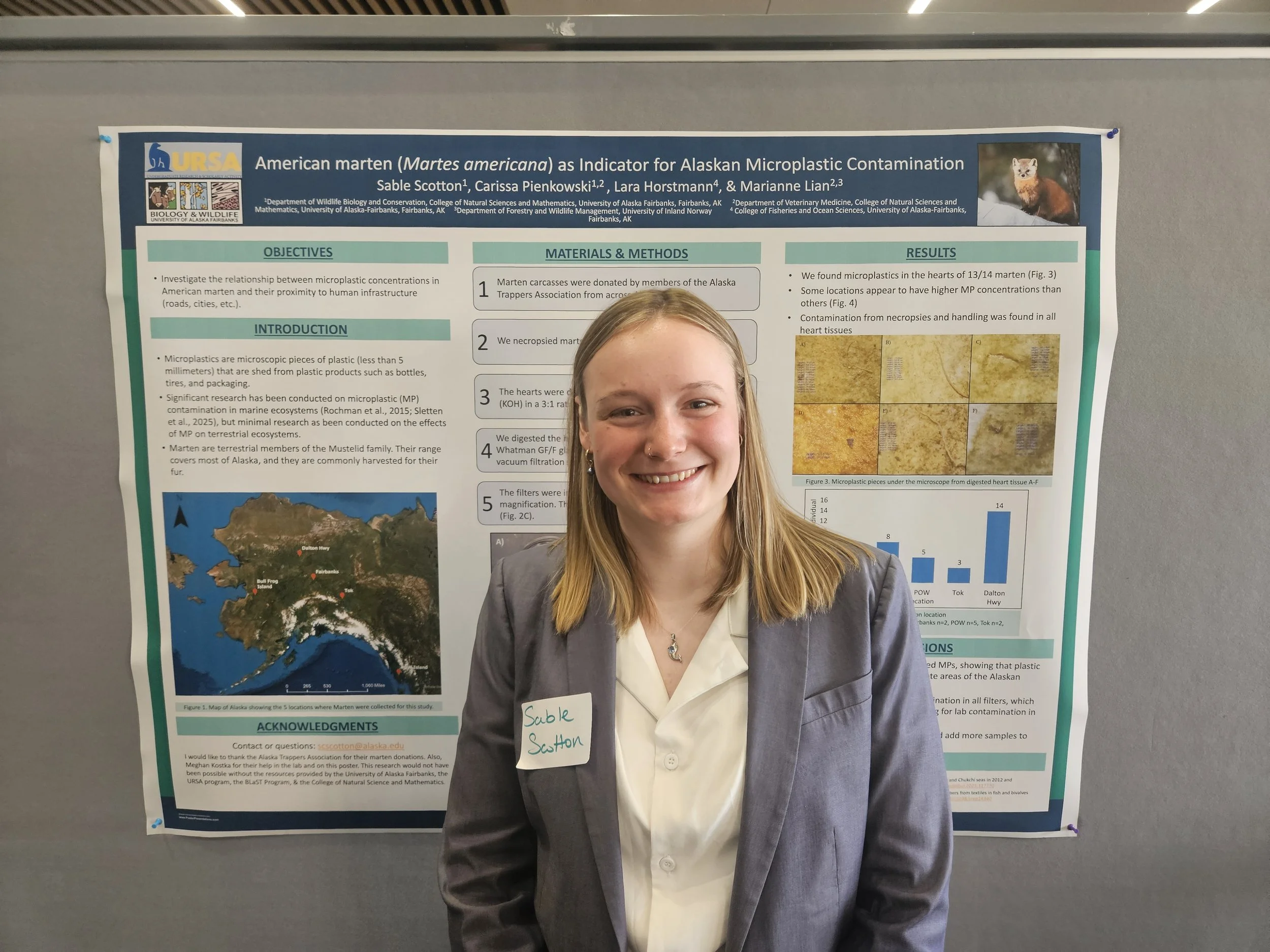
Department of Wildlife Biology and Conservation student Sable Scotton discusses American martens and microplastic next to the Davis Concert Hall April 2.
Department of Wildlife Biology and Conservation student Sable Scotton presented a project about microplastic contamination in Alaska, specifically studying the American marten.
Hearts and tissues from the weasel-like creatures, donated by the Alaska Trappers Association after fur was removed, were placed in potassium hydroxide to “digest” them.
“They became viscous and liquidy,” said Scotton.
Every bit of plastic on the tissues and hearts were then photographed and the data was analyzed. It was discovered that there were higher levels of plastic in the martens trapped in populated regions, like near the Dalton Highway and Fairbanks.
According to Scotton, microplastics shed from “anything and everything.”
“As tires wear down, they shed microplastics. Backpacks, clothing, all the things we wear day-to-day that are made out of plastic will shed,” she said.
Jennifer Tilbury, Associate Vice Provost for Student Success at UAF, made clear that URSA is not just for students in science, technology, engineering and mathematics fields.
“It’s for any research and creative activity,” she said.
Department of Psychology student Peter Lowe explained a project where he researched Indigenous students’ transitions from rural settings to university settings. Data was obtained on what challenges were faced and what is being done in order to aid UA in helping more students.
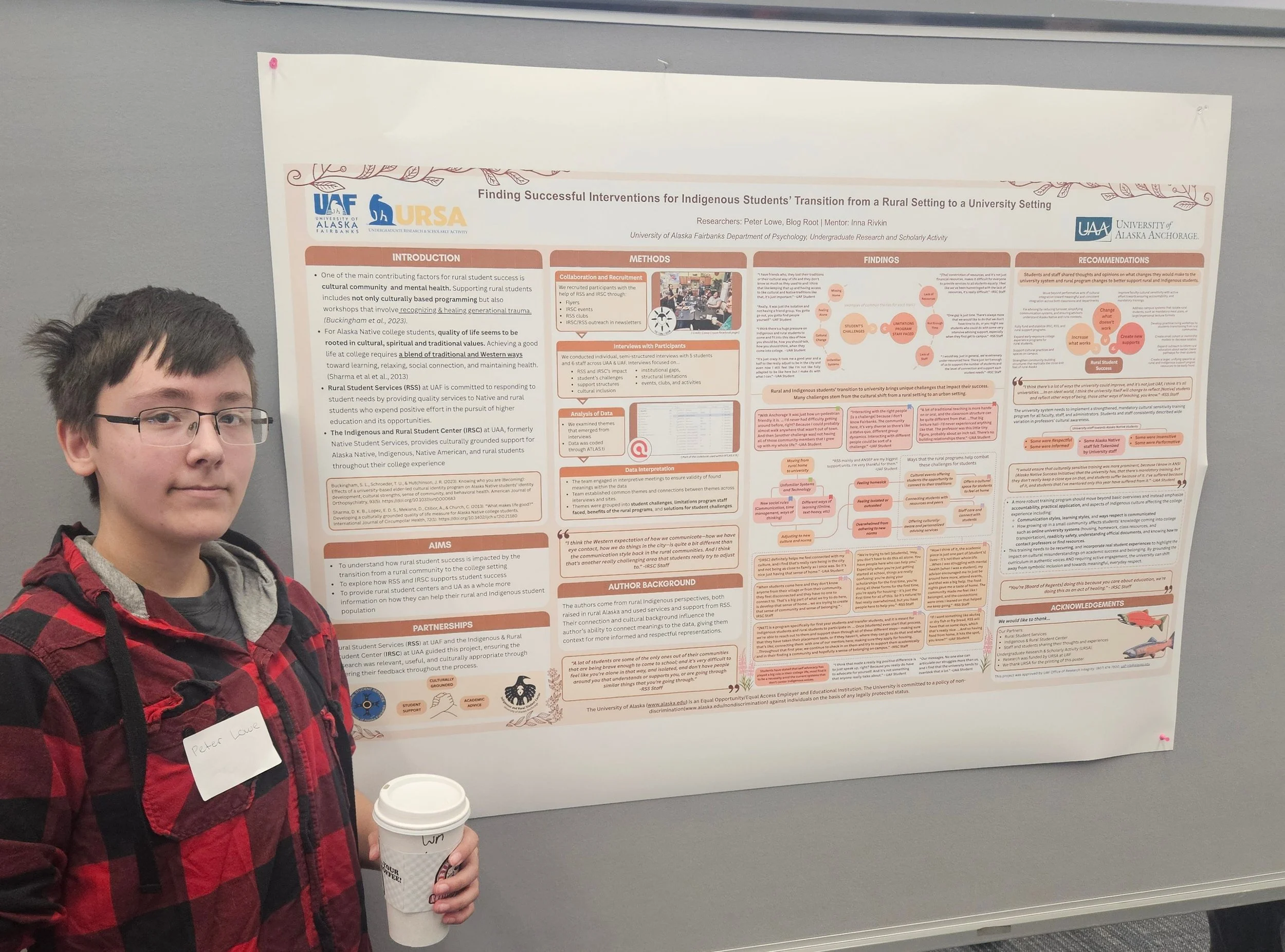
Department of Psychology student Peter Lowe discusses Indigenous students’ struggles when attending universities next to the Davis Concert Hall April 2.
According to Lowe, some challenges Indigenous students faced included missing home, feeling alone, the limitations of programs, lack of staff, dealing with cultural change, and understanding unfamiliar systems and technology.
“One example people may not think of if they’re not from a rural area are the road systems. That’s something that’s unfamiliar,” he explained.
According to the Alaska Department of Transportation, roughly 82% of rural Alaska villages are not connected to the road system.
Lowe interviewed 11 people, who were Indigenous students from the UAA and UAF, and staff at the rural centers on each campus. Each rural center has staff that connect resources to students and offer cultural events and opportunities.
When discussing what to send UA, Lowe said he wanted to be respectful, be specific, know what is being said, and understand what is needed.
“The university cares,” he said. “They’re not the big bad.”
Another URSA project was by Department of Geosciences student Ashley Brant, who studied deflation at Mount Aniakchak, a volcano that last erupted in 1931.
On July 28, 2021, the massive 8.2 Chignik Earthquake occurred in the Aleutian Islands.
“About a year after that, we started seeing some deformation around Aniakchak,” Brant said.
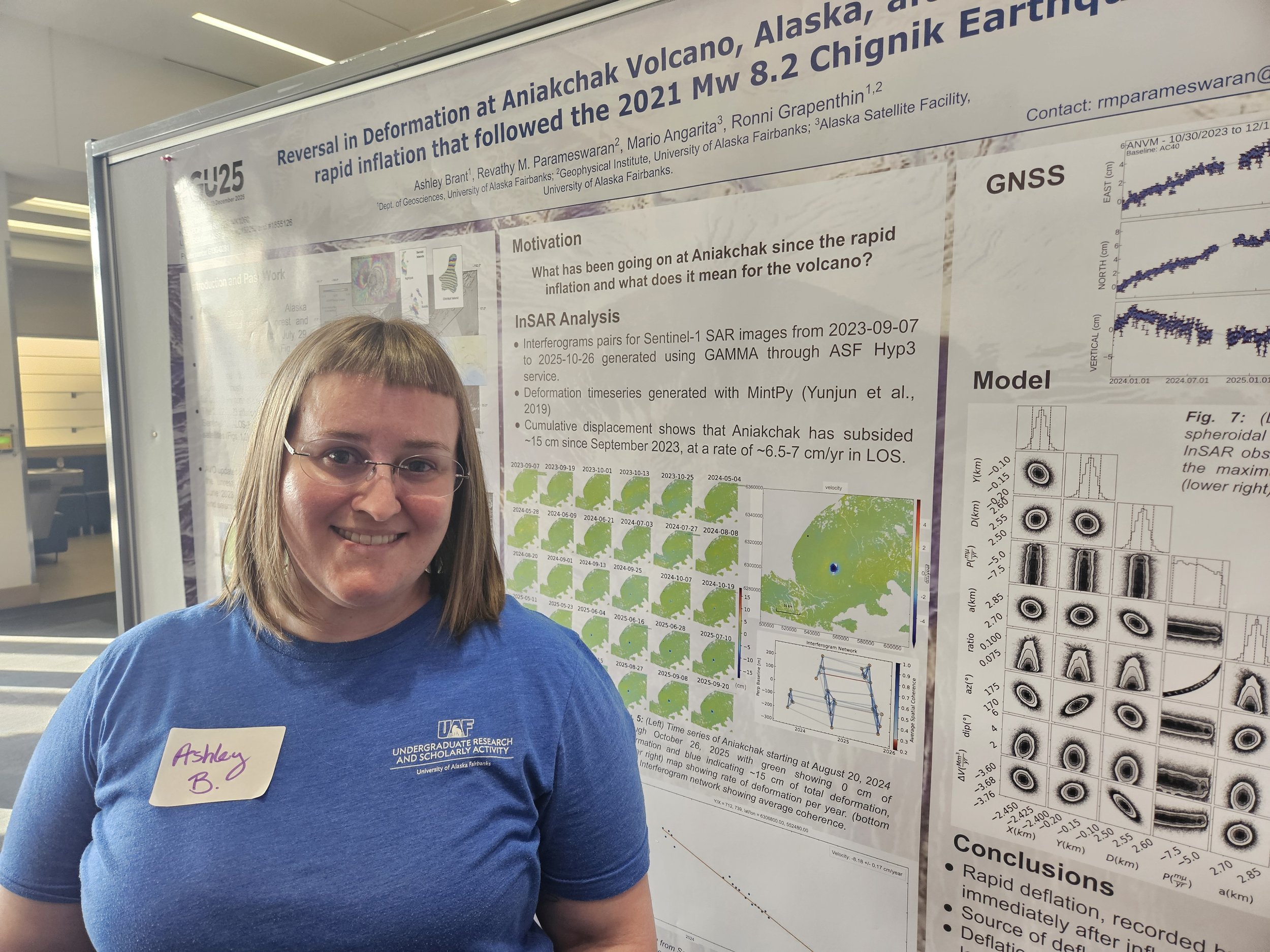
Department of Geosciences student Ashley Brant discusses the deflation of a volcano next to the Davis Concert Hall April 2.
However, she noted that there was also 80 centimeters of inflation at the center of the volcano’s crater, or caldera. The Alaska Volcano Observatory kept an eye on the volcano, and she began looking at what happened after things calmed down in 2023. Brant obtained some imaging of the area from September, 2023, to October, 2025, and made images to show the deflation happening: 15 centimeters of deflation at a rate of seven per year.
“We think that the deflation is caused by cooling, crystallization, and loss of volatility,” Brant said.
When magma cools, it crystallizes and creates igneous rock. Volatility refers to volcanic eruptions and if they are likely to occur.
Often students at other universities often have to wait until they’re in graduate programs to work on major research projects, Tilbury said.
“URSA allows students to work with a mentor on really meaningful projects that they care about,” she said. “[They] get their feet wet in the world of research.”
If students wish to do research and creative activity like the projects presented Thursday, they can submit applications through URSA’s website. The application for fall 2026 is open April 13 to June 7, 2026. No late applications will be accepted.