

Alaska Native Language Center at a crossroads as staffing changes raise questions about its future
By Amber McCain
The Alaska Native Language Center is at a pivotal moment. Longtime researchers warn that changes in staffing and institutional support could jeopardize decades of specialized language documentation, while the University of Alaska Fairbanks maintains that the center remains fully operational and committed to continuing and expanding its work.
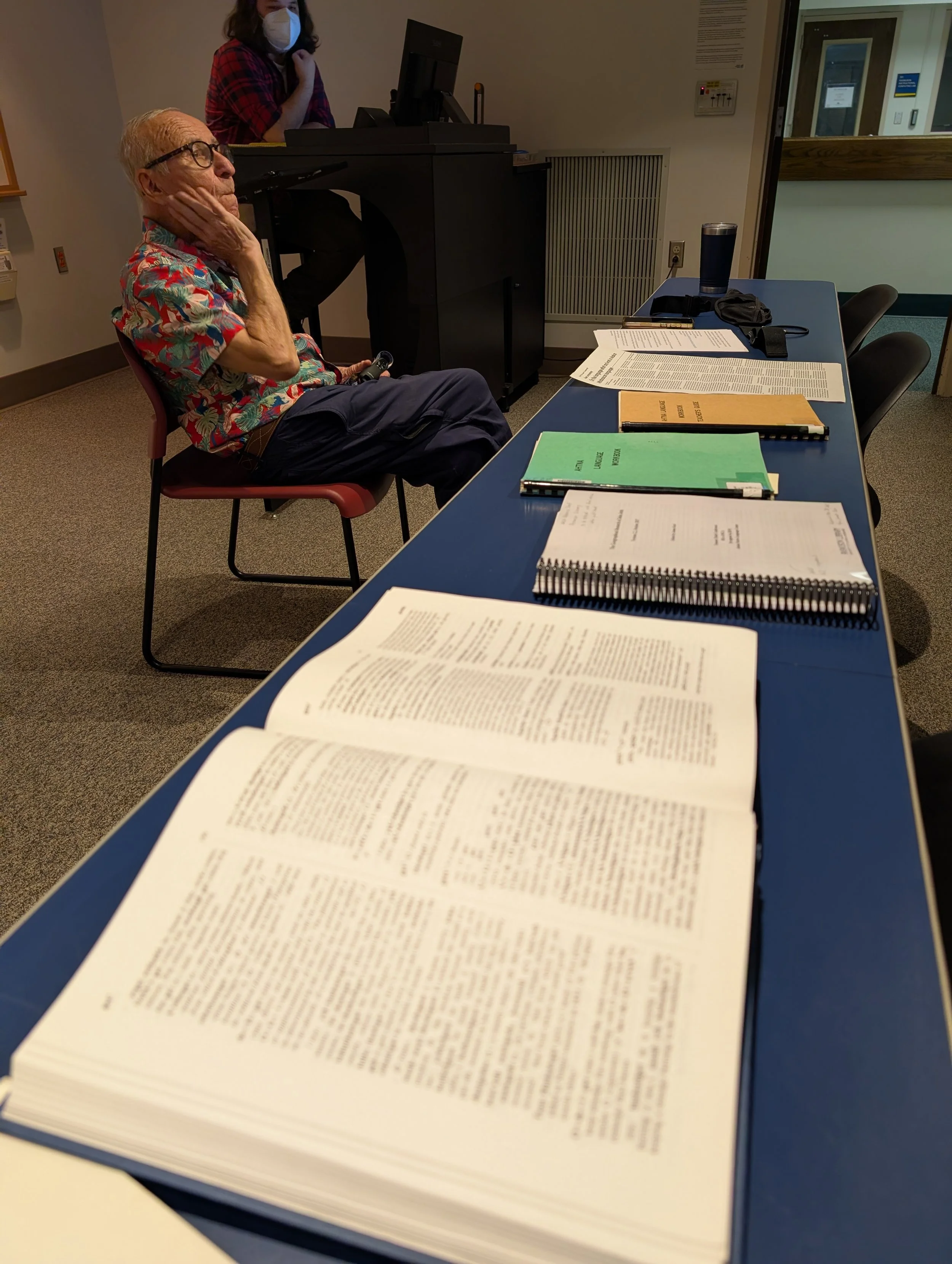
James “Jim” Kari sits among decades of translations, archives, and linguistic work, preserving Alaska Native languages and the history carried within them.
The tension was evident during a gathering last week that brought together linguists, archivists, Alaska Native community members, former students, longtime collaborators and legislative representatives whose work and policy concerns intersect with the center.
The meeting was both a celebration of what ANLC has accomplished over more than half a century and a discussion of concern about what could be lost if institutional continuity and research capacity are not maintained.
The discussion comes amid significant personnel changes at the center. Anna Berge, director of the ANLC Archives, said in a recent interview with The Sun Star that she has given notice of her retirement, effective immediately, and does not expect to continue working under the university's current structure. Assistant Professor Bruce Irwin has also resigned to spend time with his family. His departure leaves ANLC the poorer, but there is no indication that he resigned because of the controversies surrounding the center.
For decades, ANLC has been a major center for the documentation, study and teaching of Alaska Native languages. Its collections include recordings, texts, dictionaries, grammars, field notes, photographs, place-name research and other materials representing decades of work with Alaska Native speakers and communities.
Participants emphasized that much of this work cannot simply be recreated by replacing one position with another.
A Difficult Institutional Moment
The meeting comes as ANLC undergoes significant staffing changes and amid broader questions about the center's institutional future.
Berge was sharply critical of the University of Alaska Fairbanks' administration, arguing that university leaders have not adequately understood the specialized, long-term nature of ANLC's work. She also expressed concern about decisions affecting the center and its archives.
UAF officials have disputed the characterization that ANLC is being dismantled, saying the center remains operational and that the university intends to continue and expand its work.
The disagreement points to a deeper question that extends beyond any individual administrative dispute:
What happens to decades of specialized knowledge when the people who built that knowledge leave?
For an endangered language, the answer is not necessarily that another researcher can simply step in.
A new scholar may be talented and deeply committed, but developing expertise in a language can take years. Building relationships with speakers and communities takes time. Learning the existing documentation takes time. Understanding the connections among texts, grammar, vocabulary, geography and cultural knowledge takes time.
And for some Alaska Native languages, there may not be enough time to start over.
A Legacy Built Over Decades
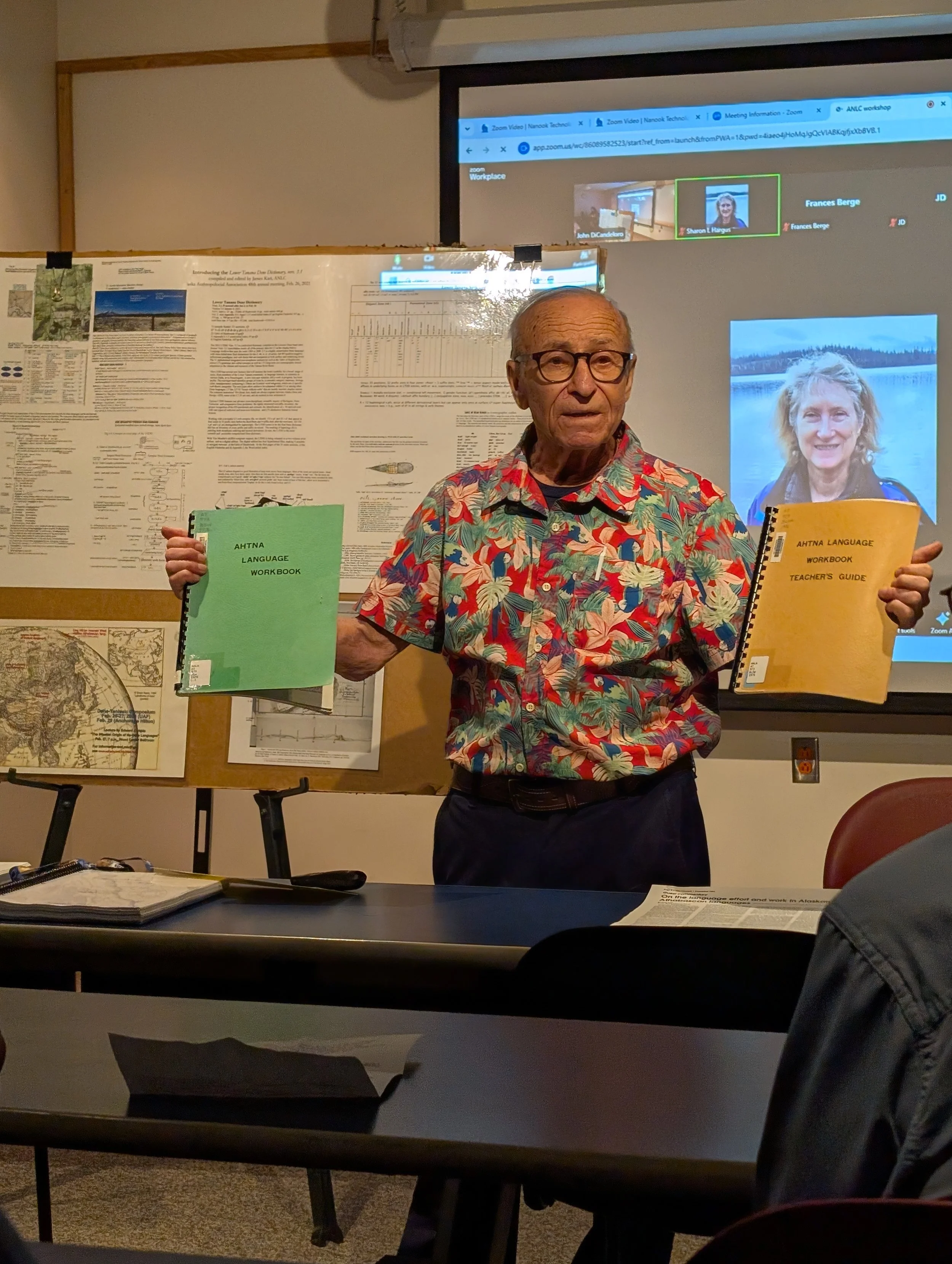
James “Jim” Kari holds up two works during the Alaska Native Language Center’s Aug. 6 update meeting in the Media Classroom at the Rasmuson Library.
Sharon Hargus, professor emerita at the University of Washington, recalled first visiting Fairbanks in 1983 as a graduate student for an Athabascan Language Conference. She returned in 1988 for another institute and later conducted extensive fieldwork in Deg Xinag, including work in Shageluk and Anvik.
Hargus said her graduate education provided little preparation for working extensively with Indigenous-language texts and recordings. She developed those skills through relationships with other linguists, including longtime ANLC researcher James "Jim" Kari.
“Working with texts is the best way to do that,” Hargus said during the meeting, while demonstrating online resources that connect audio recordings with transcriptions, translations and word glosses.
She acknowledged that this kind of painstaking documentation can be time-consuming and receive little academic recognition.
“One could say working on text is career suicide,” Hargus said. “But it’s also, I think, the best thing we can do for the languages and their future learners.”
For Hargus, texts are not simply academic publications. They allow future learners and researchers to hear a language, see how it is structured, and understand how words are used in context.
Over the years, she and her research assistants have developed digital resources for several Indigenous languages, linking written materials with audio and video recordings. One challenge, she noted, is making those resources accessible to communities where smartphones are a primary means of accessing information.
Former ANLC Director Larry Kaplan, who joined the center in 1974, also reflected on what distinguished the institution from the theoretical orientation of much academic linguistics.
“Coming out of a linguistics graduate school oriented to theoretical linguistics, I found this place very different and very refreshing, because it was really applied work working with Native communities,” Kaplan said.
He recalled researchers working closely with Alaska Native speakers, including Edna Ahgeak MacLean, Eliza Jones and Moses Dirks, to develop grammars and dictionaries at a time when few standard instructional resources existed.
That history illustrates the kind of institutional relationships that ANLC accumulated over generations.
The Knowledge Behind a Dictionary
Berge made a similar point in a recent conversation about the center's future.
She emphasized that advanced expertise in an Alaska Native language does not come automatically with a Ph.D. Deep knowledge of a particular language develops through years of sustained engagement with speakers, texts, recordings and existing documentation.
“It takes 20 to 30 years of in-depth work in a field to really master this kind of research,” Berge said.
She argued that faculty develop specialized knowledge over an extended period and expressed concern that much of that experience could soon be lost.
Berge pointed to ANLC's major dictionaries as examples of the scale of work involved. Some represent decades of research and collaboration. Edna Ahgeak MacLean's Iñupiaq dictionary, for example, developed over a career spanning decades. Other major ANLC dictionaries likewise reflect long-term relationships between linguists and Alaska Native speakers.
Such resources are much more than bilingual word lists.
A detailed dictionary can document multiple meanings of a word, grammatical behavior, metaphorical extensions, cultural contexts and connections to other words. A text can show how those words function in speech. Recordings preserve pronunciation and features of speech that cannot be captured fully on a printed page.
For languages with few remaining fluent speakers, that accumulated record can be irreplaceable.
Berge also distinguished between language description and language teaching. A person may be an excellent language teacher without being trained to produce the detailed grammatical and lexical documentation needed by future researchers, just as a specialist in linguistic description may not necessarily be an effective classroom teacher.
ANLC historically brought together both kinds of expertise.
More Than Dictionaries
The week's discussion demonstrated how broad ANLC's work has been.
Participants discussed dictionaries, grammars, recordings, photographs, manuscripts, ethnographic materials, oral histories and place names. They described projects that bring these materials together with digital mapping and other technologies.
Jim Kari focused particularly on ethnogeography— the relationship between language, landscape and geographic knowledge.
He presented maps of Tanacross place names and discussed research connecting geographic features with oral traditions, travel narratives and historical documentation.
The work can involve extraordinarily detailed knowledge of the landscape: names for trails, rivers, mountains, small geographic features and places that may never appear on conventional maps.
Such names are not simply labels.
They can preserve information about how people traveled, how they understood the terrain, where events occurred and how knowledge of a landscape was passed between generations.
John Ross, an Alaska Native member of the Alaska Historical Commission for more than two decades, also spoke about the importance of Indigenous place names and the challenges facing their official recognition.
Ross said the commission has not considered place-name proposals for more than a year and described funding and staffing problems affecting the state's Office of History and Archaeology.
For researchers involved in ANLC's work, place-name documentation represents an important intersection between language, archaeology, history and geography.
The Archives as a Living Resource
The ANLC archives sit at the center of this network of knowledge.
Participants discussed historic field notebooks, photographs, recordings, manuscripts, dictionaries and other materials collected over generations.
The archive's importance extends beyond preservation. Researchers are increasingly finding ways to connect archival materials with contemporary language learning.
A learner might be able to read a transcribed story, see its English translation and then listen to the original recording. A researcher might search a dictionary and connect an entry to examples in texts. A place-name database might be linked to a map and to the recordings or narratives in which that name occurs.
These connections can transform an archive from a collection of historical materials into an active resource for language learning and research.
But doing that work requires expertise.
Digitizing a recording is only the first step. Someone must identify the speaker, understand the language, transcribe the recording, translate it, analyze its structure, connect it to related materials and determine how it can be shared appropriately.
The ANLC Archives collections manager described the staffing constraints facing the archive during the meeting. He said the archive currently relies on a very small permanent staff and on assistance from veteran researchers and others to help organize and describe collections.
Those constraints matter because archival preservation and language documentation are closely connected. A collection can survive physically while becoming increasingly difficult to use if there are too few specialists with the knowledge required to interpret it.
Administrative and Operational Concerns
Participants also described practical challenges affecting ANLC's ability to carry out its work.
Kari pointed to ongoing administrative friction, noting that staff have been unable to update the center's website since 2013. He also highlighted long-standing curricular hurdles, specifically how shifting foundational survey courses from lower-division (ANL 215 and 216, established in 1973) to upper-division levels (ANL 315 and 316) created enrollment minimums that frequently led to class cancellations.
While event organizers explicitly set ground rules excluding topics such as directorship options, space arrangements and administrative affiliations to keep the focus on research and archival sustainability, broader public policy concerns drew attention from state lawmakers.
A chief of staff for Rep. Maxine Dibert attended the gathering and said Dibert's office is “very concerned about this issue” and the long-term preservation of Alaska Native languages.
Those concerns add a public-policy dimension to what might otherwise appear to be an internal university dispute.
The question is not only how UAF structures its language programs. It is also how Alaska preserves linguistic and cultural resources that have value to communities, educators, researchers and future generations.
A Future Beyond the University?
Despite the concerns expressed during the meeting, participants did not describe ANLC as a finished project.
Quite the opposite.
Kari and other participants discussed new possibilities for working with archival texts, ethnogeographic information, place-name mapping and language technology. Discussions also highlighted expanding interdisciplinary collaborations across the University of Alaska system—linking language research with fields such as archaeology, biology, geosciences, music, theater and climatology.
The conversation suggested that ANLC's intellectual community is much larger than its current institutional structure.
It includes Alaska Native speakers and communities, linguists, teachers, archivists, historians, archaeologists, geographers, students, and researchers across Alaska, Canada and beyond.
That raises the possibility of thinking about the future of ANLC not simply as a question of preserving a university department, but as a question of preserving an extraordinary body of knowledge.
Berge suggested that moving the center outside the university could ultimately be considered if the university is unable or unwilling to sustain its mission.
Such a move would be complicated and would require discussion among Alaska Native communities, scholars, policymakers, archivists and university leaders.
But the idea points toward a fundamental question:
What institutional structure best serves the languages?
What Remains
Perhaps the most encouraging aspect of last week's gathering was the depth of knowledge that remains connected to ANLC.
People who worked with the center decades ago are still using its collections. Linguists continue to analyze recordings and texts. Community members continue to document place names and cultural knowledge. Researchers are developing new digital tools. Younger Indigenous scholars are entering the field.
ANLC's legacy, therefore, is not simply a collection of books, tapes, photographs and manuscripts in Fairbanks.
It is a network of people and knowledge extending across Alaska and beyond.
Many endangered languages do not have extensive dictionaries. Many have only limited recordings. Some have little detailed grammatical description.
For some languages, the materials preserved through ANLC may constitute a substantial surviving record of the language.
The question is not simply whether the Alaska Native Language Center will continue under its existing organizational structure.
The larger question is whether Alaska will preserve the expertise, relationships, archives and long-term commitment necessary to continue the work that ANLC began more than half a century ago.
Last week's gathering made one thing clear: there is still an extraordinary community of people willing to do that work.
The challenge now is finding a structure that allows them to continue.